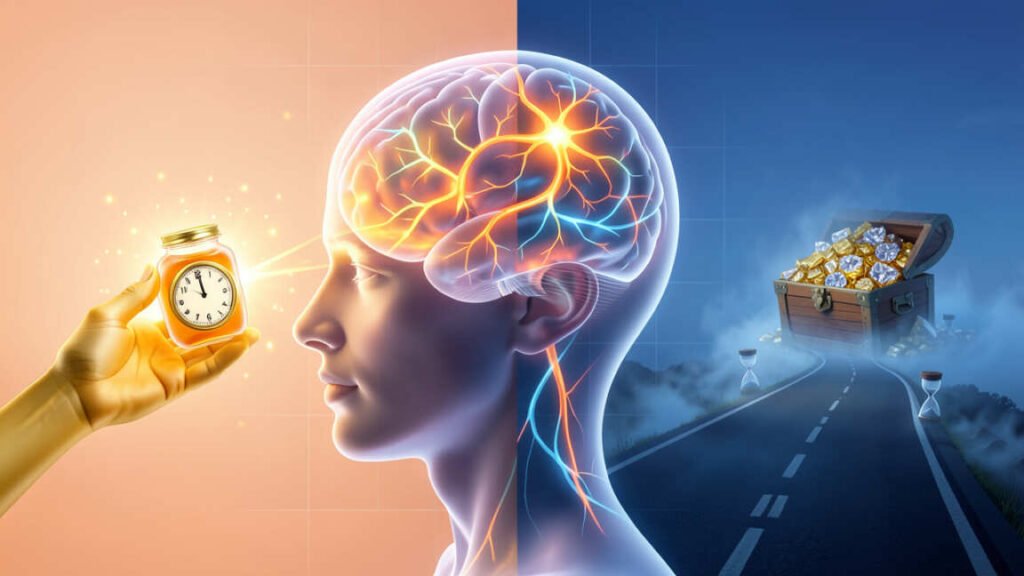
The brain chooses an immediate reward over a bigger future reward because the limbic system's fast, emotion-driven circuits deliver an instant dopamine hit that overrides the slower, more deliberate calculations of the prefrontal cortex. This neurological bias toward instant gratification is amplified by stress, fatigue, and strong emotions, which weaken executive control. To counteract this, practical strategies include managing stress, creating implementation intentions, and making future rewards feel more immediate and concrete.
Why the brain sometimes chooses an immediate reward over a bigger future reward is a question that sits at the heart of self-control and decision-making. This post unpacks the neuroscience and psychology behind impulsive choices, then shows you practical ways to shift your behavior toward long-term gains.
Simply put, the brain favors immediate rewards because fast-acting emotional circuits in the limbic system outmuscle the slower, logical prefrontal cortex. Future rewards feel abstract and uncertain, while immediate rewards trigger a powerful dopamine spike. That mismatch makes delay hard, but you can train your brain to wait.
Key Takeaways
- Immediate reward wins in the brain because the limbic system reacts to certainty and instant dopamine release.
- Future rewards depend on the prefrontal cortex, which is slower, energy-hungry, and easily overridden.
- Stress, fatigue, and background emotions make you more likely to choose short-term pleasure over long-term gain.
- You can reduce the pull of immediate rewards with simple strategies like implementation intentions and mental time travel.
- Not every immediate reward is a mistake; sometimes short-term comfort is the rational, necessary choice.
What Is Temporal Discounting?
When you choose a small reward now over a larger reward later, psychologists call it temporal discounting. Your brain literally assigns lower value to outcomes that arrive further in the future. A $20 bill today feels more valuable than $30 next month, even though the future option is mathematically better.
This discounting isn’t a flaw. Evolutionary pressure favored fast, certain wins because survival was never guaranteed. Storing food, saving energy, and delaying any gratification were risky when predators and hunger were constant threats.
- Delay discounting is measured in behavioral economics using choice tasks.
- Steeper discounting means a stronger preference for immediate rewards.
- Hyperbolic discounting describes how value falls sharply with even short delays.
- Everyone discounts future rewards, but the rate varies with age, personality, and context.
- Neuroscientists see this pattern across species, from pigeons to primates.
| Immediate Reward | Future Reward |
|---|---|
| Watching TV now | Finishing a project for a bonus |
| Eating a slice of cake | A healthy body and energy later |
| Checking your phone | Deep focus and career growth |
In each case, the brain treats the two rewards as if they belong to completely different currencies. The immediate one is concrete, while the future one is a vague promise.
The Brain’s Two Competing Systems: Limbic vs. Prefrontal Cortex
Neuroscientists often describe decision-making as a tug-of-war between two networks. The limbic system, especially the amygdala and ventral striatum, fires fast and responds to anything emotionally heated or instantly rewarding. The prefrontal cortex, by contrast, handles planning, reasoning, and impulse control.
It is slower and burns more energy.
In the famous Stanford marshmallow experiment led by Walter Mischel, only about one-third of children managed to wait the full 15 minutes for a second marshmallow. When researchers followed those children years later, the group with stronger self-control showed distinct patterns of prefrontal activity during decision tasks.
- The limbic system operates on autopilot, reacting to cues for food, sex, social approval, and novelty.
- The prefrontal cortex is the newest part of the human brain in evolutionary terms.
- fMRI studies show the ventral striatum lights up when you see an immediate reward.
- The dorsolateral prefrontal cortex activates when you successfully resist temptation.
- Both systems influence every choice you make, but neither is completely in charge.
| Feature | Limbic System | Prefrontal Cortex |
|---|---|---|
| Speed | Milliseconds | Seconds to minutes |
| Energy cost | Low | High |
| Main job | React, feel, survive | Plan, reason, decide |
| Weakness | Short-sighted | Easily fatigued |
When your brain is rested and safe, the prefrontal cortex usually wins. When you are tired, hungry, or scared, the limbic system grabs the wheel.
Important: Neither system is “bad.” The limbic system keeps you alive, and the prefrontal cortex helps you build a future. The problem starts when the balance tips too far in one direction without you noticing.
Why Dopamine Drives Immediate Reward-Seeking Behavior
Dopamine is often called the “reward molecule,” but it actually drives anticipation. When you see something that predicts pleasure, dopamine spikes before you even act. The spike is far larger for an immediate reward than for a delayed one because your brain can sense exactly when it will arrive.
This is why scrolling social media feels almost hypnotic. Each swipe, like, or notification produces a quick dopamine spike. You don’t have to wait, guess, or plan.
The reward arrives instantly.
- You notice a cue, such as a green notification badge.
- Your ventral striatum predicts a quick pleasure bump.
- Dopamine surges, raising your motivation to act.
- You take the action and feel a temporary rush.
- The cycle reinforces itself, making the cue more powerful next time.
According to the National Institute on Drug Abuse, substance use disorders hijack this exact dopamine circuit, making the immediate drug effect feel far more important than any long-term consequence. The same mechanism shows up in milder forms in gambling, selling trading, and even checking work emails at midnight.
Tip: To weaken the pull, delay your response by just 10 seconds. That small window lets your prefrontal cortex weigh in before the dopamine spike gets full control.
How Stress and Emotion Shift Your Brain Toward Instant Gratification
Stress chemicals, especially cortisol, reshape your priorities in seconds. Under acute stress, the brain assumes you are in short-term danger. Future planning becomes a luxury it cannot afford, so it pushes you toward whatever feels safe or soothing right now.
The American Psychological Association reports that stress hormones increase impulsive choice when you are under deadline pressure or have made many decisions earlier in the day.
- Decision fatigue depletes the prefrontal cortex after a long day of choices.
- Negative emotions like sadness and anxiety lower your tolerance for uncertain future gains.
- Sleep deprivation blunts prefrontal activity while leaving the limbic system fully active.
- Blood sugar dips reduce the glucose your prefrontal cortex needs for self-control.
- Social pressures, like being watched or judged, can push you toward safer immediate options.
Next time you reach for junk food after a rough meeting, notice what is driving the impulse. It is rarely hunger. It is your brain using an immediate reward as emotional anesthesia.
Warning: If you only rely on willpower to resist immediate rewards, you will lose most of the time. Willpower is a limited mental battery that gets drained by stress, exhaustion, and even ordinary daily decisions.
Real-World Examples of Choosing an Immediate Reward Over a Bigger Future Reward
You see this pattern everywhere once you know what to look for. It is not limited to food, money, or screens. The tension between now and later shows up in almost every area of life.
- Money: Taking a cash advance at high interest instead of waiting for your paycheck.
- Health: Eating fast food today rather than cooking a healthy meal that saves you from future medical costs.
- Career: Staying in a comfortable job with no growth instead of investing time in learning new skills.
- Relationships: Avoiding an uncomfortable conversation now to protect a relationship from long-term resentment.
- Environment: Buying cheap disposable products instead of spending more on durable, sustainable ones.
- Education: Watching videos instead of studying for an exam that could raise your degree and income.
In each example, the immediate reward feels certain, safe, and right now. The future reward requires imagination, trust, and patience.
Tip: Ask one question before you act: “Will this feel this good in five minutes, or will it be the same? If I waited, what exactly would I gain?” That single pause creates space for the prefrontal cortex to speak up.
How to Train Your Brain to Prefer Bigger Future Rewards
Your brain can learn to wait. The prefrontal cortex grows stronger with repetition, just like a muscle. The goal is not to eliminate immediate rewards entirely, but to make future rewards feel more real and personal.
Here are the most effective, evidence-based strategies to shift the balance.
- Mental time travel: Picture the exact moment you will enjoy the future reward. Make it vivid: who you are with, what you see, how you feel.
- Implementation intentions: Pre-decide your behavior with “If-then” plans. For example, “If I feel the urge to open Instagram, I will stand up and take five deep breaths.”
- Temptation bundling: Pair an immediate pleasure with a future benefit. Listen to your favorite podcast only while exercising.
- Pre-commitment devices: Use apps, timers, or agreements with friends that make it harder to give in later.
- Reduce friction for future rewards: Put your savings in a separate account automatically. Set your phone to grayscale. Meal-prep on Sundays.
- Incremental practice: Delay gratification in small, manageable ways, like waiting 60 seconds before eating a piece of chocolate.
| Strategy | Why It Works |
|---|---|
| Mental time travel | Makes the future reward concrete instead of abstract |
| Implementation intentions | Automates good decisions, saving willpower |
| Temptation bundling | Links dopamine from pleasure to a productive habit |
| Friction reduction | Changes the environment so good choices are default choices |
A 2011 study in Psychological Science found that people who mentally simulated future events in vivid detail were more willing to wait for larger monetary rewards. The more real the future feels, the more your brain lets it compete with the present.
When Choosing an Immediate Reward Is Actually the Smart Choice
Delaying every reward is not a virtue. Sometimes the smartest decision is to take the small reward now. The key is knowing when future rewards are too uncertain to be worth the wait.
- If the future reward is unlikely to happen anyway, take the sure thing.
- If the immediate reward protects your health, safety, or relationships, honor it.
- If the delay would cause severe stress or anxiety, a short-term comfort break can restore your judgment.
- If the future reward is tiny compared to the risk, the math favors the present.
- If you are in the middle of a crisis, your energy is better spent surviving now than building for later.
Important: Self-control is not about crushing every desire. It is about matching your choice to your values, your context, and your long-term well-being. A flexible brain that can shift between short-term and long-term thinking outperforms a rigid one.
Frequently Asked Questions
What causes someone to always choose an immediate reward?
Often a combination of biology and environment. A naturally reactive limbic system, chronic stress, low blood sugar, or a history of unstable access to resources can all make immediate rewards dominate. Repeated habits also strengthen the neural pathway that favors instant gratification.
Is temporal discounting bad for you?
Not always. Mild temporal discounting is normal and adaptive. Problems appear when it becomes so steep that you choose destructive short-term fixes over basic long-term goals.
The goal is not to eliminate discounting but to keep it balanced.
Can you increase your self-control for future rewards?
Yes. Techniques like implementation intentions, mental time travel, and temptation bundling show consistent positive effects in research. Regular practice also strengthens prefrontal pathways involved in self-regulation.
Does the brain treat money differently from food or social rewards?
No. The same reward circuitry in the ventral striatum responds to money, food, social approval, and even information. That is why a notification on your phone can compete with a bonus check at the end of the quarter.
What is delayed gratification and how is it different from self-control?
Delayed gratification is choosing a larger, later reward over a smaller, sooner one. Self-control is the broader capacity to override impulses in line with goals. Delayed gratification is one example of self-control in action, but self-control also covers emotion regulation, focus, and habit change.
Final Thoughts
Your brain picks an immediate reward not because you are weak, but because fast, certain gains historically kept you alive. The prefrontal cortex can be trained to make future rewards feel more tangible and worth the wait.
Start small. Add a ten-second pause. Visualize the future version of yourself.
Uptick your stress management. Over time, your brain will rewire itself to respect the future without ignoring the present.