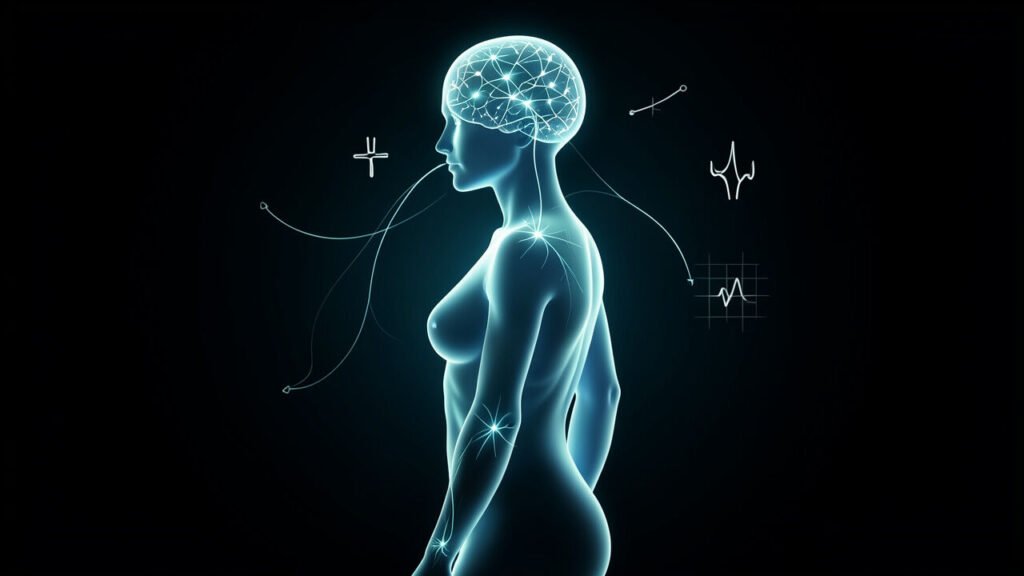
The brain knows where your body is through proprioception, an internal sense powered by specialized sensors called proprioceptors located in muscles, tendons, and joints. These proprioceptors constantly send thousands of electrical signals per second to the cerebellum and parietal lobe, creating a real-time map of your body's position without the need for vision. This unconscious awareness is critical for balance and movement, but it can decline with age or injury, making targeted balance exercises essential for maintaining functional stability.
Simply put, your brain knows where your body is thanks to specialized sensors in your muscles, tendons, and joints. These sensors, called proprioceptors, fire thousands of signals per second to your cerebellum and parietal lobe. The result is instant, unconscious awareness of your body’s position, even in complete darkness.
Key Takeaways
- Your brain knows where your body is thanks to proprioceptors in muscles, tendons, and joints.
- Body awareness without looking depends on constant signals sent to the cerebellum and parietal lobe.
- Aging, injury, and neurological conditions can weaken proprioception and increase fall risk.
- Simple balance and coordination exercises can measurably improve proprioception at any age.
- Vision and the vestibular system support proprioception but are not required for basic body awareness.
What Is Proprioception and How Does It Work?
Proprioception is your body’s internal GPS. It tells you where your arm is when you reach for a glass, how to angle your ankle on uneven ground, and whether you’re standing upright when the lights go out.
The term comes from Latin. “Proprius” means “one’s own,” and “ception” means perception. So proprioception literally translates to “perception of oneself.” Scientists often call it the sixth sense because it operates below conscious awareness.
Your body gathers this information through specialized nerve endings called proprioceptors. They live in your muscles, tendons, joints, and skin, and they respond to stretch, tension, and pressure. The National Institutes of Health describes proprioception as a critical component of motor control, and it develops rapidly in childhood as you learn to crawl, walk, and handle objects.
The main types of proprioceptors
- Muscle spindles: sense stretch inside muscles and trigger reflexes that prevent overstretching.
- Golgi tendon organs: monitor tension where muscle meets tendon and protect against excessive force.
- Joint capsule receptors: detect joint angle, pressure, and movement speed.
- Skin mechanoreceptors: add touch and pressure cues that support position sense.
- Vestibular hair cells: track head position and motion, providing a reference frame for the whole body.
Because proprioception runs around the clock, your brain can react before conscious thought kicks in. A stumble on a curb triggers corrective adjustments in under 50 milliseconds, often before you even realize you’re off balance. Without this system, even simple tasks become impossible.
How Does the Brain Know Where Your Body Is Without Looking?
Your brain knows where your body is without looking because it receives a constant stream of electrical signals from proprioceptors all over your body. These signals travel through the spinal cord and reach processing centers in under a tenth of a second.
Two brain regions do most of the heavy lifting. The parietal lobe builds a spatial map of your body, and the cerebellum compares what you planned to do with what actually happened. Together, they update your body model hundreds of times per second.
Here is the signal pathway in six steps:
- A muscle stretches or a joint bends during movement.
- Muscle spindles and joint receptors fire electrical impulses.
- Sensory neurons carry these impulses up the spinal cord.
- The signals pass through the brainstem and split toward the cerebellum and parietal lobe.
- The cerebellum compares expected movement with actual position.
- The brain adjusts motor commands instantly to correct errors.
This loop never stops, even during sleep. It’s why you can touch your nose with your eyes closed, type without looking at the keyboard, or balance on a moving bus without staring at your feet.
Important: Brain regions process position signals in parallel. That redundant design means you can lose vision or even one processing area and still maintain basic body awareness.
The Role of Muscle Spindles and Joint Receptors
Muscle spindles are the star players. These tiny sensory organs sit inside your skeletal muscles, parallel to the muscle fibers. When a muscle stretches, the spindles stretch too, and they fire signals that tell your brain exactly how fast and how far the muscle lengthened.
Joint receptors add another layer of detail. Located inside the capsules of your joints, they detect compression, tension, and the angle of the joint. They respond strongest at the extremes of motion, which is why you know when a joint is nearly fully extended without checking.
- Stretch detection: muscle spindles measure length changes.
- Tension monitoring: Golgi tendon organs sense force at the muscle-tendon junction.
- Angle tracking: joint receptors report position and movement direction.
- Speed sensing: spindles signal both position and velocity of movement.
- Reflex triggering: spindle signals activate spinal reflexes like the knee jerk.
- Adaptation: receptor sensitivity adjusts based on recent activity and fatigue.
Your brain combines these signals with copies of your motor commands. When you voluntarily move your arm, your brain predicts the sensory feedback and compares it to reality. If there’s a mismatch, you feel it as something being “off.”
This predictive mechanism is why you can catch a falling object or walk up stairs in the dark. The brain doesn’t wait for feedback. It anticipates what your body should feel and uses sensory signals to confirm the prediction.
How the Brain Knows Where Your Body Is During Movement
Movement makes body awareness more complex. Your brain must track a moving limb, update its predictions, and adjust motor commands on the fly. The cerebellum handles this continuous recalculation.
The numbers behind this are striking. Despite making up only about 10 percent of brain volume, the cerebellum holds roughly half of the brain’s total neurons. That dense processing power lets it simulate movement scenarios and correct errors in milliseconds.
When you reach for a cup, the cerebellum:
- Receives a copy of your motor plan from the motor cortex.
- Receives live feedback from proprioceptors in your arm.
- Compares the expected position of your hand with the actual position.
- Sends correction signals to the motor cortex and spinal cord.
This constant correction loop keeps your movements smooth and accurate. Damage to the cerebellum, from stroke, injury, or conditions like ataxia, disrupts this process. People with cerebellar damage often overshoot or undershoot when reaching, and they lose the ability to judge how far a limb has moved.
- Parkinson’s disease impairs automatic corrections and slows movement updates.
- Peripheral neuropathy from diabetes reduces sensory signals from feet and hands.
- Joint replacement surgery can temporarily confuse proprioceptors until the brain recalibrates.
- Mild traumatic brain injury can delay the integration of position signals.
Your brain adapts quickly to new body configurations. That’s why a new pair of glasses or a healed ankle feels normal after a short adjustment period. The brain simply updates its internal model of your body.
Visual, Vestibular, and Touch Inputs: The Three Pillars of Body Awareness
Proprioception doesn’t work alone. Vision, the vestibular system, and touch feed your brain a complete picture of your body in space. When these systems disagree, you feel dizzy, disoriented, or off balance.
Vision gives you an external reference. Your vestibular system, located in the inner ear, detects head tilt and acceleration. Touch provides surface contact information from your skin.
The brain integrates all four streams to produce stable body awareness.
| System | What It Detects | Role in Body Awareness |
|---|---|---|
| Proprioception | Muscle stretch, joint angle, tendon tension | Primary internal position sense |
| Vision | Object location, environment layout | External reference points |
| Vestibular | Head tilt, rotation, linear acceleration | Orientation and balance reference |
| Touch (skin) | Pressure, texture, contact | Confirms limb contact with surfaces |
When these systems align, you feel grounded and coordinated. When they conflict, such as on a rocking boat or in virtual reality, your brain must decide which signal to trust. Motion sickness is the result of that conflict.
Your brain favors visual information in many situations, which is why closing your eyes makes balancing harder. Training your proprioceptive system to work without vision is a cornerstone of balance rehabilitation.
Why Does Proprioception Fail and What Are the Signs?
If your brain can no longer know where your body is without looking, everyday life becomes a struggle. You may knock things over, miss steps, sway while standing, or feel like your limbs belong to someone else.
Proprioception can decline with age, injury, and chronic disease. The World Health Organization identifies falls as the second leading cause of unintentional injury deaths worldwide, and declining body awareness is a major contributor.
| Signs of Poor Proprioception | Common Causes |
|---|---|
| Stumbling or tripping often | Aging-related receptor decline |
| Difficulty touching your nose with eyes closed | Peripheral neuropathy from diabetes |
| Overshooting or undershooting when reaching | Stroke or cerebellar damage |
| Feeling unsteady in the dark | Vestibular issues |
| Frequent ankle sprains | Ligament damage and receptor loss |
After an ankle sprain, for example, damaged ligaments contain fewer functional receptors. Your brain loses accurate position information, which makes repeat sprains more likely. Rehabilitation programs focus on retraining these receptors through targeted balance work.
Warning: Sudden loss of body awareness, numbness, or severe balance problems can signal a stroke or neurological emergency. Seek medical attention immediately.
Estimates suggest that proprioceptive decline accelerates after age 60, but the rate varies widely based on activity level and overall health. Staying active is one of the most effective ways to slow this process.
Simple Tests and Exercises to Improve Proprioception
You can assess your proprioception at home, and you can train it. Balance training, joint stabilization exercises, and body awareness drills all improve the sensitivity of your proprioceptors and the speed of your brain’s responses.
Try this simple test: stand on one leg with your eyes closed. Most healthy adults can hold this position for at least 10 to 15 seconds. Shorter times suggest room for improvement.
Here are four exercises to build proprioception:
- Single-leg balance: stand on one leg for 30 seconds, then progress to eyes closed.
- Wobble board or balance pad: perform 3 sets of 1 minute, twice daily.
- Eyes-closed joint repositioning: close your eyes, move your arm to a target angle, then return and repeat.
- Tandem walking: walk heel-to-toe in a straight line for 20 steps.
- Progress slowly and hold onto a support surface when starting out.
- Do balance work on a firm surface before trying foam or unstable surfaces.
- Include strength training,