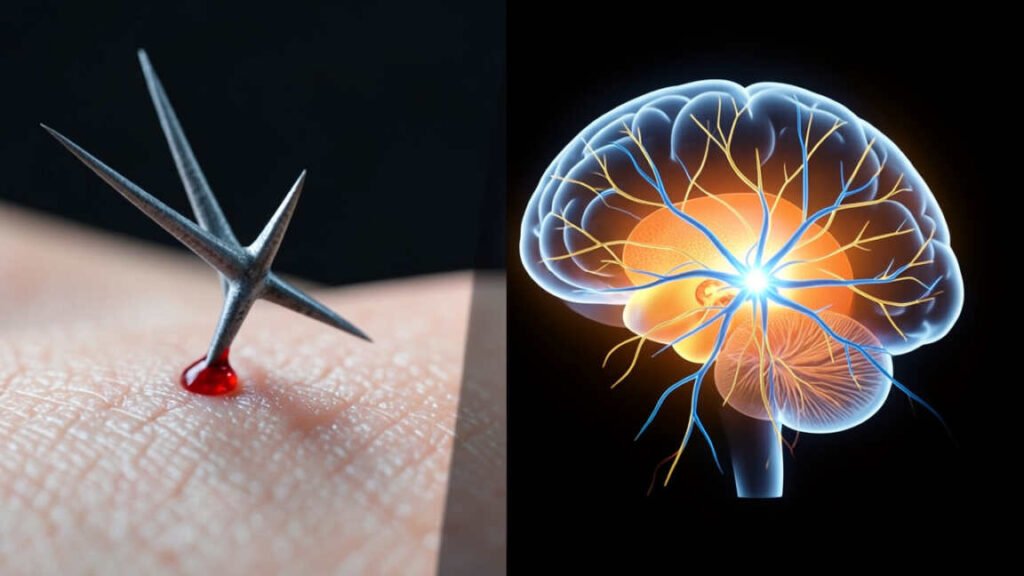
The brain creates the experience of pain by constructing a protective signal from filtered sensory input, emotional context, and past memories, rather than from a direct measure of tissue damage. This process allows the brain to assess threat levels and prioritize responses, which is why the same injury can feel different depending on your situation and state of mind. Understanding this reveals that effective pain management focuses on retraining these neural pathways using techniques like cognitive behavioral therapy and mindfulness to reduce suffering, especially when pain becomes chronic.
Simply put, pain is a brain-generated experience, not a direct copy of tissue damage. Sensory signals from your body get filtered, interpreted, and amplified by brain networks. Your context, mood, attention, and past memories all shape how painful an injury feels in the moment.
Key Takeaways
- How does the brain create the experience of pain? It builds a mental model from sensory input, emotion, and context, not from a simple alarm system.
- Pain is protective but plastic: the brain can learn, amplify, or suppress pain based on experience and threat levels.
- Brain-based pain management uses techniques like cognitive behavioral therapy, mindfulness, and graded exposure to retrain neural pathways.
- Chronic pain often means the nervous system stays in alarm mode even after tissue healing, so brain-focused treatment is essential.
What Is Pain Perception?
The International Association for the Study of Pain (IASP) defines pain as an unpleasant sensory and emotional experience linked to actual or potential tissue damage. That definition matters because it separates the physical stimulus from the conscious experience.
Pain perception is your brain’s conclusion about danger, not a simple measure of injury. The same cut can feel minor when you’re focused on an emergency, or unbearable when you’re anxious and alone.
| Aspect | Nociception | Pain Perception |
|---|---|---|
| Definition | Detection of harmful stimuli by sensory nerves | Brain-generated conscious experience |
| Origin | Peripheral tissues and organs | Central nervous system networks |
| Can it be blocked? | Yes, with local anesthetics | Yes, with attention shifts, placebos, or surgery |
Nociception is the warning signal. Pain perception is the story your brain tells about that signal. Understanding this difference is the first step to grasping the full answer to how the brain creates the experience of pain.
How Does the Brain Create the Experience of Pain?
The full journey from injury to conscious pain involves four stages. Each stage can amplify or filter the signal before you ever feel anything.
- Transduction: Specialized nociceptors in your skin, muscles, and organs convert mechanical, thermal, or chemical harm into electrical impulses.
- Transmission: These impulses travel along A-delta and C nerve fibers to your spinal cord. A-delta fibers carry sharp, fast pain; C fibers carry dull, burning, slow pain.
- Modulation: In the spinal cord dorsal horn, signals get amplified or suppressed. This is where descending pathways from your brain can block pain, like during a fight-or-flight moment.
- Perception: The signal reaches your thalamus, which routes it to the somatosensory cortex, insula, anterior cingulate cortex, and prefrontal cortex. This is when pain becomes conscious and emotional.
The brain does more than receive. It predicts and decides. Your brain uses past experience and current context to interpret ambiguous signals, sometimes creating pain with no physical trigger at all, like in phantom limb pain.
Tip: When you feel sharp pain, that fast signal comes from A-delta fibers. If dull pain lingers, C fibers keep firing. Both paths end in the same brain circuits that decide how much attention to give.
Why Does the Brain Feel Pain? The Protective Role
Pain feels terrible on purpose. The brain creates pain to protect you from further harm and to teach you to avoid dangerous situations. Without pain, minor injuries become infected, hidden heart attacks go unnoticed, and joint damage worsens silently.
Consider people with congenital insensitivity to pain. They often have short life spans because they miss warning signs of appendicitis, fractures, or burns. Pain is your biological alarm system, and the brain is the control center.
- Pain encourages immediate avoidance of harmful stimuli, like pulling your hand off a hot stove.
- Pain promotes rest and healing by making movement unpleasant after injury.
- Pain signals social awareness: facial expressions and vocalizations of pain recruit empathy and help from others.
- Pain creates strong memories so you avoid similar dangers in the future.
- Pain is modulated by context: soldiers in battle often report no pain until the danger passes.
The CDC reports that roughly one in five U.S. adults live with chronic pain, which shows how often the brain keeps sounding alarms. This last point proves that the brain actively suppresses pain when needed.
The periaqueductal gray and rostral ventromedial medulla form a descending pain modulation system that can turn the volume down.
Important: Pain is not a marker of tissue damage. In chronic pain, the alarm system stays on even after healing. That makes the brain the most important target for treatment.
What Are the Brain Regions That Create Pain?
Pain is not a single brain spot. It emerges from a distributed network called the pain matrix. Different regions handle the sensory, emotional, cognitive, and motivational parts of pain.
| Brain Region | Main Role in Pain |
|---|---|
| Thalamus | Relay station that sorts and sends pain signals to higher regions |
| Somatosensory Cortex | Identifies the location, intensity, and quality of the painful stimulus |
| Anterior Cingulate Cortex | Processes the unpleasantness and emotional distress of pain |
| Insula | Connects body states with conscious feelings, subjective intensity |
| Prefrontal Cortex | Evaluates threat, applies attention, and controls pain suppression |
| Periaqueductal Gray | Commands descending inhibition to dampen spinal pain signals |
Research using functional MRI shows that even when people receive identical heat pulses, reported pain intensity varies with prefrontal cortex activity. Attention and expectation alter these networks, which is one reason distraction can genuinely reduce pain.
- The sensory-discriminative dimension tells you where and how much.
- The affective-motivational dimension tells you how unpleasant it is.
- The cognitive-evaluative dimension tells you what it means for your life.
All three dimensions emerge together, so pain is always a blend of sensation and emotion.
How Do Emotions and Memory Shape Pain?
Your brain stores every painful experience and uses those memories to predict future danger. That is why a place where you once fell can trigger a twinge years later. Emotion acts as a volume knob for pain.
Anxiety, fear, and depression consistently increase pain sensitivity. Positive emotions, safety signals, and social support activate descending pain inhibition. This is a key reason why placebo treatments can be genuinely effective: belief changes brain chemistry.
- Anxiety amplifies anticipation, making your brain more sensitive to incoming signals.
- Depression lowers the threshold for pain perception through shared serotonin and norepinephrine circuits.
- Positive mood boosts endorphin release, reducing pain in the spinal cord.
- Pain memories can trigger pain without any new injury, a phenomenon called central sensitization.
- Sleep deprivation reduces opioid receptor availability, making pain feel worse the next day.
A study published in the journal Pain found that simply believing a cream was a powerful painkiller activated the prefrontal cortex and released endogenous opioids, even when the cream was inert.
Warning: Chronic stress keeps cortisol and noradrenaline high, which keeps pain pathways primed. If you struggle with persistent pain, ignoring emotional health can make physical symptoms worse.
How Does the Brain Create the Experience of Pain in Chronic Conditions?
When pain lasts longer than three months, it often loses its link to tissue damage. The brain and spinal cord become hyperreactive. This is called central sensitization, and it explains why a light touch or a warm shower can feel painful.
In chronic pain, the same brain regions get activated, but they start to communicate differently. The prefrontal cortex becomes less able to suppress pain, while the amygdala and anterior cingulate cortex become more excitable.
- Wind-up: Repeated pain signals cause spinal neurons to fire more easily.
- Central sensitization: The dorsal horn amplifies all incoming signals, even harmless ones.
- Conditioned pain memories: The brain links pain to activities, places, or emotions that were present during the original injury.
- Maladaptive plasticity: Gray matter volume shifts in the prefrontal cortex and hippocampus, weakening pain control and emotional resilience.
- Glial activation: Support cells in the spinal cord release inflammatory chemicals that keep pain circuits turned on.
According to the World Health Organization, roughly 1 in 5 people worldwide live with chronic pain. The National Academies estimates that chronic pain costs the U.S. economy up to $635 billion each year in medical expenses and lost productivity.
This constant alarm state drains energy, disrupts sleep, and alters mood, creating a loop that is hard to break without addressing brain processes directly.
How to Use Brain Science to Manage Pain
Once you accept that pain is a brain-generated experience, you can train your brain to turn down the volume. These strategies focus on changing inputs to your pain modulatory systems, not on ignoring pain.
- Cognitive behavioral therapy (CBT): Reframe catastrophic thoughts to reduce threat signals from the prefrontal cortex and amygdala.
- Mindfulness meditation: Regular practice increases activation in the prefrontal cortex and reduces activity in the anterior cingulate cortex, lowering emotional distress.
- Graded exposure therapy: Slowly approach feared movements to retrain the brain’s threat prediction.
- Exercise: Aerobic activity triggers endogenous opioid and endocannabinoid release, which suppresses pain in the spinal cord and brain.
- Sleep optimization: Deep sleep restores descending pain inhibition and reduces central sensitization.
- Social connection: Supportive interactions boost oxytocin, which can lower pain sensitivity.
| Technique | Target Brain Region | Effect |
|---|---|---|
| CBT | Prefrontal cortex | Reduces threat appraisal |
| Mindfulness | Anterior cingulate cortex | Lowers emotional reaction |
| Exercise | Periaqueductal gray | Boosts descending inhibition |
| Graded exposure | Hippocampus | Rewrites fear memories |
Tip: Start with one technique and practice it daily for two to three weeks. Brain changes require repetition, not occasional effort.
The Future of Brain-Based Pain Care
New treatments directly target pain circuits. Repetitive transcranial magnetic stimulation (rTMS) and transcranial direct current stimulation (tDCS) use magnetic fields or weak electrical currents to change cortical excitability.
Virtual reality, neurofeedback, and closed-loop spinal cord stimulators are expanding quickly. These approaches aim to rebalance the pain matrix rather than masking symptoms with opioids.
- rTMS and tDCS are being tested for fibromyalgia, migraine, and chronic low back pain.
- Virtual reality distraction reduces pain during wound care and potentially during labor.
- Closed-loop spinal cord stimulators deliver pulses based on real-time neural signals.
- Biomarker research using brain scans may help match patients to the right brain-based treatment.
- AI models can now predict pain intensity from fMRI activity in the insula and prefrontal cortex.
These developments support a shift from treating pain as a purely physical symptom to understanding it as a neurobiological state. For many patients, that means more options and fewer side effects.
Important: Brain-based treatments are not experimental science fiction. Many are already approved and covered by insurance. Talk to a pain specialist about what fits your condition.
Frequently Asked Questions
How does the brain create the experience of pain?
The brain creates pain by combining sensory signals from nociceptors with memories, emotions, and context. It constructs a conscious experience that motivates protective behavior, rather than acting as a simple damage meter.
Can you feel pain without tissue damage?
Yes. Conditions like fibromyalgia, phantom limb pain, and complex regional pain syndrome involve pain with minimal or no ongoing tissue damage. This happens because the nervous system becomes sensitized and generates pain even without strong peripheral input.
Why does the brain ignore some painful signals?
The brain can suppress pain through descending inhibitory pathways. This happens during life-threatening situations, intense focus, or when placebo effects convince the brain that danger has passed.
Does stress make pain worse?
Stress activates the amygdala and releases noradrenaline, which amplifies pain processing. Chronic stress keeps these systems on high alert, making you more sensitive to painful stimuli.
Can you train your brain to feel less pain?
Yes. Cognitive behavioral therapy, mindfulness, exercise, and graded exposure can strengthen prefrontal control over pain circuits. Over time, these techniques reduce pain sensitivity and improve function.
Final Thoughts
How does the brain create the experience of pain? It does so through a dynamic mix of sensory signaling, emotional context, attention, and prediction. Pain protects you in the short term, but in chronic conditions it can become a brain habit. Shifting treatment focus to brain processes offers a real path toward lasting relief.