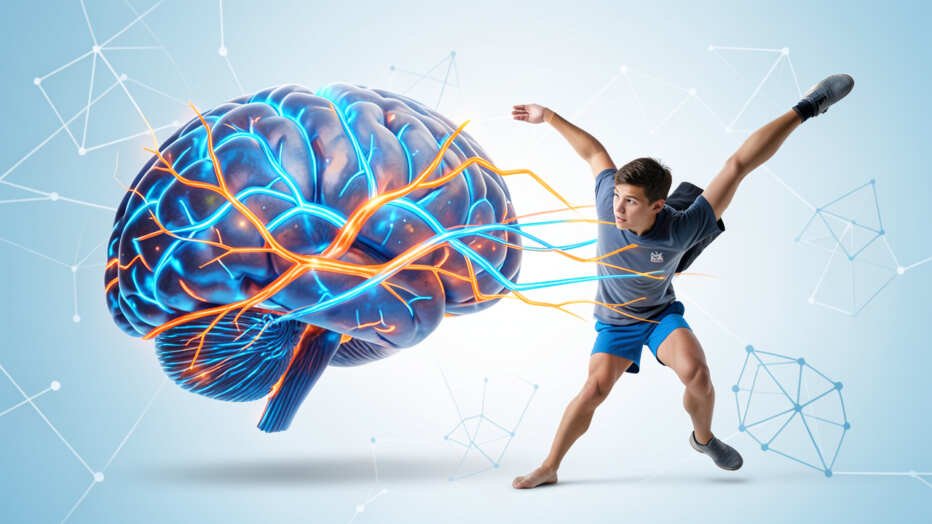
The brain learns a new physical skill fast through neuroplasticity, which involves forming and strengthening specific neural pathways during three predictable stages of motor learning: cognitive, associative, and autonomous. Critical brain regions including the motor cortex, cerebellum, and basal ganglia coordinate to refine movement, translating conscious effort into automatic, efficient action. Accelerating this process depends on consistent repetition and crucial sleep periods, which consolidate motor memories and enhance performance consolidation.
Learning a new physical skill might look like a test of muscles and coordination, but your brain is the real engine behind every improvement. From your first wobbly attempt to a perfectly fluid movement, your brain rewires itself in specific, predictable ways.
This post explains how the brain learns a new physical skill, the stages of motor learning, the brain regions involved, and practical ways to speed up the entire process.
Simply put, your brain learns a new physical skill by forming and strengthening neural pathways through three stages: cognitive, associative, and autonomous. Repetition and sleep consolidate these pathways, and regions like the motor cortex, cerebellum, and basal ganglia coordinate to make the movement automatic and efficient.
Key Takeaways
- The brain learns a new physical skill through neuroplasticity, rewiring neural circuits with every repetition.
- Motor learning follows three stages: cognitive, associative, and autonomous, each with distinct brain activity patterns.
- Physical skill learning depends heavily on sleep, which consolidates motor memories and boosts next-day performance.
- Key regions like the motor cortex, cerebellum, and basal ganglia work together to automate movement.
- Deliberate practice and spaced repetition are the fastest ways to teach your brain a new physical skill.
What Happens in the Brain When You Learn a New Physical Skill?
When you attempt a new movement, your neurons fire together in new patterns. This process, called neuroplasticity, allows your brain to reorganize its structure based on experience.
Each repetition strengthens the connections between neurons. The phrase “neurons that fire together wire together” captures the core mechanism behind all skill acquisition.
Here is what happens at the neural level:
- Your sensory systems, including proprioception, send feedback about body position, speed, and force.
- The motor cortex plans the sequence of muscle activations needed for the movement.
- The cerebellum detects mismatches between what you intended and what actually happened.
- The basal ganglia help select and refine the most efficient movement pattern.
- Synapses involved in the movement get stronger, while unused connections are pruned.
- Myelin wraps around active axons, increasing the speed of neural signaling.
- Dopamine release rewards successful attempts and motivates further practice.
This neural reorganization is why the brain learns a new physical skill long before your muscles gain strength. The muscles are simply following commands from refined neural circuits.
According to neuroscientist Suzana Herculano-Houzel, the human brain contains roughly 86 billion neurons, and a large portion of them contribute to planning, executing, and correcting movement. Research published in Nature Reviews Neuroscience notes that the cerebellum alone contains about 50 percent of the brain’s neurons despite making up only 10 percent of its volume. That tells you how much processing power your brain dedicates to movement.
The Three Stages of Learning a Physical Skill
Cognitive psychologists Paul Fitts and Michael Posner developed one of the most widely used models to explain motor learning. They described three distinct stages that every person moves through when acquiring a new physical skill.
Each stage involves different cognitive demands and activates different parts of the brain. Knowing which stage you are in helps you choose the right practice strategies.
| Stage | What Happens | Brain Activity | Example |
|---|---|---|---|
| Cognitive | You think through each step consciously. | Prefrontal cortex is highly active. | Remembering where to place your feet in a dance. |
| Associative | You refine movements and fix errors. | Basal ganglia and cerebellum take over. | Adjusting your golf swing after bad shots. |
| Autonomous | Movement becomes automatic and effortless. | Motor cortex executes with minimal conscious input. | Typing on a keyboard without looking. |
In the cognitive stage, you rely heavily on working memory. You talk yourself through each step, and movements look jerky and uncertain. Mistakes happen often because your brain is still building the correct motor program.
In the associative stage, you start to notice what works and what does not. Your brain compares actual outcomes with expected outcomes, and the cerebellum fine-tunes the movement. This is where most people see the fastest week-to-week improvement.
In the autonomous stage, the movement no longer demands conscious attention. A University College London study found that behaviors become automatic after roughly 66 days of consistent practice, though complex physical skills can take longer. At this point, your brain has learned the skill so thoroughly that you can perform it while talking, thinking, or under pressure.
- Cognitive stage: slow, conscious, error-heavy practice.
- Associative stage: refined, consistent, feedback-driven practice.
- Autonomous stage: automatic, efficient, low-effort performance.
Key Brain Regions That Control Physical Skill Learning
No single brain region is responsible for learning a physical skill. Instead, a network of regions works together, each with a specific job.
Understanding these regions gives you a clearer picture of why certain practice methods work and why others fail.
| Brain Region | Primary Role | When It Peaks |
|---|---|---|
| Motor Cortex | Plans and executes voluntary movements. | Active during all practice. |
| Cerebellum | Detects errors, fine-tunes timing and coordination. | Most active in the associative stage. |
| Basal Ganglia | Selects movement patterns and automates routines. | Critical for habit formation. |
| Prefrontal Cortex | Conscious planning and decision-making. | Dominant in the cognitive stage. |
| Hippocampus | Forms memories of practice sessions. | Active during initial learning. |
The motor cortex sends signals down to your spinal cord and muscles. The cerebellum acts like a calibration system, comparing intended movement with actual movement and sending correction signals almost instantly.
The basal ganglia play a central role in habit formation. As a movement becomes more automatic, control shifts from the prefrontal cortex to the basal ganglia. This shift explains why you can perform a well-learned physical skill without thinking about it.
The hippocampus tags practice sessions as memories, which matters for sleep-dependent consolidation. When you sleep, the hippocampus replays the day’s motor experiences and transfers them to the cortex for long-term storage.
Important: Your brain learns a new physical skill through distributed networks, not a single “skill center.” Training that engages multiple sensory and motor pathways creates stronger, more durable memories.
How Does Muscle Memory Actually Work?
Muscle memory is a misleading name. Your muscles do not store memories. The real changes happen in your brain and nervous system.
When you repeat a movement, your brain builds a motor program, a stored pattern of muscle activations. Over time, this program becomes more efficient and requires less conscious effort.
Two key mechanisms drive muscle memory:
- Synaptic strengthening: repeated firing makes neural connections more sensitive and reliable.
- Myelination: glial cells wrap axons in myelin, a fatty insulation that speeds up electrical signals.
The National Institutes of Health reports that myelination can increase nerve impulse speed from about 2 meters per second to as fast as 120 meters per second. Faster signaling means smoother, quicker, and more precise movements.
Author Daniel Coyle popularized the link between myelin and skill in his book “The Talent Code.” He describes myelin as the “dark matter” of the brain because it is invisible to most scans but profoundly shapes performance.
Research on professional athletes and musicians shows that their motor maps in the brain are larger and more finely tuned than those of beginners. For example, pianists have expanded cortical representation for their fingers. This demonstrates that the brain physically changes to accommodate a new physical skill.
Tip: Quality matters more than quantity. Slow, precise repetitions build accurate motor programs faster than sloppy, rushed ones.
Muscle memory also explains why skills persist after long breaks. Even if performance drops temporarily, the underlying motor programs remain intact. That is why returning to a sport after years away feels much easier than learning it from scratch.
Why Sleep and Repetition Are Crucial for Skill Learning