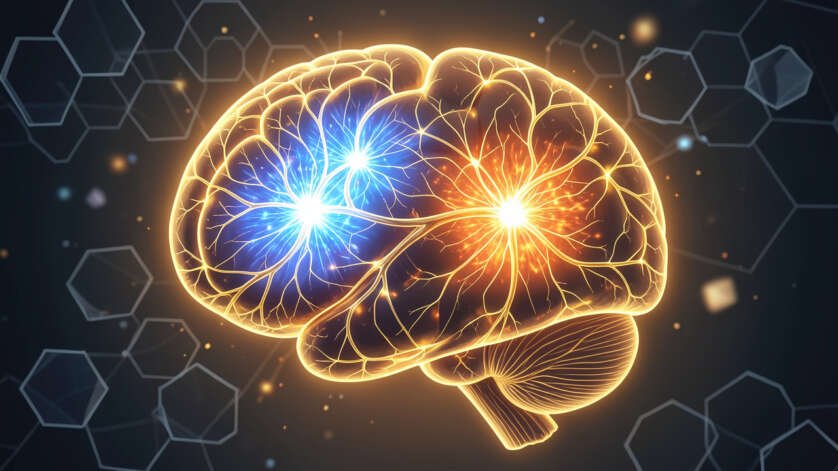
When you learn something new, your brain physically rewires itself through neuroplasticity by strengthening synaptic connections between neurons. The hippocampus serves as a memory gateway, converting short-term experiences into long-term storage with key neurotransmitters like dopamine and acetylcholine aiding focus and motivation. Repeated practice builds myelin around neural pathways, making skills automatic, while sleep consolidates these memories for efficient retention.
Simply put, learning triggers a chain reaction in your brain: neurons fire together, synapses strengthen, and the hippocampus packages the experience into memory. Over time, repeated practice builds myelin around the pathways, making the skill faster and automatic. Your brain literally rewires itself to hold onto what you’ve just learned.
Key Takeaways
- Learning something new physically changes your brain through a process called neuroplasticity.
- Your brain learns by strengthening synaptic connections between neurons during repeated practice.
- The hippocampus acts as a gateway that turns short-term experiences into long-term memories while you sleep.
- Dopamine and acetylcholine are the key chemical messengers that keep you focused and motivated while you learn.
- Factors like stress, sleep quality, and practice consistency determine how fast you acquire a new skill.
What Happens in Your Brain When You Learn: The Core Process
Your brain is made up of roughly 86 billion neurons. When you learn something new, those neurons communicate through electrical impulses and chemical signals across tiny gaps called synapses. The more you use a specific pathway, the stronger that connection becomes.
Neuroscientists call this rule “neurons that fire together wire together.” So when you practice a new skill or study a new concept, your brain strengthens the synapses involved. This process happens at the cellular level within seconds, but it takes hours, days, or weeks for the changes to become lasting.
- Each neuron connects to thousands of others, forming massive networks.
- Repeated activation increases the number of receptors at the synapse.
- Synaptic strength can increase or decrease based on how often you use it.
- Learning a new fact creates new protein molecules that stabilize the connection.
- The entire process is energy-intensive, which is why focused learning wears you out.
This strengthening is the starting point for every memory and skill you own. But the real magic happens when the brain reorganizes larger networks, which we call neuroplasticity. That is the topic of the next section.
Neuroplasticity: How Your Brain Rewires Itself
Neuroplasticity is the brain’s ability to reorganize itself by forming new neural connections throughout life. This means that learning something new isn’t just about memory; it’s about growth. The brain remaps its own circuits to accommodate new information, a process that happens at any age.
One famous example comes from a University College London study. Researchers found that London taxi drivers, who memorize the city’s 25,000 streets, had a significantly larger posterior hippocampus than non-drivers. That is direct evidence that learning physically alters brain structure.
- The brain prunes unused connections during sleep and keeps the active ones.
- New neurons are born in the hippocampus, a process called neurogenesis.
- Learning an instrument increases gray matter in motor, auditory, and visual regions.
- Stroke patients can rewire undamaged areas to take over lost functions.
- Plasticity is highest in childhood but remains active well into old age.
| Factor | Effect on Neuroplasticity |
|---|---|
| Focused attention | Boosts synaptic strengthening and new connections |
| Sleep | Consolidates newly formed neural patterns |
| Stress | Releases cortisol, which can disrupt plasticity |
| Physical exercise | Increases BDNF, a protein that supports neural growth |
Tip: Use active recall instead of passive rereading. Quiz yourself with the book closed to force the brain to rebuild those neural pathways from scratch.
This table shows that the brain’s ability to change isn’t fixed. Simple daily choices, like getting enough sleep and managing stress, directly influence how well you learn. Next, we look at the hippocampus, the brain’s memory gateway.
Why the Hippocampus Is the Brain’s Memory Gateway
The hippocampus sits deep inside the temporal lobe and acts like a filing clerk for new memories. When you learn something new, the hippocampus takes the incoming information and binds the pieces together into a single memory trace. This trace is fragile until it is consolidated, which mostly happens during sleep.
Without a healthy hippocampus, learning becomes nearly impossible. People with damage to this region can remember old events but cannot form new ones. The famous patient Henry Molaison, studied by neuropsychologist Brenda Milner, showed exactly this after his hippocampus was removed.
- Information enters the hippocampus through the entorhinal cortex.
- Neurons in the hippocampus create a quick, temporary pattern.
- During deep sleep, the pattern is replayed to strengthen connections.
- Over time, the memory shifts to the neocortex for long-term storage.
- Forgetting happens when these replay cycles are weak or interrupted.
Tip: To improve learning, repeat new information during the day and then get a full night of sleep. The hippocampus needs that offline time to solidify what you studied.
Research published in the Journal of Neuroscience suggests that the hippocampus replays the day’s experiences hundreds of times during sleep. Each replay strengthens the synaptic connections and gradually moves the memory into the cortex, making it more permanent.
What Happens in Your Brain When You Learn: Neurotransmitters at Work
Learning doesn’t happen with wires alone; it runs on chemicals. Neurotransmitters are the molecules that carry signals between neurons. For learning, three stand out: dopamine, acetylcholine, and norepinephrine.
Each one plays a different role, from motivation to attention to memory formation.
Dopamine is often called the “learning signal” because it tells the brain that something matters. When you experience a reward, dopamine surges. That surge strengthens the synapses that were active just before the reward, which is why you remember rewarding experiences more vividly.
Acetylcholine helps the hippocampus convert new input into lasting memories, while norepinephrine sharpens attention and alertness.
| Neurotransmitter | Role in Learning | How to Boost It Naturally |
|---|---|---|
| Dopamine | Reward and motivation | Set small goals and track progress |
| Acetylcholine | Memory consolidation | Eat choline-rich foods like eggs and fish |
| Norepinephrine | Focus and alertness | Take short breaks and use caffeine lightly |
| Glutamate | Synaptic plasticity | Engage in intense focus sessions |
This chemical system explains why your emotional state matters. If you feel bored, dopamine drops and learning slows. If you feel anxious, norepinephrine spikes too high and your attention narrows.
The goal is to keep these chemicals in a balanced zone of curiosity and calm.
- Check off small milestones to trigger steady dopamine release.
- Explain what you learned to someone else to strengthen cholinergic activity.
- Use a short warm-up exercise to raise norepinephrine before studying.
- Avoid multitasking; it fragments the neural reward signals.
- Eat a balanced diet; nutrient gaps can affect neurotransmitter production.
Important: Dopamine works best when rewards are unpredictable. So add a little variety to your study routine, like switching topics or testing yourself, to keep the brain engaged.
The Stages of Learning: From Novice to Automatic
Learning doesn’t feel the same from start to finish. Your brain goes through distinct stages that transform a stiff, clumsy effort into a smooth, automatic skill. Understanding where you are in that curve helps you set realistic expectations.
The classic model from educational psychologist David Kolb and others divides learning into four stages. You start with unconscious incompetence, move to conscious incompetence, then conscious competence, and finally unconscious competence. At each stage, different brain areas take over.
- Unconscious incompetence: You don’t know what you don’t know. The brain doesn’t have any relevant patterns yet.
- Conscious incompetence: You recognize the skill gap. The prefrontal cortex works hard, and errors are common.
- Conscious competence: You can perform the skill, but you need focused attention. The basal ganglia and motor cortex are still building the pattern.
- Unconscious competence: The skill becomes automatic. The brain moves the sequence into the cerebellum and basal ganglia, freeing up your attention.
| Stage | Brain Region Active | Feeling |
|---|---|---|
| Unconscious incompetence | Prefrontal cortex | Ignorant confidence |
| Conscious incompetence | Prefrontal cortex, anterior cingulate | Frustration |
| Conscious competence | Motor cortex, basal ganglia | Effortful success |
| Unconscious competence | Cerebellum, basal ganglia | Effortless flow |
Notice that the early stages feel hard because your prefrontal cortex, the logical thought center, is doing all the work. As you practice, the brain hands off the task to lower, faster regions. That is why a beginner has to think through every movement, while an expert just does it.
Important: Frustration at the conscious incompetence stage is a good sign. It means your brain has registered the gap between current ability and target skill.
How Does Sleep Help You Retain What You Learn?
You might feel tempted to pull all-nighters, but sleep is one of the most powerful learning tools you have. During deep sleep, your brain replays the circuits you activated during the day. This replay strengthens memories and prunes away extraneous data.
The National Sleep Foundation reports that both deep slow-wave sleep and REM sleep contribute to memory consolidation. In a widely cited study published in the journal Nature, researchers found that individuals who slept after practicing a motor skill performed 20% better than those who stayed awake. Your brain needs that offline period to make learning permanent.
- Deep sleep strengthens declarative memories, like facts and vocabulary.
- REM sleep helps link new concepts to existing knowledge, aiding logic and problem-solving.
- The brain replays the day’s experiences at neural level, sometimes 10 to 100 times faster than real time.
- Sleep deprivation impairs hippocampal function, so new input never gets stored properly.
- Napping for 20-30 minutes can also boost alertness, but full sleep cycles do the heavy lifting.
Warning: Skipping sleep after a study session is like pouring water into a leaky bucket. Without consolidation, most of what you tried to learn will wash away.
To get the most from sleep-based consolidation, keep a consistent schedule. Go to bed and wake at the same time every day. Your brain learns the rhythm and schedules its replay cycles accordingly.
Factors That Speed Up or Slow Down Learning
Why do some things stick easily while others take years? The answer lies in a few key variables. Your attention, stress levels, physical activity, and environment can all accelerate or block the neural changes we covered above.
First, attention is the gatekeeper. Studies show that learning fails without focused attention because the brain never encodes the input. Second, chronic stress pumps cortisol into your system, which harms the hippocampus.
The American Psychological Association notes that chronic stress reduces the ability of neurons in the hippocampus and prefrontal cortex to grow and connect.
- Practice with spaced repetition rather than cramming.
- Add physical exercise; it increases BDNF, a protein that supports neuroplasticity.
- Keep your study space free of distractions to maintain attention.
- Connect new material to things you already know to create more neural hooks.
- Sleep 7-9 hours per night to support memory consolidation.
- Use testing or self-recalling instead of passive rereading.
| Factor | Effect on Learning | Action |
|---|---|---|
| Spaced repetition | Strengthens memory at weekly intervals | Review day 1, day 3, day 7, day 30 |
| Active recall | Forces the brain to rebuild pathways | Quiz yourself without notes |
| Interleaving | Improves discrimination between concepts | Mix practice of different skills |
| Mindfulness | Boosts attention and reduces cortisol | Do 5 minutes of focused breathing |
Tip: Use the Pomodoro method: study for 25 minutes, rest for 5. The breaks keep norepinephrine from spiking too high and help maintain consistent focus.
Age also matters, but not in the way most people think. Older adults learn slower on new tasks but often have more wisdom and context to connect the dots. The brain remains plastic throughout life, so age is only one small piece of the puzzle.
Frequently Asked Questions
What is neuroplasticity in simple words?
Neuroplasticity is the brain’s ability to rewire itself by forming new connections between neurons. When you practice a skill or learn new information, your brain physically adjusts to make that knowledge or ability easier to access next time.
How many hours of sleep do you need to learn effectively?
Most adults need 7 to 9 hours of quality sleep per night. Deep sleep and REM sleep both contribute to memory consolidation, so cutting sleep short reduces how much of the day’s learning you retain.
Can adults learn new things as fast as children?
The brain remains plastic at any age, but adults and children learn differently. Children often acquire new language sounds and motor patterns more easily, while adults use reasoning and prior experience to learn complex concepts more quickly.
Which neurotransmitter is most important for learning?
Dopamine is often considered the most important because it drives motivation and signals which experiences to remember. Acetylcholine and norepinephrine also play essential roles in memory formation and focus, so no single chemical works alone.
How does stress affect the ability to learn?
Acute stress can sharpen focus, but chronic stress releases cortisol, which damages the hippocampus and disrupts neuroplasticity. Even one night of poor sleep from stress can reduce next-day memory performance. Managing stress is critical for effective learning.
Final Thoughts
Learning something new is never just about memorizing facts. Your brain rewires itself, strengthens synaptic connections, and builds entire networks to support the skill. Give it focused attention, enough sleep, and consistent practice, and the results will show up faster than you expect.