
Individuals exhibit different reaction times primarily due to a combination of genetic factors, neural processing speed, and age, though targeted training and healthy lifestyle habits can significantly improve performance. Scientific measurements show that average visual reaction time is approximately 250 milliseconds, with faster responses possible through practice and optimal physical conditioning. Ultimately, while natural variation exists, factors like sleep quality, focused practice, and physical fitness are key modifiable elements that can enhance anyone's reaction speed over time.
Reaction times vary wildly from person to person, and that split-second difference can decide a race, a game, or even a crash. This post explains the science behind why some people react faster, which factors you can actually control, and how to test your own speed.
Simply put, reaction times come down to a mix of genetics, age, brain processing speed, training, and lifestyle habits like sleep and caffeine. Some people are born with faster neural wiring, but practice and physical fitness can measurably close the gap over time.
Key Takeaways
- Reaction times are shaped by both genetics and training, not just natural talent.
- The average visual reaction time sits around 250 milliseconds, while auditory responses are closer to 170.
- Reaction times peak in your mid-20s and slowly get slower with age.
- Sleep quality, caffeine, and focused practice can improve your response speed noticeably.
- Choice reaction times are always slower than simple ones because your brain has to decide first.
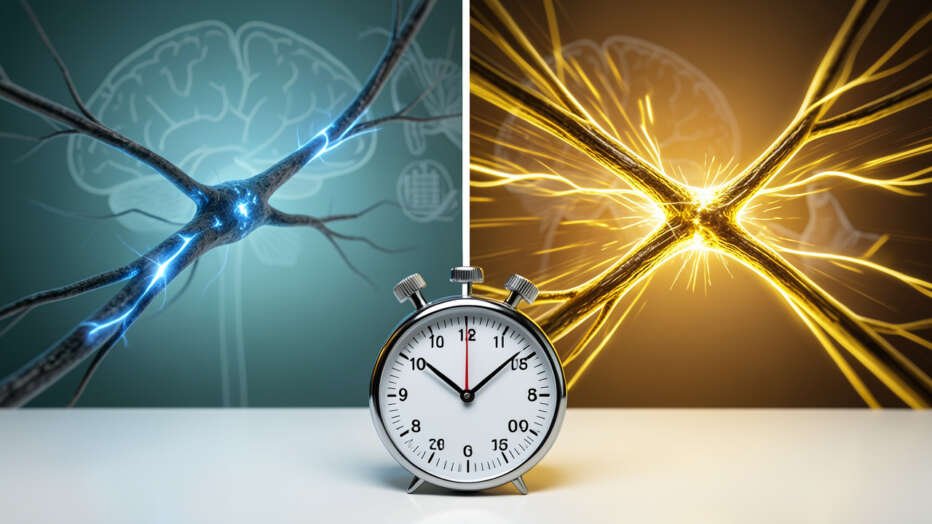
What Is Reaction Time and Why Does It Matter?
Reaction time is the delay between a stimulus and your response. It is the time your nervous system needs to notice something, process it, and tell your muscles to move. That gap can be as short as 150 milliseconds or as long as 500 milliseconds depending on the person and the situation.
This matters far more than just bragging rights in video games. Faster reaction times can help you avoid a car accident, catch a slipping glass, or land a punch in a boxing match. Slower ones increase your risk in any situation that demands split-second decisions.
Researchers usually classify reaction time into three main types:
- Simple reaction time: one stimulus, one response, like pressing a button when a light turns on.
- Recognition reaction time: you respond to a target stimulus but must ignore others, like braking only for a red light.
- Choice reaction time: you must pick the correct response from multiple options, like choosing which gear to shift into.
| Type | Average Time | Example |
|---|---|---|
| Simple | 200-300 ms | Pressing a key when a light flashes |
| Recognition | 300-400 ms | Pressing only when the green dot appears |
| Choice | 400-600 ms | Picking one of four correct buttons |
In short, your reaction time reflects how efficiently your entire nervous system works. The more complex the decision, the longer the delay.
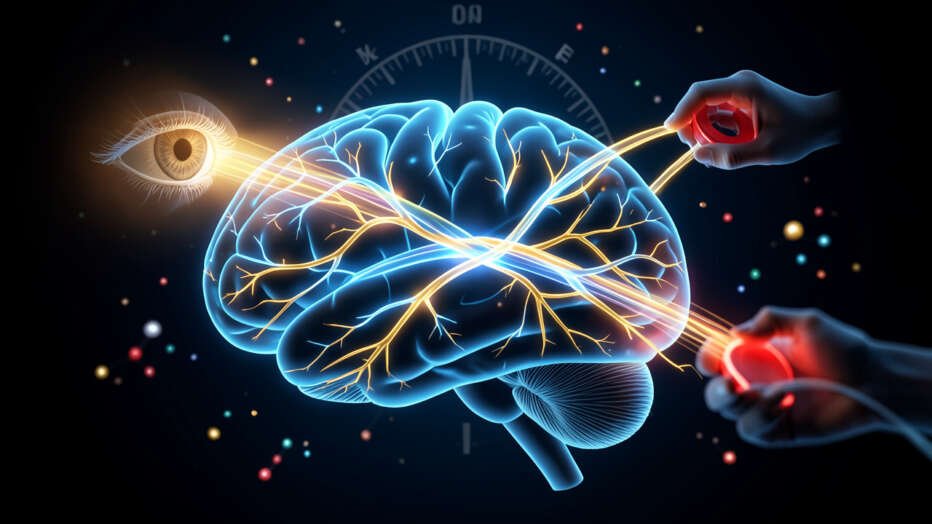
How Does the Brain Process a Reaction?
Your reaction time is not a single event. It is a chain of events that happens in four distinct stages, and any delay in one stage slows down the whole response.
- Detection: your sensory organs, usually your eyes, ears, or skin, pick up the stimulus. This takes roughly 30-50 milliseconds after light hits your retina.
- Transmission: the signal travels along sensory nerves to the brain at speeds up to 120 meters per second on myelinated fibers.
- Processing: the brain identifies the stimulus, evaluates it, and plans a response. This is where most of the delay happens, especially for complex choices.
- Action: motor neurons fire, and your muscle fibers contract. Muscle activation itself takes around 40-60 milliseconds.
Scientists have understood this pathway since 1850, when German physician Hermann von Helmholtz first measured the speed of nerve signals in frogs. His work proved that neural transmission was not instant, a radical idea at the time.
The speed of each stage depends heavily on myelin, the fatty coating around your nerve fibers. The Research Institute at Nationwide Children’s Hospital notes that thicker myelin allows signals to jump between nodes faster, which is why nervous system maturation during childhood steadily improves reaction speed.
Important: Most of the individual difference in reaction time comes from the processing stage, not the speed of the nerve signal itself. Two people can have nearly identical nerve conduction speeds but very different decision times.
What Factors Affect Reaction Times Most?
Some factors are baked into your biology. Others change hour by hour based on what you eat, how you sleep, and what you are doing at that exact moment.
Researchers who study reaction times have identified a clear list of variables that matter most:
- Age: speed improves through childhood, peaks in the mid-20s, and declines afterward.
- Genetics: some people inherit faster neural processing and stronger fast-twitch muscle fibers.
- Sleep: even one night of poor sleep can add 50-100 milliseconds to your response time.
- Caffeine: moderate doses can shorten reaction times by boosting alertness.
- Practice: repeated exposure to a specific stimulus trains your brain to respond faster.
- Stress and arousal: moderate stress sharpens reflexes, but extreme stress can freeze you.
- Alcohol and drugs: both reliably slow response speed, even in small amounts.
The National Sleep Foundation reports that staying awake for 17 hours straight impairs reaction time to a level comparable to a blood alcohol concentration of 0.05 percent. That is enough to slow you down meaningfully in driving or sport.
Another major factor is distraction. A 2016 study from the University of Utah found that drivers using a hands-free phone still showed delayed reaction times of about 0.2 seconds, because the brain cannot truly multitask. Your attention is a limited resource, and dividing it slows every stage of the response chain.
Warning: If you feel tired or distracted, your reaction time can easily double. In driving, an extra 100 milliseconds means several extra meters of travel distance before you even hit the brake.
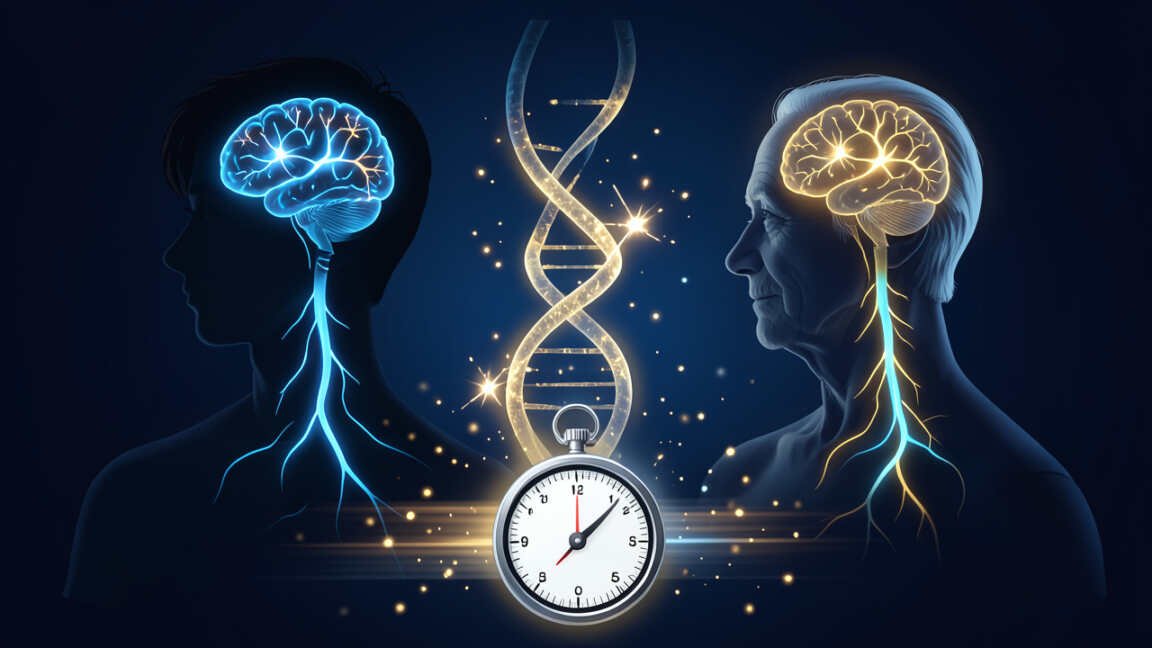
How Do Age and Genetics Influence Reaction Times?
Age is one of the most predictable influences on reaction speed. A 2015 study published in PLOS ONE, which analyzed data from over 2,400 participants, found that simple reaction time peaks around age 24 and then declines steadily. By age 60, average response times can be 20-30 percent slower than at their peak.
That decline is not a straight line for everyone. The study showed that some older adults maintain reaction times that rival people half their age, which points to the protective power of physical activity, cognitive engagement, and overall health.
Genetics play an equally strong role. Identical twins show more similar reaction times than fraternal twins, even when raised apart. Scientists have linked specific gene variants, like those affecting the DRD2 dopamine receptor, to differences in response speed.
Dopamine helps regulate how quickly your brain processes signals and initiates movement.
However, genetics only set the range, not the final number. Consider this comparison:
| Influence | Effect Size | Can You Change It? |
|---|---|---|
| Genetics | Large | No, but you can optimize your baseline |
| Age | Large | Only the slope, not the direction |
| Sleep | Medium to large | Yes, immediately |
| Training | Medium | Yes, with consistent practice |
The encouraging news is that lifestyle factors compound. A 60-year-old who exercises regularly, sleeps well, and practices reaction drills can sometimes react faster than a sedentary 25-year-old. You are not locked in by your birthday or your DNA.
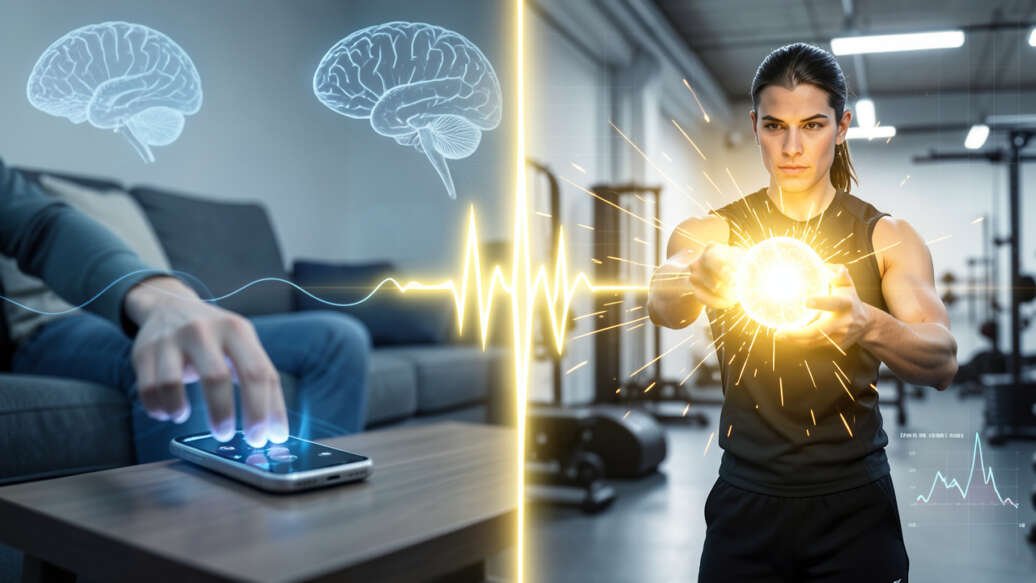
Can Training Really Improve Reaction Times?
Yes, but with one important caveat: training mostly improves specific responses to specific stimuli. Catch a bouncing ball daily, and you will get faster at catching bouncing balls. Your improvement in unrelated reaction tests will be smaller.
That said, several training methods have solid scientific backing:
- Action video games: a 2018 PLOS ONE study found that frequent action game players respond about 30 milliseconds faster than non-players on visual reaction tasks.
- Reaction ball drills: bouncing an irregular ball against a wall and catching it trains both visual tracking and motor response.
- Sprint start practice: athletes who practice starts repeatedly shorten their response to the starting gun through motor learning.
- Cognitive training apps: programs like Soma and Human Benchmark can improve simple reaction time, though transfer to real life is debated.
- Mindfulness and focus training: meditation improves attention, and better attention means less processing delay.
The Journal of Athletic Training reports that most healthy adults fall between 200 and 300 milliseconds on simple visual tests. With consistent training, many people can shave 20-40 milliseconds off that baseline within weeks.
Tip: Train in a fatigued state occasionally, not always. A tired brain learns to compensate, but constant exhausted training builds sloppy habits. Balance hard sessions with fresh, focused ones.
Physical exercise also matters. High-intensity interval training improves blood flow to the brain and boosts levels of brain-derived neurotrophic factor, a protein that supports neural plasticity. People who exercise regularly tend to maintain faster reaction times as they age.
What Are the Best Ways to Test and Measure Reaction Time?
You do not need a lab to get a decent estimate of your reaction speed. Simple online tests and smartphone apps can give you a ballpark number, but their accuracy depends heavily on your device and testing conditions.
Here are the most common methods people use:
| Method | Typical Accuracy | Best For |
|---|---|---|
| Online ruler test | Moderate | Quick self-check |
| Human Benchmark website | Good | Tracking progress over time |
| Smartphone apps | Variable | Convenient daily testing |
| Strobe glasses | High | Athletes training visual processing |
| Lab equipment | Very high | Research and professional testing |
To get reliable results, take at least 10 trials and use the median, not the average. A single sneeze or notification can wreck one trial and pull your average up. Also test at the same time of day, since circadian rhythms affect alertness.
Warning: Online tests that rely on screen refresh rates and click latency will not match lab-grade equipment. Treat your score as a rough indicator, not a medical measurement.
Athletic organizations use specialized systems like the FITLIGHT trainer, where players touch randomly illuminated discs. NASA also runs reaction time assessments for astronauts as part of cognitive performance monitoring, which shows how seriously professionals take this metric.

Why Do Athletes and Gamers Have Faster Reaction Times?
Elite athletes and professional gamers do not necessarily have faster raw nerve conduction than everyone else. What they have is highly trained perceptual systems and decision shortcuts. Their brains anticipate, so they start moving before the stimulus fully arrives.
At the 2016 Rio Olympics, Usain Bolt recorded a reaction time of 0.155 seconds out of the blocks in the 100-meter final. That is well below the average human visual response time of around 250 milliseconds. Bolt was not just physically fast, he was neurologically fast off the gun.
Research shows several reasons why trained performers have quicker responses:
- Anticipation: experienced athletes read subtle cues, like a pitcher’s shoulder movement, before the ball is released.
- Pattern recognition: gamers and athletes recognize familiar scenarios faster and skip unnecessary processing steps.
- Motor preparation: trained muscles are pre-activated and ready to fire the instant a decision is made.
- Lower anxiety: competition experience reduces the panic that slows down untrained opponents.
- Visual processing speed: athletes track moving objects more efficiently, as shown by studies from the University of California, Berkeley.
F1 drivers offer another extreme example. A Formula 1 driver reacts to a starting light in roughly 200 milliseconds, but they also maintain reaction times under 0.3 seconds while traveling at 300 km/h. Their brains have effectively automated execution, so conscious processing delay shrinks to almost nothing.
Gamers show a similar pattern. Esports professionals in games like Counter-Strike and League of Legends consistently hit 150-200 millisecond reaction times in simple tests, and a 2021 meta-analysis published in Frontiers in Human Neuroscience confirmed that action game players outperform non-players on multiple attention and reaction metrics.
The key distinction is that these skills are largely practice-based, not magical gifts. A person who starts young and trains deliberately builds faster neural pathways over years.
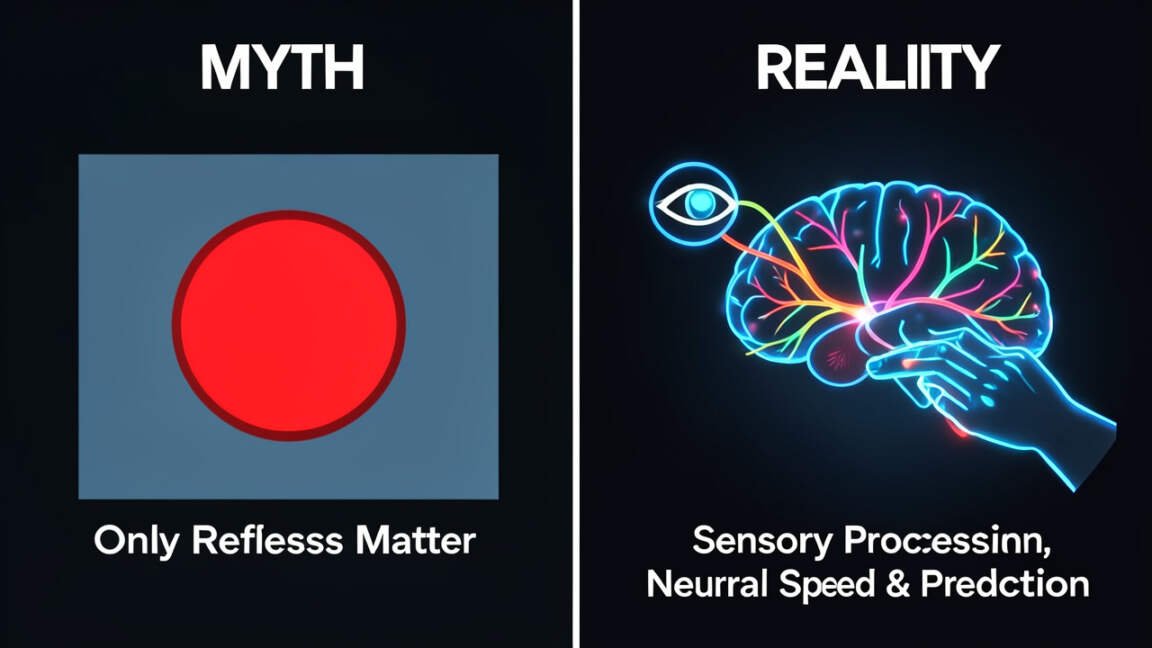
Common Myths About Reaction Time, Debunked
Reaction time is surrounded by folk wisdom that does not hold up to scientific scrutiny. Here are the biggest myths and the evidence against them.
- Myth: You are born with a fixed reaction time. False. Training, sleep, diet, and focus all shift your speed significantly.
- Myth: Older people simply cannot react fast. Partially false. Active older adults often outpace sedentary younger ones. Age slows you down, but lifestyle determines how much.
- Myth: More caffeine always helps. False. Moderate doses help, but too much causes jitteriness and overthinking, which can actually slow decisions.
- Myth: Video games rot your reflexes. False. Action games improve visual attention and response speed, though excessive play still has downsides like fatigue.
- Myth: Left-handed people react faster. False. Studies show no meaningful reaction time difference between left and right-handed people.
- Myth: Reaction time and reflexes are the same thing. False. Reflexes are automatic spinal responses, while reaction time involves conscious brain processing.
Important: Many popular “reflex tests” actually measure anticipation, not reaction time. If you know exactly when the stimulus will appear, you are timing your action, not reacting to it. True tests use random intervals.
The takeaway from this section is simple: your reaction time is a trainable skill with biological limits, not a fixed lottery ticket. Understanding the myths helps you focus your energy on things that actually work.
Frequently Asked Questions
What is a good reaction time?
For simple visual stimuli, anything under 250 milliseconds is considered good, and under 200 is excellent. The average healthy adult lands between 200 and 300 milliseconds. Competitive athletes and gamers often sit in the 150-200 range.
Can reaction time be improved at any age?
Yes, though the ceiling is higher when you are young. Older adults can still improve their reaction times with physical exercise, cognitive training, and reaction drills. The gains may be smaller than in youth, but they remain meaningful for daily safety and independence.
Why are my reaction times slower in the morning?
Your core body temperature and alertness rise throughout the day, peaking in the late afternoon. Lower morning temperature means slower neural processing. Most people hit their fastest reaction times between 2 PM and 6 PM, which is why many sports competitions schedule finals in the evening.
What is the fastest human reaction time ever recorded?
Simple visual reaction times below 100 milliseconds are extremely rare and often involve anticipation rather than true reaction. Elite sprinters at the Olympic level record times around 120-160 milliseconds. The scientific consensus sets the lower limit of human visual reaction time at roughly 100-120 milliseconds.
Do left-handed people have faster reaction times?
No consistent evidence supports this claim. Some small studies found differences, but larger analyses show no meaningful gap between left and right-handed individuals. Handedness affects which hand is faster, not overall reaction speed.
Final Thoughts
Reaction times are a fascinating mix of biology, practice, and daily habits. Genetics and age set your starting point, but sleep, training, and focus can shift your speed by tens of milliseconds. Whether you want sharper reflexes for sports, gaming, or simply safer driving, the same rules apply: sleep well, stay active, and practice deliberately.
Your brain is more trainable than you think.