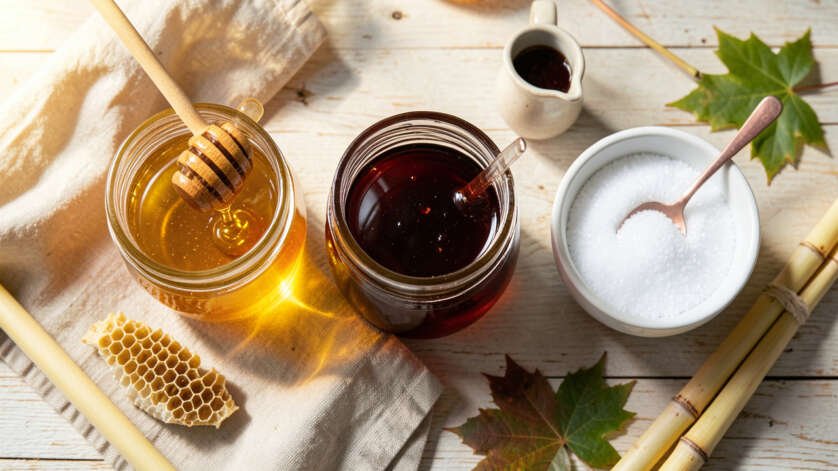
Honey, maple syrup, and table sugar are distinct sweeteners differing primarily in nutritional content and processing. While honey and maple syrup contain trace minerals and antioxidants, all three are high in sugar, spike blood glucose similarly, and should be used sparingly for optimal health. Choosing between them depends more on flavor preference and specific dietary goals than on significant nutritional advantages.
Honey, maple syrup and table sugar are all natural sweeteners, but they affect your body in surprisingly different ways. This post breaks down the real differences in nutrition, taste, and health impact so you can choose the best option for your lifestyle.
Simply put, honey and maple syrup bring trace minerals and antioxidants to the table, while table sugar offers zero nutrition beyond calories. In short, all three spike blood sugar and should be used sparingly. For flavor and subtle benefits, honey or maple syrup edge out plain sugar, but moderation still matters most.
Key Takeaways
- Honey, maple syrup and table sugar contain nearly the same calories per teaspoon, so swapping one for another won’t magically speed up weight loss.
- Honey and maple syrup provide small amounts of vitamins, minerals, and antioxidants that table sugar completely lacks.
- Your blood sugar response depends on the exact mix of sugars and the glycemic index, not just whether the sweetener is “natural.”
- Maple syrup usually has a slightly lower glycemic index than honey and sugar, but the difference is too small to change health outcomes by itself.
- For most people, the best sweetener is the one you use least, because all three count as added sugar.
What Are the Real Differences Between Honey, Maple Syrup and Table Sugar?
At first glance, honey, maple syrup and table sugar look interchangeable. You can use them in coffee, baking, or pancakes, and they all deliver sweetness. But they come from completely different sources, and those sources change their chemistry, flavor, and how your body processes them.
Honey is made by bees from flower nectar. Maple syrup comes from boiling down the sap of sugar maple trees. Table sugar, or sucrose, is extracted from sugar cane or sugar beets.
These different origins mean each sweetener has its own ratio of glucose, fructose, and sucrose, plus trace compounds that affect flavor and health.
- Honey is primarily fructose (about 38%) and glucose (about 31%), with water, enzymes, and pollen leftovers.
- Maple syrup is mostly sucrose (about 90% of its dry weight), similar in structure to table sugar but less processed.
- Table sugar is pure sucrose, a 50-50 split of glucose and fructose bonded together.
- Honey and maple syrup contain more moisture than sugar, which affects baking ratios and microbial growth.
- Maple syrup takes roughly 40 gallons of sap to make one gallon of syrup, giving it a distinct caramel-like taste.
- Honey can be raw or pasteurized, and its color and flavor change based on the flowers bees visit.
- Table sugar is heavily refined, which strips away molasses, minerals, and any natural plant compounds.
So the biggest structural difference is that honey and maple syrup are less processed and carry small amounts of non-sugar compounds. Table sugar is pure sucrose with zero micronutrients. That distinction sets the stage for everything else in this post.
How Does Each Sweetener Affect Blood Sugar?
Your body breaks down all digestible carbohydrates into glucose, which raises blood sugar. The speed of that process is measured by the glycemic index (GI). Foods with a low GI (below 55) cause a slower, gentler rise, while high-GI foods (above 70) cause rapid spikes followed by crashes.
Honey, maple syrup and table sugar all fall in the medium range, so none of them are “free” foods for people with diabetes or insulin resistance. However, small differences exist because honey and maple syrup contain trace acids and compounds that may slow gastric emptying.
| Sweetener | Glycemic Index | Main Sugar |
|---|---|---|
| Table sugar | 60 | Sucrose |
| Honey | 58 | Fructose + glucose |
| Maple syrup | 54 | Sucrose |
According to the University of Sydney’s Glycemic Index database, these values are based on real people’s responses, not just chemical guesses. The practical takeaway is that maple syrup’s slightly lower GI won’t protect you from a spike if you keep topping off your waffles.
- Check serving size first: 1 tablespoon is the standard reference point.
- Pair any sweetener with protein, fiber, or fat to flatten the blood sugar curve.
- Eat sweet treats after a meal rather than on an empty stomach.
- Test your own response if you have diabetes, because individual GI results vary.
Warning: A low glycemic index does not mean “safe for diabetics.” Even maple syrup is still concentrated sugar, and calories add up quickly.
Honey vs Maple Syrup vs Table Sugar: Vitamins and Minerals
If you compare the nutrition labels, the differences look tiny. But honey and maple syrup contain real antioxidants and minerals that table sugar does not. Table sugar is stripped down during refining until only sucrose remains.
Honey offers small amounts of vitamin C, B vitamins, calcium, iron, magnesium, and potassium. Maple syrup provides zinc, manganese, calcium, and potassium. A tablespoon of maple syrup delivers about 22% of your daily manganese, making it the mineral superstar of the three.
| Nutrient (per 1 tbsp) | Honey | Maple Syrup | Table Sugar |
|---|---|---|---|
| Calories | 64 | 52 | 49 |
| Carbohydrates | 17 g | 13 g | 12.6 g |
| Manganese | 0% DV | 22% DV | 0% DV |
| Antioxidants | Flavonoids, phenolic acids | Benzoic acid, cinnamic acid | None |
That table shows why you should not dismiss honey or maple syrup as “liquid sugar.” A 2009 study in the Journal of Medicinal Food found that darker honey varieties have more antioxidant activity than lighter ones, similar to what you find in fruits and vegetables.
- Honey’s antioxidant content varies by floral source, with buckwheat honey on the high end.
- Maple syrup contains 24 different antioxidant compounds, according to a University of Rhode Island study.
- All three sweeteners still contribute to your daily added sugar limit, so the nutrients do not cancel out the calories.
- The World Health Organization recommends keeping added sugar below 10% of daily calories, and ideally below 5%.
- Darker syrups and honeys generally have more micronutrients and stronger flavor, so you can use less.
The bottom line: honey and maple syrup give you a little nutritional bonus, but not enough to treat them like supplements. You would need several tablespoons to get meaningful antioxidant levels, and that much sugar brings health risks of its own.
What Are the Flavor Differences and Best Uses in Baking and Cooking?
Taste tells the real story. Honey is floral and can be fruity or even slightly bitter, depending on the flowers. Maple syrup has a smoky, caramel-like depth that works in both sweet and savory dishes.
Table sugar is pure sweetness with a clean, neutral finish.
This makes them less interchangeable than people think. Swap honey into a recipe and you add extra liquid and a distinct flavor. Swap maple syrup and you change the texture and browning.
Use table sugar and you get predictable, consistent results every time.
- Honey is ideal in tea, yogurt, salad dressings, and marinades because it dissolves easily and adds a floral note.
- Maple syrup shines on pancakes, oatmeal, roasted vegetables, and glazes for pork or chicken.
- Table sugar is the standard for most baked goods because it creams with butter and helps cookies spread.
- Honey and maple syrup are both acidic; they react with baking soda to help cakes rise.
- Liquid sweeteners brown faster in the oven, so lower the temperature by 25°F (about 14°C) when substituting honey.
- Reducing the liquid by roughly 1 tablespoon for every cup of liquid sweetener keeps baked goods from turning soggy.
- Use the same volume substitution in most recipes: 1 cup sugar equals ¾ cup honey or ¾ cup pure maple syrup.
- Myth: Honey is safe for diabetics. Honey still raises blood sugar. It has only a slightly lower GI than white sugar, and the difference is usually not clinically meaningful.
- Myth: Maple syrup is a health food. It contains minerals, but you would need unrealistically large servings to hit meaningful daily values, and those servings come with massive sugar loads.
- Myth: Brown sugar is healthier than white sugar. Brown sugar is just white sugar with molasses added back, so its nutrient profile is nearly identical to white sugar.
- Myth: Honey never spoils. Real honey can crystallize or ferment if exposed to moisture, despite its legendary prolonged shelf life in sealed containers.
- Myth: You can use equal amounts of honey in any recipe. Honey adds liquid and acidity, so recipe adjustments are necessary for consistent results.
- Myth: Raw sugar is cleaner than regular sugar. Raw sugar still goes through significant processing and offers no meaningful nutritional advantage over refined sugar.
Tip: When substituting honey or maple syrup for sugar, add about ¼ teaspoon of baking soda per cup to neutralize the extra acidity and help browning.
The same cooking chemistry explains why table sugar is so common in industrial foods. It is cheap, stable, and behaves predictably. Honey and maple syrup are more expensive and introduce variables that require recipe adjustments.
How Should You Choose a Sweetener Based on Your Health Goals?
Your personal health goals influence which sweetener works best for you. If you want antioxidant trace compounds, honey and maple syrup beat table sugar. If you need to manage blood sugar precisely, portion control matters more than the glycemic index number.
If you have a histamine intolerance or infant under one year, honey is off the table entirely.
Let’s compare the main decision factors in one table:
| Factor | Honey | Maple Syrup | Table Sugar |
|---|---|---|---|
| Best for antioxidants | Good | Good | Poor |
| Lowest calorie density | No | Yes | Yes |
| Lowest glycemic index | Medium | Low | Medium |
| Flavor versatility | Medium | Medium | High |
| Cost | High | High | Low |
| Vegan-friendly | No | Yes | Yes |
If you follow a vegan diet, honey is out because bees produce it. Maple syrup and table sugar are plant-based, though some refined sugar brands process with bone char. Look for organic or certified vegan sugar if that matters to you.
Important: Never give honey to infants under 12 months old. It can contain spores of Clostridium botulinum that a baby’s immature digestive system cannot handle.
For weight control, the calorie math is simple. Honey is the most calorie-dense per tablespoon, maple syrup is lower, and table sugar is in between. But because honey and maple syrup are sweeter, you may use less, which can offset the extra calories.
The American Heart Association recommends limiting added sugar to 6 teaspoons (100 calories) for women and 9 teaspoons (150 calories) for men.
Common Myths About Honey, Maple Syrup and Table Sugar
Many people assume that “natural” automatically means “healthier.” That leads to a few persistent myths that can actually hurt your dietary choices. Let’s bust the biggest ones.
If you take one thing from this post, remember that all three sweeteners are sources of added sugar. The American dietary guidelines classify honey and maple syrup as added sugars, even though they come from nature. Your liver and pancreas treat them similarly.
Warning: Consuming too much any sweetener, natural or not, is linked to obesity, type 2 diabetes, and fatty liver disease. The WHO recommends less than 10% of daily calories from free sugars.
Instead of chasing the perfect sweetener, focus on reducing your overall sweetness tolerance. Cut portions by half and let your taste buds adjust over two to three weeks. That strategy beats swapping sugar for syrup every time.
Frequently Asked Questions
Which is healthier: honey, maple syrup, or table sugar?
Honey and maple syrup are generally healthier because they contain trace antioxidants and minerals that table sugar lacks. However, all three are added sugars, so the healthiest choice is whichever one you consume in the smallest amount.
Can I substitute honey for sugar in any recipe?
You can, but you need to adjust the liquid and baking temperature. Use about ¾ cup honey for every 1 cup sugar, reduce the liquid by 2 tablespoons, and lower the oven temperature by 25°F to prevent burning.
Does maple syrup spike blood sugar less than honey?
Maple syrup has a slightly lower glycemic index (54) than honey (58), so it produces a modestly slower blood sugar rise. The difference is small, and total carbohydrate intake still matters more for blood sugar control.
Is honey vegan?
No, honey is not vegan because it is produced by bees. Maple syrup and most table sugars are plant-based, though some refined sugars use bone char in processing, so strict vegans may choose organic or certified vegan products.
Why does honey crystallize and how can I fix it?
Honey crystallizes because glucose precipitates out of the supersaturated solution over time. Place the jar in warm water (not boiling) and stir gently to return it to liquid. This does not mean the honey went bad.
Final Thoughts
Honey, maple syrup and table sugar are more alike than different in terms of calories and blood sugar impact. Honey and maple syrup win on antioxidants and trace minerals, but table sugar wins on cost and baking reliability. Choose the one that fits how you cook and what you enjoy, then use it sparingly.
Your overall diet pattern matters far more than which liquid gold you drizzle on your oatmeal.