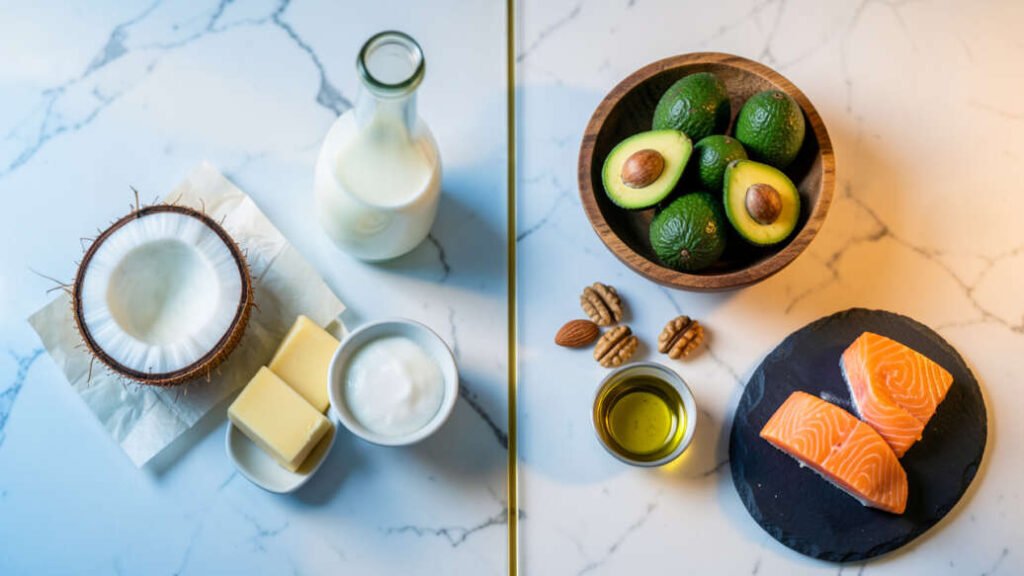
Saturated and unsaturated fats differ primarily in their chemical structure and impact on cholesterol levels. Saturated fats, found in animal products and some tropical oils, raise LDL cholesterol, while unsaturated fats, from plants and fish, can help lower it and improve heart health. For better cardiovascular outcomes, dietary guidelines recommend limiting saturated fat to less than 10% of daily calories and choosing unsaturated sources like olive oil, nuts, and avocados.
Saturated vs unsaturated fat is one of the most important nutrition distinctions you can understand, and it directly affects your cholesterol, heart health, and long-term disease risk. This guide breaks down the science, the food sources, and the practical swaps that make a real difference.
By the end, you will know exactly which fats to prioritize, which ones to limit, and how to read labels like a pro.
Simply put, saturated fats stay solid at room temperature and come mainly from animal sources, while unsaturated fats stay liquid and come mainly from plants. For heart health, unsaturated fats are the clear winner, and experts recommend keeping saturated fat below 10% of your daily calories.
Key Takeaways
- Saturated vs unsaturated fat comes down to chemical structure: saturated fats have no double bonds, while unsaturated fats have one or more.
- Unsaturated fats lower LDL cholesterol and reduce heart disease risk when they replace saturated fats in your diet.
- Saturated fats raise LDL cholesterol, so the American Heart Association recommends limiting them to less than 6% of daily calories for people with high cholesterol.
- Olive oil, nuts, seeds, and fatty fish are rich in unsaturated fats, while butter, red meat, and coconut oil are high in saturated fat.
- Simple swaps, like using avocado instead of butter, can shift your fat balance in a heart-healthy direction without sacrificing flavor.
Quick Comparison: Saturated vs Unsaturated Fat at a Glance
The quickest way to grasp saturated vs unsaturated fat is to look at them side by side. Saturated fat molecules are straight and packed tightly together, which is why they stay solid at room temperature. Unsaturated fat molecules have bends that keep them apart, so they stay liquid.
| Feature | Saturated Fat | Unsaturated Fat |
|---|---|---|
| Chemical structure | No double bonds | One or more double bonds |
| State at room temperature | Solid | Liquid |
| Main food sources | Meat, dairy, eggs, tropical oils | Plant oils, nuts, seeds, avocados, fish |
| Effect on LDL cholesterol | Increases LDL | Decreases LDL |
| Recommended intake | Less than 10% of calories | Most of your total fat intake |
The table above sums up the core differences. But the deeper question is how these fats behave inside your body, and that comes down to their chemical structure and how your liver processes them.
Tip: A simple mental shortcut, if it is solid at room temperature, it is mostly saturated. If it is liquid, it is mostly unsaturated.
What Is Saturated Fat?
Saturated fat is a type of dietary fat in which every carbon atom in the chain is fully “saturated” with hydrogen atoms. Because there are no double bonds, the molecules form straight chains that stack tightly, which is why these fats appear solid at room temperature.
Your body needs some saturated fat for cell membranes and hormone production. The problem is that most people eat far more than they need, which raises LDL cholesterol and increases the risk of cardiovascular disease.
Common Sources of Saturated Fat
- Butter, ghee, and lard
- Fatty cuts of beef, pork, and lamb
- Chicken with skin and processed meats like bacon and sausage
- Whole milk, cream, and full-fat cheese
- Coconut oil, coconut milk, and palm oil
- Ice cream, pastries, and baked goods made with butter
The Dietary Guidelines for Americans advise keeping saturated fat below 10% of total daily calories. For someone eating 2,000 calories a day, that works out to about 22 grams of saturated fat. The American Heart Association takes an even stricter stance, recommending 5% to 6% for anyone who needs to lower their cholesterol.
However, not all saturated fats behave identically. Stearic acid, found in dark chocolate and cocoa butter, has a neutral effect on cholesterol in many people. Meanwhile, palmitic acid, abundant in butter and palm oil, raises LDL more consistently.
This is a nuance worth remembering when evaluating saturated vs unsaturated fat debates.
What Is Unsaturated Fat?
Unsaturated fat has one or more double bonds in its carbon chain, which means it is missing a few hydrogen atoms. Those double bonds create kinks in the molecule, preventing the fat from packing tightly, so it stays liquid at room temperature.
Unsaturated fats are generally considered the healthiest fats you can eat. They lower LDL cholesterol, reduce inflammation, and support brain function. They also help your body absorb fat-soluble vitamins like A, D, E, and K.
There are two main categories:
- Monounsaturated fats (MUFAs): one double bond, found in olive oil, avocados, and most nuts.
- Polyunsaturated fats (PUFAs): two or more double bonds, found in vegetable oils, seeds, and fatty fish.
| Type | Key Sources | Main Benefit |
|---|---|---|
| Monounsaturated (MUFA) | Olive oil, avocado oil, canola oil, almonds, cashews, pecans | Lowers LDL, protects HDL |
| Omega-6 polyunsaturated (PUFA) | Sunflower oil, corn oil, soybean oil, walnuts | Reduces LDL cholesterol |
| Omega-3 polyunsaturated (PUFA) | Salmon, sardines, flaxseeds, chia seeds, walnuts | Anti-inflammatory, heart protective |
Omega-3 and omega-6 fatty acids are essential. Your body cannot make them, so you must get them from food. Most people get plenty of omega-6s from cooking oils, but far too few omega-3s from fish and seeds.
How Saturated vs Unsaturated Fat Affects Your Cholesterol
The cholesterol connection is the main reason saturated vs unsaturated fat matters so much. When you eat saturated fat, your liver responds by producing more LDL cholesterol, the “bad” kind that builds up in artery walls. Unsaturated fats do the opposite, they help clear LDL from the bloodstream.
- Saturated fat signals the liver to reduce LDL receptor activity, so less LDL is removed from the blood.
- LDL particles accumulate in the arteries, where they oxidize and trigger inflammation.
- Unsaturated fat, especially polyunsaturated fat, increases LDL receptor activity and helps the liver clear LDL.
- Monounsaturated fats also maintain or improve HDL, the “good” cholesterol that removes cholesterol from arteries.
According to the American Heart Association, replacing saturated fats with unsaturated fats can lower LDL cholesterol by roughly 8% to 10% in people with elevated levels. That may sound modest, but a persistent 10% reduction in LDL is linked to a significant drop in heart attack and stroke risk over time.
Warning: Trans fats are worse than both saturated and unsaturated fats. They raise LDL and lower HDL at the same time. The FDA largely banned artificial trans fats (partially hydrogenated oils) from the food supply, but you should still check labels for them.
Which Fat Is Healthier: Saturated or Unsaturated?
The evidence is consistent and strong. Unsaturated fats are healthier than saturated fats. A 2015 Cochrane review found that reducing saturated fat intake and replacing it with polyunsaturated fat cut the risk of cardiovascular events by 17%.
The World Health Organization similarly advises that saturated fat should make up less than 10% of total energy intake.
That does not mean saturated fat is poison. Your body needs it in small amounts, and foods like grass-fed beef and full-fat yogurt provide other nutrients like protein, iron, and calcium. The issue is proportion.
In a typical Western diet, saturated fat far exceeds the recommended limit, while unsaturated fat often falls short.
Important: The goal is not a zero-fat diet. The goal is to shift the balance. Most of your fat should come from unsaturated sources, with saturated fat kept well below the 10% ceiling.
One confusing case is coconut oil. It is mostly saturated fat, but it has been marketed as a health food. The American Heart Association reviewed the evidence in 2017 and concluded that coconut oil raises LDL cholesterol just like other saturated fats, advising against treating it as a health food.
Here is how the fat quality hierarchy stacks up:
- Best: omega-3 and omega-9 unsaturated fats (fish, olive oil, avocado)
- Good: omega-6 unsaturated fats (nuts, seeds, vegetable oils) in balance with omega-3s
- Limit: saturated fats (butter, red meat, coconut oil)
- Avoid: trans fats and highly processed oils
Smart Food Swaps to Balance Saturated vs Unsaturated Fat
You do not need to overhaul your entire diet to improve your saturated vs unsaturated fat balance. Small, repeatable swaps add up quickly. The table below shows easy replacements that preserve taste while improving your fat profile.
| Instead of This | Use This | Why It Helps |
|---|---|---|
| Butter on toast | Avocado or olive oil | Replaces saturated with monounsaturated fat |
| Ground beef in pasta | Ground turkey or lentils | Cuts saturated fat, adds fiber |
| Coconut oil for cooking | Canola or avocado oil | Lowers saturated fat content |
| Cheese as a snack | A handful of almonds or walnuts | Adds unsaturated fats and plant protein |
| Bacon at breakfast | Smoked salmon | Provides omega-3 fats instead of saturated |
Tip: Aim for two servings of fatty fish like salmon, mackerel, or sardines per week. If fish is not your thing, ground flaxseeds and chia seeds are excellent plant-based omega-3 sources.
Notice what this list does not include. It does not say “eat fat-free.” Fat is satiating, helps you absorb nutrients, and makes food taste good. The switch is about quality, not elimination.
Common Myths About Saturated and Unsaturated Fats
Nutrition misinformation is everywhere, and fat is one of the most misunderstood topics. Let us clear up the biggest myths about saturated vs unsaturated fat.
Myth 1: All Saturated Fats Are Equally Bad
Different saturated fats have different effects. Stearic acid in dark chocolate has a neutral effect on cholesterol for many people, while palmitic acid in butter and palm oil raises LDL more. Still, the overall recommendation to limit saturated fat remains solid, so do not treat chocolate as a health food.
Myth 2: Low-Fat Diets Are the Healthiest Approach
Low-fat processed foods often replace fat with sugar and refined carbohydrates, which can be worse for your heart. The landmark PURE study found that higher fat intake was associated with lower mortality, while high carbohydrate intake was linked to higher mortality. Quality matters more than total fat quantity.
Myth 3: Unsaturated Fats Make You Gain Weight
All fats have 9 calories per gram, so portions matter. But unsaturated fats from whole foods like nuts and avocados increase satiety, helping you eat less overall. Several studies show that nut consumption is linked to lower body weight, not higher.
Myth 4: Cholesterol-Free Food Means Heart Healthy
Plant foods are naturally cholesterol-free, but that does not make them healthy. Processed vegan snacks can still be loaded with refined carbs and hydrogenated oils. Read the whole label, not just the cholesterol line.
The common thread is this: replace saturated fats with unsaturated fats, keep trans fats at zero, and be cautious about foods that trade fat for sugar.
How to Read Nutrition Labels for Fat Content
Nutrition labels make it easy to compare saturated vs unsaturated fat once you know what to look for. The “Total Fat” line includes both types, so you need to look at the subcategories below it.
- Check the serving size first, all numbers apply to one serving.
- Look at “Total Fat” and note how many grams come from “Saturated Fat.”
- Subtract saturated fat from total fat to estimate unsaturated fat.
- Check “Trans Fat” and avoid any product with more than 0 grams.
- Scan the ingredient list for terms like “partially hydrogenated oil” or “shortening.”
- Use the Daily Value percentage, 5% or less is low, 20% or more is high.
Tip: In the US, the FDA has largely eliminated artificial trans fats, but imported foods and some commercial baked goods may still contain them. Always scan the ingredient list.
Here is an example. A serving of a frozen meal might list 12 grams of total fat and 6 grams of saturated fat. That means about half the fat is saturated, which is higher than ideal.
A similar meal made with olive oil and chicken might list 10 grams of total fat but only 2 grams of saturated fat, a much better balance.
Once you practice this for a few weeks, reading labels takes seconds. You will quickly spot products where saturated fat dominates.
Frequently Asked Questions
What is the main difference between saturated and unsaturated fat?
The main difference is chemical structure. Saturated fats have no double bonds and are solid at room temperature, while unsaturated fats have one or more double bonds and are liquid. That structure affects how your body processes them and how they influence cholesterol.
Is saturated fat always bad for you?
No, saturated fat is not inherently toxic, and your body needs small amounts for hormone and cell function. The issue is excess. Most people consume well above the recommended limit of less than 10% of daily calories, which raises LDL cholesterol and heart disease risk.
Which oils are highest in unsaturated fat?
Olive oil, canola oil, avocado oil, and sunflower oil are all high in unsaturated fat. Extra virgin olive oil is especially rich in monounsaturated fats along with antioxidant polyphenols, making it a top choice for everyday cooking and dressings.
How much saturated fat can I eat per day?
On a standard 2,000-calorie diet, the 10% limit equals about 22 grams of saturated fat per day. If you have high LDL cholesterol or known heart disease, the American Heart Association suggests lowering that to 5% to 6%, which is 11 to 13 grams daily.
Does saturated fat directly cause heart disease?
Saturated fat raises LDL cholesterol, which is a well-established risk factor for heart disease. Research shows that replacing saturated fat with polyunsaturated fat reduces cardiovascular events. So saturated fat contributes to risk indirectly through LDL cholesterol rather than causing damage on its own.
Final Thoughts
Understanding saturated vs unsaturated fat gives you a simple framework for better eating. Prioritize unsaturated fats from olive oil, nuts, seeds, avocados, and fish, and keep saturated fat from meat, butter, and tropical oils under 10% of your daily calories.
You do not have to be perfect. Small swaps, repeated consistently, shift your cholesterol profile and lower your long-term heart risk. Start with one swap this week, and build from there.