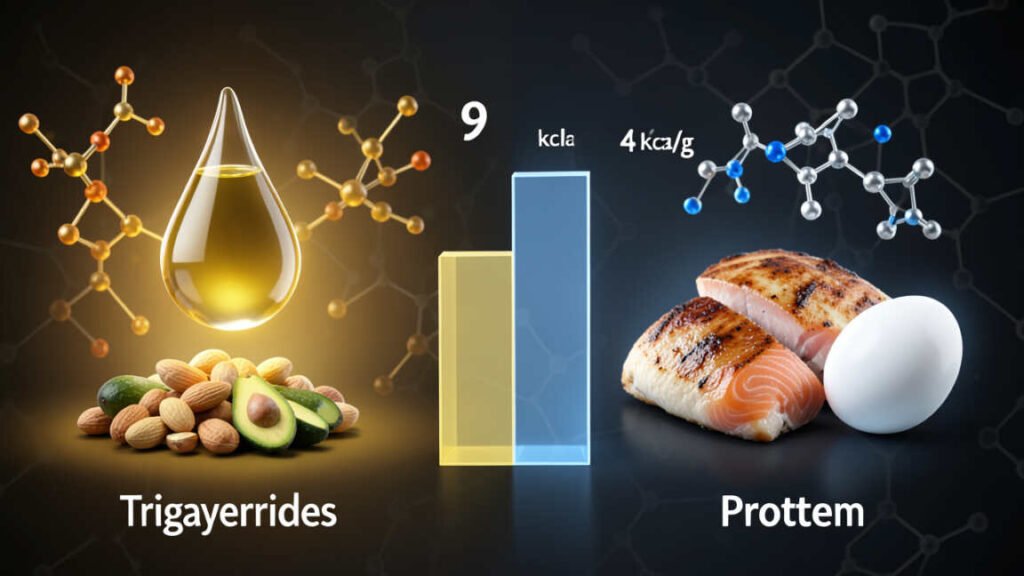
Fat contains more calories per gram than protein because its molecular structure consists primarily of energy-rich carbon and hydrogen bonds with very little oxygen. According to the 9-4-4 rule used in nutrition labeling, this results in fat providing about 9 calories per gram, while protein and carbohydrates provide about 4. Consequently, understanding this density is crucial for practical nutrition, as it means portion control is especially important for high-fat foods like oils, nuts, and fatty meats.
Fat contains more calories per gram than protein or carbohydrates because of its unique chemical structure and how your body converts it into energy. Fat delivers about 9 calories per gram, while protein and carbs deliver only about 4. This guide breaks down the science behind that difference and shows you why it matters for real-world nutrition.
You will learn how calories are measured, why fat is so energy-dense, and how to use this knowledge for better portion control, weight management, and smarter food choices.
Simply put, fat delivers about 9 calories per gram, while protein and carbohydrates deliver about 4. Fat molecules are packed with carbon-hydrogen bonds and very little oxygen, which releases more energy when oxidized. That chemical structure makes fat the most calorie-dense of the three macronutrients.
Key Takeaways
- Fat contains more calories per gram because its molecules are mostly energy-rich carbon-hydrogen bonds with minimal oxygen.
- The 9-4-4 rule is the basis for nutrition labels: 9 calories per gram of fat, 4 for protein, and 4 for carbs.
- Because fat has more calories per gram, portion size matters most with oils, nuts, butter, cheese, and fatty meats.
- Protein burns 20 to 30 percent of its calories during digestion, while fat burns almost none, which changes your net calorie intake.
- You do not need to eliminate fat. You need to balance it with the right portions and food choices.

What Are Calories and How Do We Measure Them?
A calorie is a unit of energy. On food labels, the number you see is actually kilocalories, or kcal. One kilocalorie is the energy needed to raise the temperature of 1 kilogram of water by 1 degree Celsius.
Your body spends those calories on everything from breathing to running.
Scientists first measured food energy with a bomb calorimeter. This device burns a food sample in a sealed chamber filled with pure oxygen and measures the heat released. That number represents the total energy in the food, but your body does not extract every last calorie during digestion.
That is why nutrition researchers developed the Atwater system, named after American chemist Wilbur O. Atwater. The system assigns average energy values to macronutrients based on how well humans digest and absorb them.
Those values still shape food labels today.
- A bomb calorimeter measures total heat, not usable energy.
- The Atwater system assigns 4, 4, and 9 calories per gram to protein, carbs, and fat.
- Fiber counts as about 2 calories per gram because your gut ferments a small portion.
- According to the FDA, food labels can be off by up to 20 percent because they use average values.
- Alcohol is measured separately at 7 calories per gram.
The table below shows the standard energy values used in the Atwater system.
| Macronutrient | Calories Per Gram | Primary Role |
|---|---|---|
| Fat | 9 | Energy storage, hormones, cell structure |