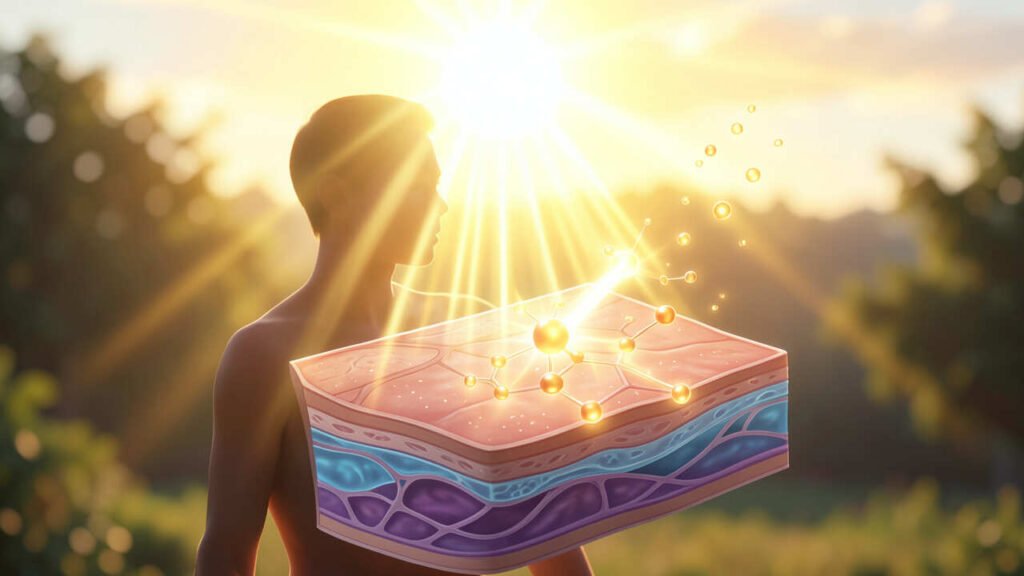
The human body makes vitamin D from sunlight through a chemical reaction in the skin triggered by ultraviolet B (UVB) radiation. This process converts a cholesterol derivative into pre-vitamin D3, which is then metabolized by the liver and kidneys into its active form essential for bone and immune health. Your production is self-regulating and can be significantly limited by factors like sunscreen use, glass, clothing, and higher skin melanin levels.
How does the human body make vitamin D from sunlight is a fascinating process involving a simple chemical reaction in your skin. This vital nutrient is crucial for bone health, immune function, and overall well-being, and understanding its creation helps you optimize your exposure. You don’t need to overthink it, but knowing the basics can help you maintain healthy levels year-round.
Simply put, your skin uses ultraviolet B (UVB) radiation from sunlight to convert a cholesterol precursor into pre-vitamin D3. Your body then automatically processes this into active vitamin D through your liver and kidneys.
Key Takeaways
- Your skin produces vitamin D when exposed to UVB rays from the sun, which triggers a chemical conversion.
- The process is self-regulating; your body will not produce excessive vitamin D from sunlight alone.
- Sunscreen, glass, and higher skin melanin can all reduce the skin’s ability to make vitamin D from sunlight.
- Dietary sources and supplements are important alternatives, especially in regions with limited sun.
Vitamin D is technically a hormone that your body can manufacture on its own. Often called the “sunshine vitamin,” its synthesis is a straightforward example of how your body interacts with the environment. This article will break down each step of the process, from the moment sunlight hits your skin to the nutrient becoming active in your bloodstream.
What Is the Biological Pathway for Vitamin D Production?
The creation of vitamin D is a multi-step biochemical pathway. It begins in the outer layers of your skin and ends in the kidneys. Think of it as a three-stage assembly line where each organ plays a specific role in activating the vitamin.
The first stage happens entirely in your skin. The second occurs in the liver, and the third final activation takes place in the kidneys. This system ensures that your body can precisely control how much active vitamin D is available.
- Stage 1 – Skin Synthesis: A form of cholesterol called 7-dehydrocholesterol (7-DHC) is present in skin cell membranes.
- Stage 2 – Liver Processing: The pre-vitamin D travels to the liver, where it is converted into calcidiol (25-hydroxyvitamin D).
- Stage 3 – Kidney Activation: Calcidiol is sent to the kidneys, where it is transformed into calcitriol (1,25-dihydroxyvitamin D), the active hormone form.
| Stage | Location | Product | Function |
|---|---|---|---|
| 1 | Epidermis (Skin) | Pre-vitamin D3 | Initial photochemical product |
| 2 | Liver | Calcidiol | Storage and transport form |
| 3 | Kidneys | Calcitriol | Active hormone form |
This regulated pathway prevents toxicity. Your body has built-in safety mechanisms that stop vitamin D production in the skin once sufficient levels are reached. You cannot overdose on vitamin D from sunlight alone.
How Does UVB Radiation Trigger the Chemical Reaction?
The specific trigger for vitamin D synthesis is ultraviolet B (UVB) radiation. UVB rays have the correct wavelength (290-315 nanometers) to break the chemical bonds in 7-dehydrocholesterol. This bond-breaking is a photochemical reaction, meaning it is initiated by light energy.
When a UVB photon strikes a 7-DHC molecule in your skin, it opens a specific ring structure in the cholesterol molecule. This rearranges the atoms to form a new compound called pre-vitamin D3. This entire process happens in mere seconds of effective exposure.
The angle of the sun determines UVB availability. During winter months at higher latitudes, the sun is too low in the sky, and the UVB rays are filtered out by the thicker atmosphere. This is why many people in northern regions cannot produce vitamin D from the sun during winter.
- Photon Contact: A UVB photon hits the 7-DHC molecule in the skin’s cell membrane.
- Energy Absorption: The molecule absorbs the photon’s energy.
- Bond Breaking: This energy breaks a specific bond in the 7-DHC’s steroid ring structure.
- Isomerization: The molecule rearranges itself into the new structure of pre-vitamin D3.
- Thermal Conversion: Over hours, body heat slowly converts most pre-vitamin D3 into stable vitamin D3 (cholecalciferol).
Important: UVA rays, which are more prevalent and penetrate deeper into the skin, do not trigger vitamin D production. They are primarily associated with skin aging and damage.
Your skin’s ability to absorb UVB depends on several factors, including time of day, season, location, and cloud cover. The “shadow rule” is a simple guide: if your shadow is shorter than you are, the UVB index is high enough for vitamin D synthesis.
What Factors Can Limit Your Skin’s Ability to Produce Vitamin D?
Several external and internal factors can significantly reduce or block the skin’s production of vitamin D. Understanding these barriers is key to managing your levels, especially if you live in a less sunny climate or have specific lifestyle habits.
The most common factor is inadequate sun exposure. Many people spend their time indoors or wear extensive clothing that covers most of their skin. Even when outside, they may use sunscreen, which is essential for skin cancer prevention but also blocks UVB rays.
- Sunscreen Use: An SPF of 30 or higher can reduce vitamin D synthesis by more than 95%.
- Age: Older adults have lower concentrations of 7-DHC in their skin, reducing production capacity.
- Skin Pigmentation: Melanin acts as a natural sunscreen. Darker skin requires 3-5 times more sun exposure to produce the same amount of vitamin D as lighter skin.
- Geographic Latitude: North of 37°N latitude (e.g., north of San Francisco, Philadelphia, or Athens), UVB rays are too weak from November to February.
- Time of Day: Synthesis is most efficient between 10 a.m. and 3 p.m. when the sun is at its peak.
- Clothing Coverage: Covering skin with fabric completely blocks UVB penetration.
- Glass and Windows: Standard glass blocks almost all UVB rays. Sitting in a sunny window does not help you make vitamin D.
Warning: Relying on sun exposure for vitamin D carries risks. Unprotected sun exposure increases the risk of skin cancer and accelerates skin aging. Balance is crucial.
Health conditions can also play a role. Obesity traps vitamin D in fat cells, making it less available for use. Diseases that affect fat absorption, like Crohn’s or celiac disease, can impair the absorption of dietary vitamin D.
Certain liver and kidney diseases can disrupt the later stages of vitamin D activation.
Why Is This Sunlight-Triggered Vitamin D Considered So Important?
The vitamin D your body produces from sunlight is not just for bone health. It acts more like a hormone, with receptors found in nearly every cell of your body. It plays a critical role in systems far beyond calcium absorption.
Adequate levels are essential for immune function, mood regulation, muscle strength, and cardiovascular health. Low vitamin D is linked to increased risk of autoimmune diseases, depression, and frequent infections. Its production is a fundamental part of human biology.
| System | Role of Active Vitamin D | Consequence of Deficiency |
|---|---|---|
| Skeletal System | Enhances calcium and phosphorus absorption in the gut. | Rickets (children), osteomalacia/osteoporosis (adults). |
| Immune System | Modulates innate and adaptive immune responses. | Increased susceptibility to infections, autoimmune issues. |
| Muscular System | Supports muscle function and strength. | Weakness, increased risk of falls in the elderly. |
| Cardiovascular System | May help regulate blood pressure and inflammation. | Potential increased risk of hypertension and heart disease. |
According to the National Institutes of Health, approximately 42% of American adults are vitamin D deficient. The Endocrine Society defines deficiency as a blood level below 20 ng/mL and insufficiency as 21-29 ng/mL. Many experts argue these thresholds are too low and that optimal levels may be above 30 ng/mL.
What Are the Best Dietary Sources to Complement Sun Exposure?
While sunlight is a primary source, few foods naturally contain significant amounts of vitamin D. This makes a two-pronged approach of sensible sun exposure and dietary awareness important for many people.
Fatty fish is the richest natural dietary source. Fortified foods, like milk, orange juice, and cereals, are added with vitamin D2 or D3 to boost population intake. Supplementation is often necessary, especially for those with limited sun access or absorption issues.
- Fatty Fish (D3): Salmon, mackerel, herring, sardines, tuna. A 3.5 oz serving of salmon can provide 500-1000 IU.
- Fortified Foods (D2 or D3): Milk, plant milks, yogurt, orange juice, breakfast cereals. Check labels for specific amounts.
- Egg Yolks (D3): Contain small amounts, about 40 IU per yolk. Amount depends on the hen’s feed.
- Beef Liver (D3): Provides modest amounts, around 42 IU per 3.5 oz serving.
- Cod Liver Oil (D3): Very high in vitamin D (over 1000 IU per tablespoon), but also very high in vitamin A, so caution is needed.
- Mushrooms (D2): Some mushrooms, especially those exposed to UV light, contain vitamin D2. The amount varies widely.
It’s important to note the two main dietary forms: D2 (ergocalciferol) and D3 (cholecalciferol). D3 is the same form your body makes from sunlight and is generally considered more effective at raising blood levels of vitamin D.
How Can You Safely Optimize Your Vitamin D Levels?
The goal is to maintain sufficient blood levels without increasing skin cancer risk. This requires a balanced strategy that combines limited, unprotected sun exposure with diet and possibly supplementation.
Many health organizations now recommend “sensible sun exposure” for vitamin D. This means short, unprotected periods of sun exposure on bare skin, several times a week, outside of peak burning hours. For most people, this can be as little as 10-30 minutes around midday, depending on skin tone and location.
- Assess Your Risk Factors: Consider your skin tone, age, location, and daily routine.
- Practice Short, Unprotected Exposure: Expose arms and legs to midday sun for a time that is less than the time it takes for your skin to turn pink (10-30 mins). Do this a few times a week.
- Never Burn: Sunburn indicates DNA damage and significantly increases skin cancer risk. Protect your skin before it turns pink.
- Use Diet and Supplements Wisely: Include vitamin D-rich foods and consider a supplement (D3 is preferred), especially in winter or if you have limited sun access.
- Get Your Levels Tested: A simple 25-hydroxy vitamin D blood test can tell you if you’re deficient, sufficient, or optimal.
- Genetic Variation: Researchers are studying how genetic differences affect an individual’s ability to produce and metabolize vitamin D.
- UV Exposure and Other Benefits: Sunlight also triggers the release of nitric oxide from the skin, which can help lower blood pressure. This may be an independent benefit of sun exposure.
- Seasonal Affective Disorder (SAD): While not directly related to vitamin D, bright light exposure is a known treatment for SAD, highlighting the broader health benefits of sunlight.
- Gut Microbiome: Emerging research explores how vitamin D might influence the composition and health of gut bacteria.
Tip: A UV index of 3 or higher is typically sufficient for vitamin D synthesis. You can check this index daily in weather forecasts or apps.
The American Academy of Dermatology advises getting vitamin D from diet and supplements, not unprotected sun exposure, due to skin cancer risks. However, many researchers argue that the benefits of moderate, smart sun exposure for vitamin D synthesis outweigh the risks for most people. The key is to avoid burning entirely.
What Does the Latest Research Say About Sunlight and Vitamin D?
Research continues to evolve, refining our understanding of the ideal blood levels, the risks and benefits of sun exposure, and the role of vitamin D in chronic disease. There is ongoing debate between dermatological and endocrinological perspectives.
Recent studies are exploring the non-bone benefits of vitamin D in greater detail. Researchers are investigating links between vitamin D status and outcomes in conditions like multiple sclerosis, diabetes, certain cancers, and severe respiratory infections. The results are promising but not yet conclusive enough for universal supplementation guidelines.
One key area of research is the concept of “vitamin D adequacy.” While deficiency is clear, what constitutes optimal levels is still debated. Some studies suggest benefits continue to rise until blood levels reach 50 ng/mL, while others see a plateau around 30 ng/mL.
The consensus remains that maintaining a healthy vitamin D status is important for overall health. The method to achieve it should be personalized, considering individual risk factors for skin cancer versus the health risks of deficiency.
Frequently Asked Questions
How long do I need to be in the sun to make vitamin D?
It depends on your skin tone, the time of day, season, and geographic location. For fair-skinned individuals, 10-15 minutes of midday sun exposure on bare arms and legs a few times a week may be sufficient. Those with darker skin may need 30-60 minutes.
A good rule is to stay in the sun for half the time it takes for your skin to turn the slightest pink.
Can I get enough vitamin D from food alone?
It is very difficult for most people to get adequate vitamin D from food alone. Natural food sources are limited, and even fortified foods may not provide enough to maintain optimal blood levels without consistent, mindful consumption. Supplementation is often recommended, especially for those with limited sun exposure.
Does sunscreen completely block vitamin D production?
Yes, sunscreen with an SPF of 30 or higher reduces the skin’s production of vitamin D by approximately 95-99%. This is why some experts recommend short, unprotected sun exposure before applying sunscreen. However, protecting your skin from DNA damage and cancer should always be the top priority.
Are vitamin D2 and vitamin D3 supplements the same?
No, they are different forms. Vitamin D3 (cholecalciferol) is the same form your body makes from sunlight and is more effective at raising blood levels of vitamin D. Vitamin D2 (ergocalciferol) is plant-derived and is not as well utilized by the human body.
Most health professionals recommend D3 supplements.
Is it possible to have too much vitamin D from sunlight?
No, it is not possible to overdose on vitamin D from sunlight alone. Your body has a natural feedback mechanism that stops producing vitamin D in the skin once levels are sufficient. Toxicity can only occur from excessive intake of high-dose supplements, not from sun exposure or diet.
Final Thoughts
Understanding how the human body makes vitamin D from sunlight reveals an elegant biological process that connects us directly to our environment. Your skin harnesses UVB rays to initiate a vital chemical transformation, a process fine-tuned over millennia. While this natural synthesis is efficient, modern life often limits it, making dietary awareness and testing valuable tools.