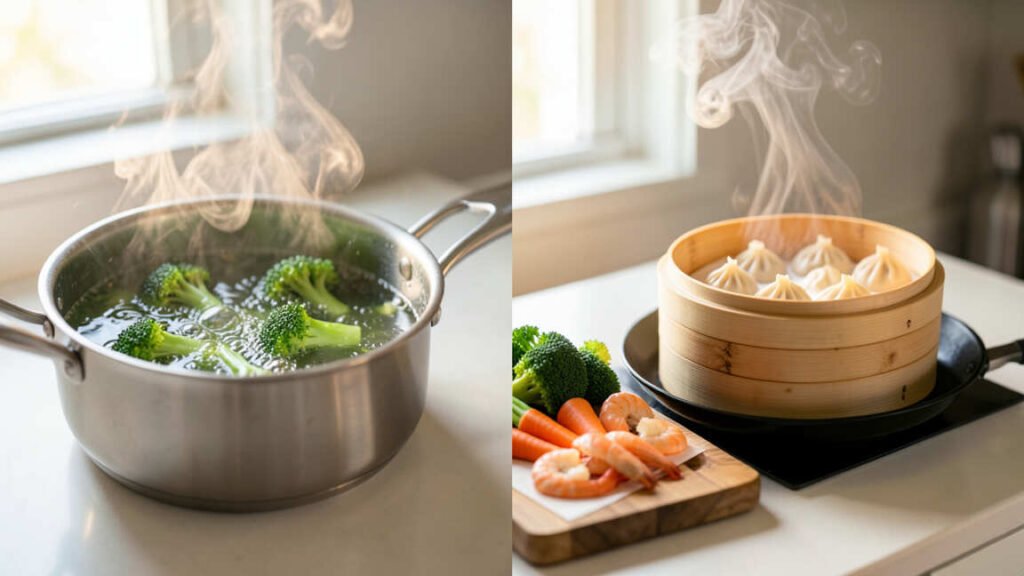
Steaming and boiling affect food differently primarily in nutrient retention and texture, with steaming preserving more heat-sensitive vitamins and boiling often leaching nutrients into the water. Steaming cooks food with indirect heat, resulting in a lighter, more delicate texture and better preservation of color and flavor in many vegetables. Boiling uses direct immersion, which can be faster for starchy foods but may lead to a softer texture and significant loss of water-soluble vitamins like C and B-complex, making steaming the preferred method for maximizing nutritional value.
Steaming vs boiling is one of the most common debates in home kitchens and professional restaurants alike. Both methods use water as the primary cooking medium, yet they produce noticeably different results in taste, texture, and nutrition.
Understanding the differences between these two techniques can transform the way you prepare meals. Whether you are trying to preserve vitamins in your vegetables or achieve the perfect texture in proteins, choosing the right method matters more than most people realize.
Simply put, steaming cooks food with indirect heat from water vapor, preserving more nutrients and producing lighter textures. Boiling submerges food directly in hot water, which is faster for some tasks but can leach out water-soluble vitamins and alter texture more aggressively. Your choice depends on the food type and your nutrition goals.
Key Takeaways
- Steaming vs boiling produces different outcomes in nutrient retention, with steaming preserving significantly more vitamins and minerals.
- Boiling is faster for cooking large quantities of starchy foods like pasta and potatoes, while steaming excels for delicate vegetables and fish.
- Water-soluble vitamins like vitamin C and B-complex are highly vulnerable to boiling, with losses ranging from 30% to over 50%.
- Steaming maintains the natural color, flavor, and crunch of vegetables far better than boiling.
- Both methods have ideal use cases – knowing when to use each one is the key to better cooking.
What Is Steaming and How Does It Work?
Steaming is a moist-heat cooking method that uses the vapor from boiling water to cook food. The food sits above the water level in a steamer basket, perforated insert, or makeshift setup using a colander inside a pot. The rising steam surrounds the food and transfers heat gently and evenly.
Because the food never touches the boiling water directly, steaming is considered one of the gentlest cooking methods available. The temperature stays around 212°F (100°C), and the cooking environment is consistently humid without being submerged.
According to the Harvard T.H. Chan School of Public Health, steaming is one of the best methods for retaining water-soluble vitamins in vegetables. This is because the food is not exposed to a large volume of water that would otherwise dissolve and carry away nutrients.
Common Steaming Equipment
- Bamboo steamer baskets – traditional and lightweight, great for Asian cooking
- Stainless steel steamer inserts – fit inside standard pots with a snug lid
- Electric steamers – plug-and-play devices with timers and multiple tiers
- Microwave steaming bags – quick and convenient for single servings
- Improvised setups – a colander or metal sieve placed over a pot of simmering water
Steaming works best when the pot is properly sealed. A tight-fitting lid traps the steam inside, creating a consistent cooking environment. If steam escapes freely, cooking times increase and results become uneven.
What Is Boiling and How Does It Work?
Boiling is a moist-heat cooking method where food is completely submerged in water heated to its boiling point of 212°F (100°C) at sea level. The rolling, turbulent movement of the water transfers heat directly to the food from all sides simultaneously.
Boiling is one of the oldest and most straightforward cooking techniques. It requires nothing more than a pot, water, and a heat source. From cooking pasta to preparing stocks, boiling serves as the foundation for countless recipes across every cuisine.
The key difference between boiling and other water-based methods like simmering lies in intensity. A full boil produces large, vigorous bubbles throughout the liquid, while simmering maintains smaller, gentler bubbles at around 185-205°F (85-96°C).
Types of Boiling
| Type | Temperature | Best For |
|---|---|---|
| Rapid Boil | 212°F (100°C) | Pasta, potatoes, corn on the cob |
| Gentle Simmer | 185-205°F (85-96°C) | Eggs, delicate fish, vegetables |
| Poaching | 160-180°F (71-82°C) | Eggs, chicken breast, fruit |
Boiling is the preferred method when you need rapid, even heat distribution. It is especially useful for foods that benefit from being surrounded by water, such as dried beans, grains, and pasta that need to absorb moisture as they cook.
Warning: Do not discard the water you used to boil vegetables. It contains leached nutrients and can be reused as a base for soups, stocks, or sauces to recapture some of those lost vitamins and minerals.
How Steaming and Boiling Affect Nutrients Differently
This is where the steaming vs boiling debate gets most interesting. Nutrient retention is one of the biggest factors that separates these two cooking methods. Water-soluble vitamins, in particular, are highly sensitive to how food is cooked.
Vitamin C, thiamine (B1), riboflavin (B2), and folate are all water-soluble vitamins that dissolve readily when exposed to large volumes of hot water. When you boil vegetables, these nutrients leach out of the food and into the cooking liquid. If you drain and discard that water, you lose a significant portion of the nutrition.
A study published in the Journal of Food Science found that boiling broccoli resulted in a loss of approximately 55% of its vitamin C content, while steaming the same broccoli retained nearly 90% of its vitamin C. That is a dramatic difference from a simple change in cooking technique.
Nutrient Retention: Steaming vs Boiling
| Nutrient | Steaming Retention | Boiling Retention | Difference |
|---|---|---|---|
| Vitamin C | 80-90% | 45-55% | +35-40% |
| Vitamin B (Thiamine) | 85-90% | 55-65% | +25-30% |
| Folate | 80-85% | 50-60% | +25-35% |
| Potassium | 75-85% | 40-50% | +35-40% |
| Fat-Soluble Vitamins (A, D, E, K) | 90-95% | 80-90% | +5-10% |
Fat-soluble vitamins like A, D, E, and K are more stable during both methods because they do not dissolve in water. However, even these nutrients show slightly better retention with steaming due to the shorter exposure to heat and the absence of submersion.
Tip: If you do boil vegetables, save the cooking water and use it in soups, gravies, or rice. You can recover many of the leached nutrients this way, turning a potential loss into added flavor and nutrition.
How Do Steaming and Boiling Affect Texture and Flavor?
Texture and flavor are where steaming and boiling diverge in ways that go beyond nutrition. The way heat is applied to food changes the structure of proteins, starches, and cell walls, and these changes manifest as the mouthfeel and taste you experience.
Steaming applies heat gently and gradually. The food retains more of its natural structure because it is not being jostled around by turbulent water. This means steamed vegetables tend to stay firmer, crunchier, and more vibrant in color.
The natural sugars and flavors remain concentrated within the food rather than dispersing into cooking water.
Boiling, on the other hand, creates a more aggressive cooking environment. The constant movement of bubbling water can break down delicate cell structures in vegetables, leading to softer, sometimes mushy results. Starchy foods absorb water during boiling, which is desirable for pasta and potatoes but less ideal for crisp vegetables.
Texture Comparison by Food Type
- Broccoli: Steaming keeps florets bright green and crisp-tender. Boiling can turn them olive-green and mushy within minutes.
- Carrots: Steamed carrots retain a pleasant snap. Boiled carrots become softer and develop a more muted sweetness.
- Fish: Steamed fish stays moist and flakes gently. Boiled fish can fall apart and lose its delicate flavor to the water.
- Eggs: Boiled eggs are a staple, but steamed eggs produce a creamier, more uniform texture.
- Potatoes: Boiling excels here because the absorbed water creates the fluffy interior needed for mashing.
Flavor intensity is another important distinction. Steamed foods generally taste more like themselves because flavor compounds stay within the food. Boiled foods can taste diluted or bland unless seasoned water or broth is used.
This is why many recipes call for heavily salted boiling water – it seasons the food from the outside in as it cooks.
According to culinary research from the Culinary Institute of America, chefs increasingly favor steaming for vegetable-forward dishes because it delivers cleaner, more pronounced flavors that require less added fat or seasoning.
Steaming vs Boiling: Which One Is Better?
Neither method is universally superior. The better choice depends on what you are cooking, what nutritional outcome you want, and what texture you prefer. Here is a practical breakdown to help you decide.
For health-conscious cooking where nutrient retention is the top priority, steaming wins almost every time. The data is clear: steaming preserves significantly more water-soluble vitamins and minerals. If you are preparing a salad, a side of vegetables, or any dish where the natural quality of the ingredient should shine through, steaming is the answer.
For convenience, speed, and certain food types, boiling has clear advantages. You cannot boil pasta in a steamer. You cannot make a proper stock without submerging bones and aromatics in water.
Boiling is also more practical when cooking for large groups because you can cook more food at once in a large pot.
When to Choose Steaming
- You are cooking delicate vegetables like broccoli, asparagus, or spinach
- You want to preserve maximum vitamin and mineral content
- You prefer crisp-tender textures and bright colors
- You are preparing fish, dumplings, or other delicate proteins
- You want to avoid adding extra fat or calories to the dish
When to Choose Boiling
- You are cooking pasta, rice, grains, or dried beans
- You need to cook large quantities quickly
- You are making soups, stews, or stocks that require submersion
- You want to soften root vegetables for mashing or pureeing
- You are making hard-boiled eggs or blanching for freezing
Important: Blanching – briefly boiling then plunging food into ice water – is a hybrid technique that combines boiling with rapid cooling. It locks in color and texture before freezing or using in salads, but it still causes some nutrient loss.
What Are the Common Mistakes When Steaming or Boiling?
Even simple cooking methods can go wrong. Here are the most frequent errors people make with steaming and boiling, along with how to avoid them.
Overcooking is the number one mistake with both methods. Vegetables that go just one minute too long become mushy, lose their color, and suffer additional nutrient degradation. Setting a timer and checking food a minute before the recommended cook time is a simple habit that makes a big difference.
Steaming Mistakes
- Using too little water: The pot can boil dry, scorching food and ruining your steamer. Always start with enough water to last the entire cooking time.
- Not preheating the steamer: Place food in after the water is already producing steam. This ensures even cooking from the start.
- Overcrowding the basket: Steam needs to circulate around each piece. Leave space between items for the best results.
- Lifting the lid too often: Every time you peek, you release valuable steam and extend cooking time.
- Using the wrong cut size: Pieces that are too large take forever to cook through. Cut vegetables into uniform sizes for even results.
Boiling Mistakes
- Crowding the pot: Too much food lowers the water temperature and leads to uneven cooking. Cook in batches if needed.
- Salted water too late: Season the water before it boils and before adding food. This allows proper absorption.
- Using high heat unnecessarily: Once water reaches a boil, reduce to a simmer. Continuous rapid boiling wastes energy and breaks up delicate foods.
- Reusing starchy water without care: Pasta water is great for sauces, but bean cooking water can cause digestive issues if reused improperly.
- Not drying food after boiling: Wet vegetables do not brown or crisp. Pat them dry if you plan to roast or saute after boiling.
Warning: Never leave a pot boiling unattended, especially with a small amount of water. It can evaporate completely and damage your cooktop or create a fire hazard.
How to Get the Best Results From Steaming
Getting great results from steaming comes down to a few key principles. Follow these guidelines and your steamed dishes will be consistently excellent.
First, always bring the water to a full boil before adding food. The steam should be actively rising and visible before your ingredients go into the basket. This ensures the food starts cooking immediately at the correct temperature rather than slowly warming up as the water heats.
Second, cut your food into uniform sizes. This is not just a recommendation – it is essential. Pieces of different thicknesses will cook at different rates, leaving you with some that are underdone and others that are overcooked.
Aim for pieces that are roughly the same size and thickness.
Third, do not overfill the steamer. Air and steam need to circulate freely around every piece of food for even cooking. A single layer with small gaps between pieces is ideal.
If you are cooking a large batch, work in rounds.
Steaming Times for Common Foods
| Food | Cut/Preparation | Steam Time | Doneness Indicator |
|---|---|---|---|
| Broccoli florets | 1-inch pieces | 4-5 minutes | Bright green, fork-tender |
| Carrots | Diagonal slices | 5-7 minutes | Pierce with fork easily |
| Asparagus | Trimmed spears | 3-5 minutes | Crisp-tender, vibrant green |
| Fish fillets | 4-6 oz portions | 8-10 minutes | Flakes with a fork |
| Dumplings | Frozen or fresh | 8-12 minutes | Translucent wrapper, hot center |
| Spinach | Whole leaves | 2-3 minutes | Wilted and dark green |
Fourth, season after cooking. Steamed food absorbs seasoning better after it has been cooked. A light drizzle of olive oil, a squeeze of lemon, or a sprinkle of salt and pepper immediately after removing from the steamer makes a noticeable difference.
How Does Boiling Remain Useful in Modern Kitchens?
Despite steaming’s nutritional advantages, boiling remains an indispensable technique. It is the foundation of countless essential cooking processes that simply cannot be replicated by any other method.
Boiling is the only practical way to cook dried pasta, which requires full submersion and ample water to prevent sticking. Grains like rice and quinoa are typically started in boiling water to kick off the cooking process. Dried beans and legumes need to be submerged for hours to rehydrate and soften properly.
Beyond direct cooking, boiling serves critical roles in food preparation and preservation. Blanching vegetables before freezing preserves their color, texture, and nutritional value during long-term storage. Making stocks and broths requires simmering bones, vegetables, and aromatics in water for hours to extract flavor and collagen.
Essential Boiling Applications
- Pasta cooking: Requires 4-6 quarts of rapidly boiling salted water per pound of pasta for proper starch hydration and preventing sticking
- Potato preparation: Boiling whole or diced potatoes is the standard first step for mashing, potato salad, and gnocchi
- Stock and broth making: Bones, vegetables, and herbs are simmered for 4-24 hours to extract flavor compounds and gelatin
- Blanching for freezing: Brief boiling followed by an ice bath preserves vegetables for up to 12 months in the freezer
- Egg cookery: Hard-boiled and soft-boiled eggs are cooked entirely by boiling water immersion
- Grain cooking: Rice, quinoa, barley, and oats are typically brought to a boil then reduced to a simmer
The key to successful boiling in a modern kitchen is understanding temperature control. Not every boiled dish requires a rolling boil. Many foods benefit from a gentler simmer after the initial boil, which reduces agitation while maintaining the cooking temperature.
Water quality also matters more in boiling than in steaming. Hard water with high mineral content can affect the taste and color of food, particularly beans and legumes which may stay tough in very hard water. Using filtered or softened water can improve results.
Can You Combine Steaming and Boiling for Better Results?
Absolutely. Many professional cooks use a two-step approach that combines both methods to get the best of each. This technique is particularly common in Asian cuisines and in restaurant kitchens where consistency and quality are paramount.
One popular approach is to par-boil dense root vegetables before finishing them by steaming or roasting. This reduces the total cooking time while allowing the final stage to develop flavor and texture. For example, par-boiling potatoes for five minutes before roasting creates a fluffier interior and crispier exterior.
Another combination technique is steaming vegetables until they are almost done, then briefly tossing them in boiling salted water to season them. This gives you the nutritional benefits of steaming with the seasoning advantages of boiling in a single dish.
Popular Combination Techniques
- Par-boil then roast: Boil potatoes, carrots, or beets for 5-10 minutes, drain, then roast at high heat for crispy exteriors and creamy interiors
- Steam then sear: Steam vegetables until barely tender, then quickly sear in a hot pan for a caramelized finish without overcooking
- Blanch then ice bath: Boil briefly, then shock in ice water to stop cooking. Perfect for meal prep and freezing
- Boil pasta, steam sauce: While pasta boils, steam seafood or vegetables on a tier above for a complete one-pot meal
- Steam then boil in sauce: Steam dumplings first for shape, then transfer to a seasoned broth for soup
Tip: If you have a multi-tier steamer, you can boil soup on the bottom while steaming vegetables and fish on the upper tiers. This saves time and energy while cooking a complete meal simultaneously.
Frequently Asked Questions
Is steaming healthier than boiling?
Yes, steaming is generally healthier because it preserves more water-soluble vitamins like vitamin C, B vitamins, and folate. Steaming retains 80-90% of these nutrients, while boiling can reduce them by 30-50%. However, both methods are healthier than frying and both have valid uses depending on the food you are preparing.
Does boiling food remove all the nutrients?
No, boiling does not remove all nutrients. Fat-soluble vitamins (A, D, E, K) and minerals like iron and calcium are relatively stable during boiling. The main losses are water-soluble vitamins, and even those are only partially reduced.
Using the cooking liquid in soups or sauces can help you recover a significant portion of the lost nutrients.
Can you steam food without a steamer?
You can steam food without a dedicated steamer using several alternatives. Place a heat-safe colander or wire rack inside a pot with an inch of boiling water and cover tightly with a lid. You can also wrap food in foil with small holes punched in it, or use a microwave-safe container with a vented cover.
A small amount of water and a tight-fitting lid are the only requirements.
What foods are best boiled rather than steamed?
Pasta, rice, dried beans, and other grains require boiling because they need full submersion to cook properly. Potatoes intended for mashing are best boiled to absorb water and become fluffy. Eggs are traditionally hard-boiled.
Stocks and broths require submersion to extract flavor from bones and aromatics over extended cooking times.
Does boiling make food lose its flavor?
Boiling can dilute the natural flavors of some foods because flavor compounds leach into the cooking water. This is why heavily salting pasta water is important. Vegetables often taste more bland after boiling compared to steaming.
However, when the cooking liquid is incorporated into the final dish, as in soups and stews, the flavors are captured rather than lost.
Final Thoughts
Steaming vs boiling is not about finding a single winner. Both methods serve important roles in the kitchen, and the best cooks know when to reach for each one. Steaming excels at preserving nutrients, maintaining texture, and highlighting natural flavors in delicate foods.
Boiling remains essential for grains, pasta, stocks, and large-batch cooking.
The next time you prepare a meal, consider what matters most for that specific dish. If nutrition and flavor purity are your priorities, reach for the steamer. If convenience, speed, or a specific texture is what you need, the boiling pot is your tool.
Mastering both techniques gives you the flexibility to cook smarter, healthier, and more delicious food every day.