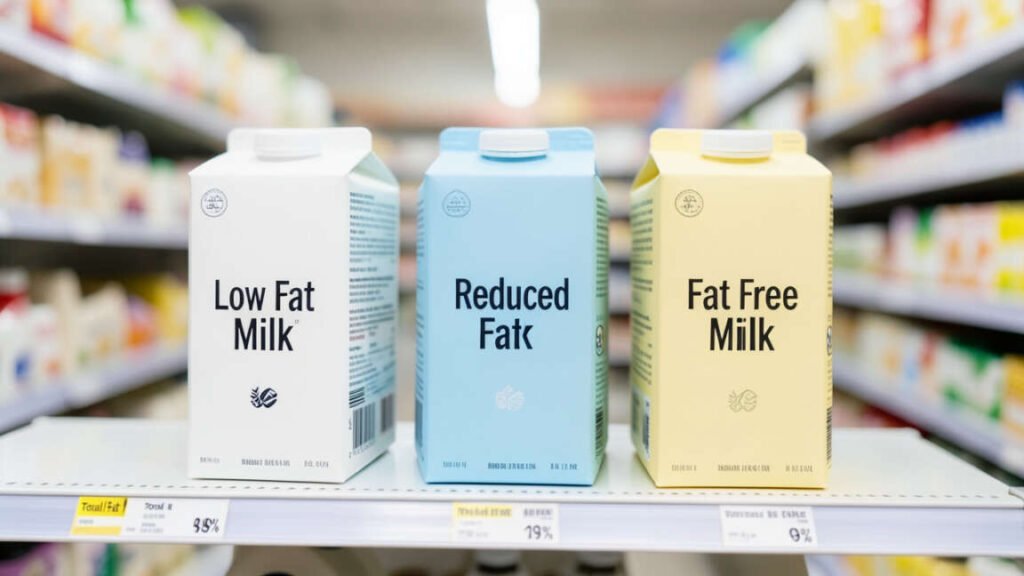
On food labels, "fat-free" indicates less than 0.5 grams of fat per serving, "low-fat" means 3 grams or less per serving, and "reduced-fat" signifies at least 25% less fat than the original product. These regulatory terms from the FDA are all based on the specific serving size listed on the nutrition facts panel, not the entire package. Understanding these definitions is essential for accurately comparing products and making informed dietary choices based on genuine nutritional content rather than marketing claims.
Seeing labels like “low fat,” “reduced fat,” and “fat free” on packaging can feel like a shortcut to healthier eating. These claims promise specific benefits, but understanding what they truly mean is crucial for making informed dietary choices. Decoding these terms helps you navigate the grocery store aisles with confidence, ensuring the food you pick aligns with your nutritional goals and avoids misleading marketing.
Simply put, “fat free” means less than 0.5g of fat per serving, “low fat” means 3g or less per serving, and “reduced fat” means at least 25% less fat than the original version. The key is checking the serving size and nutrition facts panel, as these claims refer specifically to a single serving.
Key Takeaways
- Fat free legally means the food contains less than 0.5 grams of fat per labeled serving, a significant reduction from its full-fat counterpart.
- Low fat indicates a maximum of 3 grams of fat per serving and no more than 1.5 grams of saturated fat.
- Reduced fat means the product has at least 25% less fat than its original version, but the total fat per serving could still be high.
- Always check the nutrition facts panel and serving size; front-of-package claims can be misleading without context.
- Lower fat often means higher sugar, sodium, or refined carbs to compensate for flavor and texture lost from fat removal.
What Is the FDA’s Role in Regulating Fat Claims?
The U.S. Food and Drug Administration (FDA) sets strict, legally binding definitions for nutrient content claims like those concerning fat. This regulation aims to prevent misleading marketing and provide consumers with reliable information.
Manufacturers cannot simply slap these terms on packaging; they must meet specific criteria and often require prior approval.
These rules standardize the meaning of terms across all food products. Whether you’re buying ice cream, salad dressing, or cheese, “low fat” should mean the same thing. This consistency is vital for consumer trust and fair competition among food producers.
Key Regulatory Bodies and Guidelines
- FDA (Food and Drug Administration): Primary regulator for most packaged foods sold in the United States. They define and enforce the rules for nutrient content claims.
- USDA (United States Department of Agriculture): Regulates claims on meat, poultry, and processed egg products. Their definitions generally align with the FDA’s.
- Code of Federal Regulations (CFR): Title 21, Part 101 contains the specific, detailed legal definitions for all authorized nutrient content claims.
- Pre-market Review: Some claims may require submission and approval before they can be used on a label to ensure compliance.
- Compliance Monitoring: The FDA routinely tests products and reviews labels to ensure manufacturers adhere to these regulations.
| Regulator | Jurisdiction | Primary Focus |
|---|---|---|
| FDA | Most packaged foods, dietary supplements | Defining and enforcing nutrient content claims like “low fat” and “fat free”. |
| USDA | Meat, poultry, processed egg products | Ensuring fat-related claims on regulated products meet established standards. |
| CFR Title 21 | All FDA-regulated products | Contains the exact legal text and numerical thresholds for each claim. |
This regulatory framework ensures that when you see a fat claim, it’s based on measurable criteria, not just a marketing tactic. However, the burden is still on you, the consumer, to look beyond the front label.
How Does “Fat Free” Really Work?
The “fat free” claim is the most definitive of the three terms. For a product to bear this label, the FDA mandates it must contain less than 0.5 grams of total fat per serving. This applies to both total fat and saturated fat.
Crucially, this threshold is per serving, not per package.
A food that is naturally low in fat, like a plain vegetable or fruit, might be labeled “fat free.” More commonly, it’s a product where fat has been intentionally removed or minimized during processing. This often involves the use of fat replacers or thickeners to maintain texture and mouthfeel.
Key Characteristics of Fat-Free Products
- Numerical Threshold: Must have less than 0.5 grams of total fat per labeled serving.
- Serving Size Dependency: A product can be “fat free” per serving but contain significant fat if you eat multiple servings.
- Common in Naturally Low-Fat Foods: Fresh fruits, vegetables, plain beans, and grains are often naturally fat-free.
- Processed Fat-Free Foods: Often use additives like maltodextrin, modified food starch, or gums to mimic the texture of fat.
- Calorie Impact: Fat is calorie-dense (9 calories per gram). Removing it can reduce calories, but sugar or refined carbs are often added to compensate.
Warning: “Fat free” does not mean calorie free or sugar free. Many fat-free products, especially snacks and desserts, are high in added sugars to replace the flavor and satisfaction lost from removing fat. Always check the entire nutrition label.
Understanding this distinction is vital. A fat-free cookie is still a cookie. The lack of fat doesn’t automatically make it a health food.
The nutritional profile is a balance of all components, not just one nutrient.
What Are the Rules for “Low Fat” Labels?
The “low fat” claim has a two-part definition set by the FDA. The product must contain 3 grams or less of total fat per serving. Additionally, it must meet a further condition: the fat content must not be more than 20% of the total calories in that serving.
This second rule helps ensure the fat content is proportionally low within the food’s overall energy makeup.
This claim is common on dairy products like milk and yogurt, as well as on processed snacks, canned soups, and prepared meals. It signals a significant reduction in fat compared to the standard version of the product but does not eliminate fat entirely.
Comparison: “Fat Free” vs. “Low Fat”
| Feature | Fat Free | Low Fat |
|---|---|---|
| Maximum Fat per Serving | < 0.5 grams | ≤ 3 grams |
| Calorie from Fat Limit | Not specified | Fat must be ≤ 20% of total calories per serving |
| Saturated Fat Limit | < 0.5 grams | ≤ 1 gram |
| Example Product | Fat-Free Greek Yogurt (plain) | Low-Fat (2%) Milk |
This table clarifies the specific numerical boundaries. “Low fat” allows for a small amount of fat, which can be important for nutrient absorption and satiety, whereas “fat free” aims for near-total elimination.
How Does “Reduced Fat” Differ from “Low Fat”?
“Reduced fat” is a comparative claim, not an absolute one. The FDA definition states that a “reduced fat” product must contain at least 25% less fat per serving than an appropriate reference food. This reference is typically the regular, full-fat version of the same product.
Importantly, it does not specify a maximum amount of fat.
This means a “reduced fat” item could still be relatively high in fat if the original version was very high in fat. For example, a full-fat salad dressing might have 15 grams of fat per serving. Its “reduced fat” version could have 11 grams (a 25% reduction) and still be labeled as such.
Why “Reduced Fat” Can Be Misleading
- Relative, Not Absolute: A 25% reduction from a very high-fat food can still result in a high-fat product. The claim doesn’t tell you the starting point.
- No Maximum Threshold: Unlike “low fat” (≤3g), there is no upper limit for “reduced fat” beyond the 25% reduction requirement.
- Comparison Dependency: The benefit is relative to a specific product. It doesn’t inherently make the food “healthy” or “low in fat.”
- Common in High-Fat Categories: Often used for items like chips, frozen desserts, and sauces where the base product is very rich in fat.
Important: Always ask yourself, “Reduced compared to what?” Check the brand’s own regular version if possible, or look at similar products to understand the baseline fat content.
The key takeaway is that “reduced fat” requires critical thinking about the reference product. It’s a marketing tool that highlights improvement over a specific baseline, not a universal health endorsement.
What Happens When Fat Is Removed from Food?
Fat plays several critical roles in food beyond nutrition. It provides flavor, carries aroma compounds, creates a desirable texture and mouthfeel (think creamy ice cream or a tender cake), and helps with browning during cooking. Removing fat, therefore, requires formulation adjustments to prevent a product from tasting bland, dry, or pasty.
Food manufacturers commonly use a variety of ingredients to compensate for the loss of fat. These include added sugars, refined carbohydrates, sodium, and various fat replacers or mimetics.
Common Fat Replacement Strategies
- Sugar and Refined Carbs: Often added to baked goods and sauces to restore sweetness and bulk. This can significantly increase calorie and carbohydrate content.
- Thickeners and Stabilizers: Ingredients like modified food starch, maltodextrin, cellulose gel, and gums (guar, xanthan) are used to mimic the creamy texture of fat.
- Protein Concentrates:
- Flavor Enhancers: Increased salt, artificial flavors, or spices may be used to boost taste that fat would have delivered.
- Emulsifiers: These help blend fat and water components in a product, creating a smoother consistency in reduced-fat versions.
This is why the “low fat” or “fat free” label on one part of the nutrition panel doesn’t tell the whole story. You must examine the ingredients list and the full Nutrition Facts to see what was added in place of the fat.
Why Are Serving Sizes So Important for Fat Claims?
All three fat-related claims—”fat free,” “low fat,” and “reduced fat”—are based on a specific, defined serving size. This is the single most critical piece of context on the nutrition label. A product can be “fat free” per serving but contain substantial fat if you consume multiple servings in one sitting.
Manufacturers determine the serving size, often based on what people typically eat in one sitting. However, these sizes can sometimes be unrealistically small, making the fat (and calorie, sugar, etc.) numbers appear lower than what people actually consume.
How to Handle Serving Sizes
- Locate the Serving Size: Always look at the top of the Nutrition Facts panel for the serving size (e.g., “1 cup,” “2 cookies,” “1 container”).
- Check Servings Per Container: Note how many servings are in the entire package. A small bag of chips might have 2.5 servings.
- Calculate Actual Intake: Multiply the fat grams (and calories) by the number of servings you actually eat. If you eat the whole small bag, that’s 2.5 times the listed numbers.
- Be Skeptical of “Single-Serve” Packages: Large muffins or drinks may be labeled as one serving, but they could contain 2-3 standard servings worth of nutrients.
| Scenario | Label Says (Per Serving) | Actual Consumption | Your Actual Fat Intake |
|---|---|---|---|
| Yogurt | Fat Free (0g fat), Serving size = 1 container | You eat the whole container | 0 grams |
| Cookies | Low Fat (1.5g fat), Serving size = 2 cookies | You eat 6 cookies (3 servings) | 4.5 grams |
| Ice Cream | Reduced Fat (5g fat), Serving size = 1/2 cup | You eat 1.5 cups (3 servings) | 15 grams |
This table illustrates how quickly fat intake can add up. The label’s claim is technically accurate for one serving, but your total intake depends entirely on how much you eat.
Are Lower-Fat Foods Always Healthier Choices?
Not necessarily. The push for low-fat products in past decades often led to formulations high in sugar, sodium, and refined carbohydrates to maintain palatability. A food labeled “low fat” can still be highly processed and nutritionally poor.
Health is determined by the overall nutritional profile, the quality of ingredients, and how the food fits into your overall diet.
Furthermore, not all dietary fat is harmful. Unsaturated fats from sources like avocados, nuts, seeds, and olive oil are essential components of a healthy diet. They support brain health, hormone production, and the absorption of fat-soluble vitamins (A, D, E, K).
Removing these beneficial fats can sometimes be counterproductive.
When Lower-Fat Options Can Be Beneficial
- For Reducing Saturated Fat Intake: Choosing “low fat” or “fat free” versions of dairy products like milk and yogurt can help reduce saturated fat, which is linked to heart health concerns when consumed in excess.
- For Calorie Management: Since fat is calorie-dense, lower-fat options can help reduce overall calorie intake, which is useful for weight management goals.
- For Medical Dietary Needs: Some medical conditions, like certain digestive disorders or pancreatitis, require a very low-fat diet. These labels help identify appropriate foods.
- When the Base Food is Very High in Unhealthy Fat: Opting for a “reduced fat” version of a typically very high-fat processed snack can be a better choice, though not necessarily a great one.
Tip: Focus on the overall quality of the food. A whole food like an apple or a handful of almonds, which contains natural fats, is often a healthier choice than a highly processed “fat free” snack cake.
The goal should be balanced nutrition, not the elimination of a single macronutrient. Reading the full nutrition facts and ingredient list is the best way to assess the true healthfulness of a product.
How Can You Make Informed Choices Using These Labels?
Navigating the grocery store with these labels requires a strategic approach. The front-of-package claim is just the starting point. Your decision-making process should involve a few key steps to look beyond the marketing and assess the actual nutritional value.
This process becomes second nature with practice. It empowers you to choose products that genuinely support your health goals rather than falling for potentially misleading claims.
A Step-by-Step Guide to Evaluating Fat Claims
- Start with the Front Label: Note the claim (“fat free,” “low fat,” etc.) and which product category it’s in.
- Turn to the Nutrition Facts Panel: Immediately locate the serving size and servings per container.
- Check the Total Fat Line: Verify that the product meets the legal definition for its claim. Is “low fat” really ≤3g per serving?
- Examine Saturated and Trans Fat: These are fats you generally want to limit. A “low fat” product could still be high in saturated fat.
- Scan the Ingredients List: Look for what might have replaced the fat. Is sugar, high-fructose corn syrup, or refined flour near the top? This is a red flag.
- Compare to Alternatives: Look at the full-fat version or other brands. Is the “reduced fat” version significantly better, or just marginally different?
- Consider the Whole Diet: Does this food fit into your overall daily intake of calories, fats, sugars, and nutrients? One “low fat” cookie doesn’t define a healthy diet.
By following this checklist, you transform a quick glance at a front label into a comprehensive evaluation of the product’s place in your diet.
Frequently Asked Questions
Does “fat free” mean the food has zero fat?
No. Legally, “fat free” means the food contains less than 0.5 grams of fat per labeled serving. Trace amounts are allowed and are common in many processed foods due to manufacturing processes or naturally occurring fats in ingredients.
Can a “low fat” food still be high in calories?
Absolutely. Calories come from fat, carbohydrates, and protein. A “low fat” product might be high in sugar or refined carbohydrates, which are also calorie sources.
For example, a low-fat granola bar or flavored yogurt can have a significant calorie count.
Is “reduced fat” healthier than “low fat”?
Not necessarily. “Reduced fat” is a relative claim (25% less than the original), while “low fat” is an absolute claim (3g or less per serving). A “reduced fat” product from a very high-fat original could still have more fat per serving than a “low fat” product.
You must check the nutrition facts to compare actual fat grams.
Why do fat-free cookies taste so sweet?
To compensate for the flavor and texture lost when fat is removed, manufacturers often add more sugar, refined flours, and artificial flavorings. Fat is a flavor carrier and provides mouthfeel; replacing it requires other ingredients, and sugar is the most common substitute in baked goods.
Do these fat claims apply to trans fat?
The “fat free” claim implies less than 0.5g of total fat, which would include trans fat. The “low fat” claim (≤3g total fat) doesn’t explicitly set a trans fat limit. However, the FDA has banned the use of partially hydrogenated oils (the primary artificial source of trans fat) in food, so naturally occurring or process-formed trans fats are minimal.
Always check the trans fat line on the label to be sure.
Final Thoughts
Understanding what low fat, reduced fat, and fat free mean empowers you to look beyond front-of-package marketing. These terms have strict legal definitions based on fat per serving, but they only tell part of the story. The most critical step is to always check the Nutrition Facts panel, paying close attention to serving size, the ingredients list, and the overall nutritional profile.
Remember, lower fat does not automatically equal healthier, as other components like sugar and sodium are often increased. Making truly informed choices involves looking at the food as a whole, not just its fat content.