The "no added sugar" label is a legally regulated claim indicating that no sugars or sugar-based ingredients were introduced to a product during manufacturing or packaging. However, the product may still contain significant naturally occurring sugars from ingredients like fruit or milk, which are counted in the total sugar content on the nutrition facts panel. For practical dietary management, consumers should always review the total sugars listed and understand this term differs fundamentally from "sugar-free" or "unsweetened" claims.
Understanding “no added sugar” labels is crucial for making informed dietary choices today. Many products claim this benefit, but the definition has strict legal parameters that might surprise you.
This guide breaks down exactly what the term means, how it’s regulated, and how to interpret it alongside other sugar-related claims on your grocery list.
Simply put, “no added sugar” means the product contains no sugars or sugar-based ingredients added during processing or packaging. It does not mean the product is sugar-free, as it can still contain naturally occurring sugars from ingredients like fruit or milk.
Key Takeaways
- No added sugar is a regulated claim meaning no sugars were introduced during manufacturing.
- The product can still be high in natural sugars from ingredients like fruit juice concentrate or milk.
- This label is different from “sugar-free,” “reduced sugar,” and “unsweetened.”
- Always check the nutrition label for total sugars, including naturally occurring ones.
- For people managing conditions like diabetes, “no added sugar” does not automatically mean the food is low-carb or low-glycemic.
What Does “No Added Sugar” Actually Mean?
The “no added sugar” claim is a nutrient content claim defined by the U.S. Food and Drug Administration (FDA). Its primary rule is straightforward: the product must not contain any added sugars or ingredients that are sources of added sugars.
Added sugars include table sugar (sucrose), syrups (like high-fructose corn syrup or maple syrup), honey, and concentrated fruit or vegetable juices. If a manufacturer adds any of these during processing, the product cannot legally carry the “no added sugar” label.
Key Legal Requirements for the Claim
- No added sugars of any kind: This includes sugars, syrups, honey, and concentrated fruit/vegetable juices.
- No ingredients that are sources of added sugars: If a recipe calls for apple juice to sweeten applesauce, it counts as an added sugar.
- Nutrition facts panel must show 0g “Added Sugars”: This is the definitive check on the label.
- Must specify what is not added: If the claim might be misleading (e.g., on fruit with a small amount of added sugar), it must clarify with phrasing like “no added sugar; not a low sugar food.”
- Processing aids: Sugars used as part of a processing aid that doesn’t remain in the final product may be exempt, but this is rare and complex.
- Natural sugars in fermentation: Sugars naturally occurring in ingredients like milk that convert to lactic acid during fermentation (like in yogurt) are not counted as added sugars.
- Fruit juice concentrates: These are always considered added sugars when used to sweeten, even though they come from fruit. This is a key rule from the updated Nutrition Facts label.
- Fiber content: A medium apple has about 4.4 grams of fiber. The same amount of sugar in juice is drunk quickly with no fiber to slow it down.
- Volume and satiety: Eating an apple is filling due to its volume and fiber. Drinking apple juice is not, making it easy to consume a large amount of sugar quickly.
- Nutrient density: Whole foods provide essential nutrients alongside their natural sugars. Added sugars are often called “empty calories” because they provide energy with no other nutritional benefit.
| Food Item Example | Can it say “No Added Sugar”? | Reason |
|---|---|---|
| Plain canned peaches | Yes | Contains only peaches and water. |
| Canned peaches in “juice from concentrate” | No | The juice concentrate is considered an added sugar. |
| Unsweetened applesauce | Yes | Made only with apples and maybe water/lemon juice. |
| Flavored applesauce with honey | No | Honey is an added sugar source. |
This table illustrates that the source of sweetness is the deciding factor. Natural sugars inherent to the main ingredient are fine, but any sweetener added during production disqualifies the claim.

How Is “No Added Sugar” Regulated?
The FDA and the USDA’s Food Safety and Inspection Service (FSIS) enforce the rules for this claim. The FDA regulates most packaged foods, while the FSIS handles meat, poultry, and certain egg products. Both agencies follow similar definitions.
The regulation exists to prevent manufacturers from misleading consumers. Without it, a company could add sugar to fruit juice and still call it “all-natural fruit juice.” The “no added sugar” rule ensures transparency in the ingredient list and nutrition facts panel.
What About Sugars in Processing?
A common point of confusion is whether sugars used in processing that are later removed still count. For example, if a food is cooked in a sugar syrup that is then drained off, the FDA considers the sugar an added ingredient. The small amount absorbed by the food still contributes to the “added sugars” total.
Warning: Some fruit products labeled “no added sugar” may use fruit juice concentrate to sweeten. Always check the ingredient list. If you see “apple juice concentrate” or similar, it is an added sugar, and the product should not legally carry the claim. If it does, it may be a labeling error.
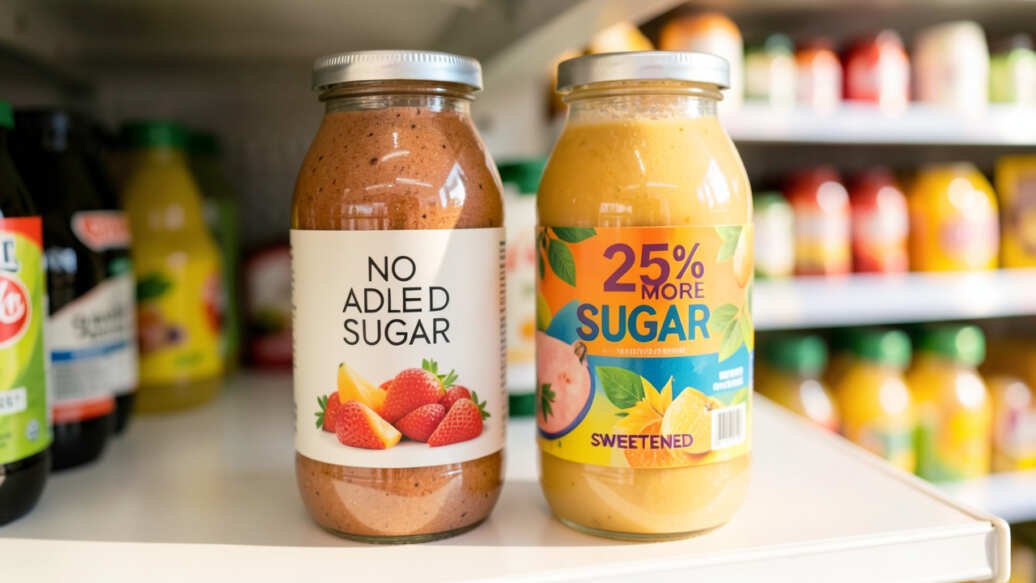
What Is the Difference Between “No Added Sugar” and Other Sugar Claims?
Food labels are filled with similar-sounding terms. Understanding the precise differences is key to making choices that align with your health goals. The FDA regulates all of these claims, and each has a specific definition.
Confusing them can lead to consuming more sugar than intended. A “reduced sugar” cookie, for example, might still have 28 grams of sugar per serving, just less than a standard version. “No added sugar” focuses only on the source, not the total amount.
Comparing Common Sugar-Related Claims
| Claim | FDA Definition | Key Consideration for You |
|---|---|---|
| No Added Sugar | No sugars or ingredients that are sources of added sugars added during processing. | Product may still be high in natural sugars. Check total sugars. |
| Sugar-Free | Less than 0.5g of sugar per serving. | Often contains sugar alcohols or non-nutritive sweeteners. Check for carbohydrates. |
| Reduced Sugar | At least 25% less sugar per serving than a reference food. | The original version may be very high in sugar. 25% less of a lot is still a lot. |
| Unsweetened | No sugar or sweetener added. (Commonly used voluntarily for juices, plant milks.) | Similar to “no added sugar” but is often a voluntary, unregulated term. Trustworthy when on labels for juices/milks. |
According to a 2022 report from the Environmental Working Group (EWG), misleading “natural” and sugar-related claims are a top concern for consumers. This underscores why reading beyond the front-of-package claim is essential.
Why Are Naturally Occurring Sugars Different from Added Sugars?
The body metabolizes glucose from a whole apple differently than glucose from table sugar added to applesauce. The difference lies in the food matrix—the combination of fiber, water, vitamins, and phytonutrients that slows digestion and sugar absorption.
Naturally occurring sugars in whole fruits and vegetables come packaged with fiber. Fiber creates a gel-like substance in your gut, which slows the emptying of the stomach and the absorption of sugar into the bloodstream. This leads to a more gradual rise in blood sugar.
The Role of the Food Matrix
The World Health Organization (WHO) recommends limiting “free sugars” to less than 10% of total energy intake. They define free sugars as both added sugars and sugars naturally present in honey, syrups, and fruit juices. Notably, sugars in whole fruits and milk are not considered free sugars.
Important: For individuals with diabetes or insulin resistance, even naturally occurring sugars must be counted towards carbohydrate intake. A product with “no added sugar” but made from fruit juice can still cause a significant blood sugar spike.
Who Benefits Most from the “No Added Sugar” Claim?
This label is most valuable for specific groups making targeted dietary changes. It simplifies grocery shopping by quickly filtering out products with sweeteners like high-fructose corn syrup, cane sugar, or honey.
Parents looking to reduce their children’s intake of added sugars find it helpful. People trying to lower their consumption of processed foods also benefit, as added sugars are a hallmark of ultra-processed items.
Benefits for Different Groups
- Parents and Caregivers: Quickly identifies yogurts, cereals, and snacks without hidden added sugars, helping reduce children’s excessive sugar intake from processed foods.
- Individuals Managing Weight: Helps eliminate a major source of empty calories, supporting a calorie-controlled diet. However, total calories still matter.
- Heart Health-Conscious Consumers: The American Heart Association recommends limiting added sugars to protect heart health. This claim helps identify compliant products.
- Anyone Reducing Processed Foods: Since added sugars are most common in processed foods, this label often points to simpler, more whole-food-based options.
- People with Certain Metabolic Conditions: Can be a starting point for identification, but they must still account for total carbohydrates from natural sugars.
A study published in the Journal of the Academy of Nutrition and Dietetics found that products making “no added sugar” claims are often perceived as healthier overall, which can lead to overconsumption. This is known as a “health halo” effect. The food might still be high in saturated fat, sodium, or total calories.
How to Make Smart Choices with “No Added Sugar” Products
Seeing “no added sugar” is a good first step, but it shouldn’t be the only factor in your decision. Use this claim as a starting point, then dig deeper into the nutrition label and ingredient list. This two-step process ensures you’re not falling for a health halo.
Focus on the total sugar content per serving, the serving size itself, and what other nutrients the food provides. A “no added sugar” granola bar might still have 20 grams of sugar from dried fruit and be very calorie-dense.
A Step-by-Step Label Check Process
- Verify the Claim: Look at the “Added Sugars” line on the Nutrition Facts panel. It should say 0g. This is the legal confirmation.
- Check Total Sugars: Note the “Total Sugars” line. This includes both natural and added sugars. Compare this number to the serving size. Are you okay with consuming that amount in one sitting?
- Review the Ingredient List: Scan for any sweeteners. If the product has “no added sugar,” you shouldn’t see sugar, syrup, honey, or juice concentrate. Look for artificial sweeteners like sucralose or stevia, which indicate the product is sweetened without sugar.
- Look at Serving Size: Is the serving size realistic? A bottle might contain 2.5 servings. If you drink the whole bottle, you’re consuming 2.5 times the sugars listed.
- Consider the Whole Package: Is the product nutrient-dense? Does it provide fiber, protein, vitamins, or minerals? Or is it just flavored water or a low-nutrient snack?
According to a 2023 analysis by the Center for Science in the Public Interest, 70% of packaged foods in U.S. supermarkets contain added sugars. This makes the “no added sugar” claim both valuable and rare, highlighting the need for vigilant label reading.
Common Misconceptions About “No Added Sugar”
Several myths surround this food label, leading to confusion and sometimes poor choices. Clarifying these misconceptions helps you use the label more effectively.
One major misconception is that “no added sugar” equals “low sugar” or “low calorie.” This is not true. Another is that the claim applies to the entire product category, like “all fruit snacks with no added sugar,” which is inaccurate as each product must be evaluated individually.
Debunking the Myths
- Myth 1: It means the product is healthy.
Fact: A product can have no added sugar but be high in saturated fat, sodium, or refined carbohydrates. Always evaluate the entire nutrition profile. - Myth 2: It means the product is low in sugar.
Fact: A 100% fruit juice with no added sugar can have more than 20 grams of sugar per glass from natural fruit sugars. It is not a low-sugar beverage. - Myth 3: It’s the same as “unsweetened.”
Fact: While often similar, “no added sugar” is a regulated claim with legal definitions. “Unsweetened” is a voluntary descriptor, but in practice (like on almond milk), it means the same thing. - Myth 4: Products with this label won’t spike blood sugar.
Fact: Foods with high amounts of natural sugars, like fruit juice or smoothies, can still cause a rapid increase in blood glucose, especially in people with diabetes. - Myth 5: All sugars are equally bad.
Fact: As discussed, the sugar in a whole apple (with fiber) is metabolized very differently than added sugar in a pastry. Context matters.
Tip: Use the “no added sugar” claim to narrow your choices, then use the ingredient list to make your final decision. If the first ingredient is a whole food (like “blueberries”) and the list is short, it’s likely a better choice than a product with a long list of additives, even if both claim no added sugar.
Frequently Asked Questions
Does “no added sugar” mean there is no sugar at all?
No. “No added sugar” means no sugars or sweeteners were added during manufacturing or packaging. The product can still contain naturally occurring sugars from its main ingredients, such as the lactose in milk or the fructose in fruit.
Can a “no added sugar” product spike my blood sugar?
Yes, it can. Foods with high amounts of natural sugars, like fruit juice, dried fruit, or milk-based yogurts, can cause a significant rise in blood glucose. People managing diabetes should still count the carbohydrates from these natural sources.
Is “no added sugar” the same as “sugar-free”?
No, they are different. “Sugar-free” means the product contains less than 0.5 grams of sugar per serving. “No added sugar” focuses on the source of sugar, not the total amount.
A “no added sugar” fruit juice can have 20 grams of sugar, while a “sugar-free” drink has virtually none.
Why does my “no added sugar” yogurt have sugar listed on the label?
The sugar listed is likely naturally occurring lactose from the milk used to make the yogurt. If the yogurt is plain and has no other sweeteners, this is normal. Check the ingredient list to confirm it only contains milk and live cultures.
Are the sugars in “no added sugar” products healthier?
Not necessarily. The claim tells you about the processing, not the nutritional quality. A “no added sugar” cookie made with refined flour and saturated fat is not healthier than a small piece of fruit.
The benefit comes from reducing empty calories from added sugars, not from the product automatically being nutritious.
Final Thoughts
“No added sugar” is a regulated and useful tool for identifying products where manufacturers have not introduced extra sweeteners. It is your first line of defense against hidden added sugars like syrups and concentrates.
However, this label is not a guarantee of a healthy or low-sugar product. Always look at the total sugar content and the ingredient list to understand what you’re really eating. Making informed choices means looking beyond the front-of-package claim to the detailed information on the back.