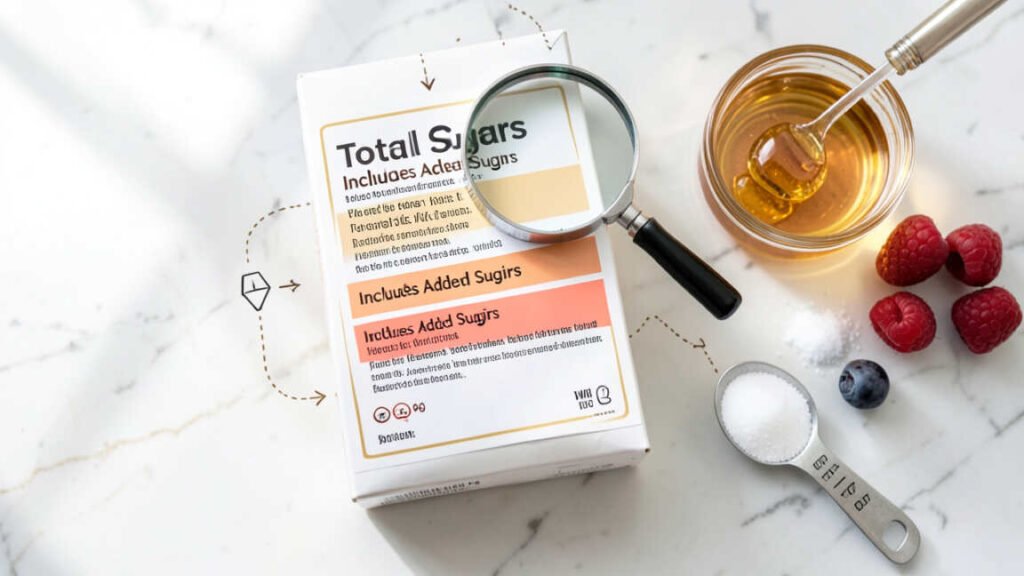
Total sugar encompasses all sugars in a food, including both naturally occurring sugars from sources like fruit and milk, and any added sugars and syrups introduced during processing. You can distinguish them on a label by noting the "Total Sugars" line and the sub-line indicating "Includes Xg Added Sugars," which specifies only the sweeteners added by the manufacturer. This distinction is critical for health because added sugars contribute to excess calorie intake without nutritional benefit, while natural sugars often come packaged with fiber, vitamins, and minerals.
Total sugar vs added sugar is one of the most important distinctions on a nutrition label, yet it often confuses shoppers. Understanding this difference is key to making healthier food choices and managing your intake. This guide breaks down exactly what each term means, where they appear on packaging, and why it matters for your health.
Simply put, total sugar includes all sugars in a food, both naturally occurring (like fruit and milk sugar) and those added during processing. Added sugar is just the second category-sugars and syrups manufacturers put in. The Nutrition Facts panel lists total sugar, and you must check the ingredients list to find added sugars.
Key Takeaways
- Total sugar is the overall sugar content in a food, combining natural and added sources.
- Added sugar refers to sweeteners added during food processing, separate from naturally occurring sugars.
- The Nutrition Facts label clearly shows “Total Sugars,” with a sub-line for “Includes Xg Added Sugars” to separate them.
- Health guidelines, like those from the American Heart Association, recommend limiting added sugar, not necessarily natural sugars.
- To identify added sugars, scan the ingredients list for specific names like cane sugar, high fructose corn syrup, or dextrose.
What Is Total Sugar on a Food Label?
Total sugar represents the combined weight of all sugars in a single serving of food. This measurement includes every type of sugar molecule present. It’s the grand total you see in bold on the label.
The total sugar count encompasses two main categories. First, it includes naturally occurring sugars found in whole foods. Examples are the fructose in a piece of fruit or the lactose in plain yogurt.
Second, it includes any sugars or syrups that were added by the manufacturer during preparation.
This distinction is critical for accurate dietary tracking. A plain Greek yogurt will have a total sugar count that comes entirely from lactose, its natural milk sugar. A flavored yogurt, however, will have a higher total sugar number because it contains both lactose and added fruit syrups or sugar.
The label shows the sum of both.
| Source Type | Examples | Included in “Total Sugars”? |
|---|---|---|
| Naturally Occurring Sugars | Fructose in apples, lactose in milk, glucose in corn | Yes, always |
| Added Sugars | Table sugar, honey, agave nectar, high fructose corn syrup | Yes, always |
This table illustrates that all sugar sources contribute to the total sugar count. You cannot separate them by looking at this number alone. To find out how much is added, you must look at the next line on the label.
How Do You Find Added Sugar on the Label?
Finding the added sugar content is straightforward once you know where to look. The updated FDA nutrition label format makes this information very clear. It is no longer hidden in the ingredients list alone.
Directly beneath the “Total Sugars” line, you will see a new, indented line. This line starts with “Includes” and specifies the grams of added sugar. For example, it might read “Includes 12g Added Sugars.” This number tells you exactly how much sugar was added during manufacturing.
This sub-line is a percentage of your daily value (%DV). The FDA uses a daily value of 50 grams for added sugars. This helps you quickly see if a single serving contributes a large portion of your daily limit.
A product with 10g of added sugar provides 20% of the daily value.
Tip: Train your eyes to go directly to the “Includes Xg Added Sugars” line after checking calories and serving size. This is the fastest way to assess a product’s healthfulness regarding sugar.
The ingredients list provides further confirmation. Added sugars will be listed, but manufacturers can use many different names. They are legally required to list them, but the terms are not always intuitive.
This is why the dedicated line on the nutrition panel is so valuable.
What Are the Different Names for Added Sugar?
Food manufacturers use a wide variety of ingredients that all qualify as added sugar. Learning to recognize these names is essential for reading the ingredients list effectively. Any ingredient that ends in “-ose” or is a syrup is a form of added sugar.
- Sucrose: Common table sugar derived from sugar cane or sugar beets.
- High Fructose Corn Syrup (HFCS): A cheap, sweet syrup made from corn starch, used in many processed drinks and snacks.
- Dextrose: A simple sugar made from corn, often used in packaged baked goods.
- Maltose: Sugar formed from two glucose molecules, found in barley and some processed foods.
- Honey: While natural, it is considered an added sugar when manufacturers put it into a product.
- Agave Nectar: A syrup derived from the agave plant, popular as a “natural” sweetener.
- Rice Syrup: A sweetener made by breaking down rice starch into simple sugars.
- Maple Syrup: Another “natural” option that counts as added sugar when included in packaged foods.
The order of ingredients on the list matters. Ingredients are listed by weight from most to least. If a sugar name appears in the first three ingredients, you know the product contains a large amount.
Some products contain multiple types of added sugars to keep any single one from dominating the top of the list.
Warning: “Fruit juice concentrate” is often used as a sweetener. While derived from fruit, it has been stripped of fiber and is functionally similar to added sugar. It will usually be counted in the “Added Sugars” line on the label.
Why Is the Distinction Between Total and Added Sugar Important?
Understanding the split between total sugar and added sugar is fundamental to healthy eating. Not all sugars affect your body the same way. The context in which you consume sugar matters significantly for nutrition.
Naturally occurring sugars in whole foods like fruit come packaged with fiber, water, and micronutrients. Fiber slows down the absorption of sugar into your bloodstream. This leads to a more gradual rise in blood sugar and provides lasting energy.
You also benefit from the vitamins and minerals that accompany these sugars.
Added sugars in processed foods offer no nutritional benefit beyond calories. They are often consumed in liquid form (sodas, juices) or with refined carbohydrates, leading to rapid spikes in blood sugar. This can contribute to insulin resistance, weight gain, and increased risk for chronic diseases.
| Aspect | Naturally Occurring Sugar | Added Sugar |
|---|---|---|
| Source | Inherent in whole foods (fruits, vegetables, dairy) | Added by manufacturers during processing |
| Nutritional Context | Comes with fiber, vitamins, minerals | Provides “empty calories” with no other nutrients |
| Impact on Blood Sugar | Generally slower absorption due to fiber | Often causes rapid spikes, especially in liquids |
| Health Recommendation | Not restricted; focus on whole food sources | Limit to less than 10% of daily calories (WHO) |
According to the American Heart Association, men should limit added sugar to 36 grams (9 teaspoons) per day, and women to 25 grams (6 teaspoons). These are not limits for total sugar from all sources. A single can of soda can contain over 30 grams of added sugar, nearly meeting the daily limit for men.
How Does Sugar Impact Your Health and Daily Limits?
Excessive added sugar consumption is linked to numerous health issues. The primary concern is its role in providing excess calories without satiety. This can easily lead to a calorie surplus and weight gain.
Over time, this pattern significantly increases the risk of obesity.
Sugary drinks are the largest source of added sugar in many diets. They do not trigger the body’s fullness signals the way solid food does. This makes it easy to consume hundreds of extra calories from a single beverage.
The World Health Organization recommends that added sugars make up less than 10% of total energy intake, with further benefits if reduced to under 5%.
- Metabolic Health: High added sugar intake is a direct cause of insulin resistance, a precursor to type 2 diabetes.
- Heart Health: Studies link diets high in added sugar to increased blood pressure, chronic inflammation, and elevated triglycerides.
- Dental Health: Bacteria in the mouth feed on added sugars, producing acids that erode tooth enamel and cause cavities.
- Non-Alcoholic Fatty Liver Disease: The liver metabolizes fructose (a common added sugar) in a way that can lead to fat buildup in liver cells.
- Nutrient Displacement: Foods high in added sugars often replace more nutritious options in the diet.
Checking the added sugar line helps you stay within these guidelines. A breakfast cereal might have 10g of total sugar. If 9g of that is added sugar, you know it’s a significant source.
This information empowers you to choose items with more naturally occurring sugars and less added sweetener.
What Are Common Mistakes When Reading Sugar Labels?
Many consumers make errors when interpreting sugar information on labels. Avoiding these common pitfalls will make you a much more effective label reader. Here are the biggest mistakes and how to correct them.
- Ignoring Serving Size: All sugar numbers are per serving. If a container has 2.5 servings and you eat the whole thing, you multiply all values by 2.5. This is a major source of hidden sugar consumption.
- Trusting Marketing Buzzwords: Terms like “organic,” “natural,” or “lightly sweetened” do not mean low in added sugar. “Organic cane sugar” is still sugar. Always verify with the numbers on the panel.
- Overlooking Liquid Sugars: People often focus on solid foods. Fruit juice, smoothies, coffee drinks, and sports drinks are massive sources of added sugar that are easy to overlook.
- Focusing Only on Total Sugar: As established, total sugar includes natural sources. A product with 15g of total sugar from all raisins is very different from one with 15g from corn syrup. Check the “Includes” line.
- Being Fooled by Package Size: A “snack pack” or “mini” container can trick you into thinking it’s a single serving, when the label may list a smaller portion as one serving. Always check the serving size at the top of the label.
Important: The “Per Package” and “Per Serving” columns can appear on some labels, especially on single-serving packages. “Per Package” shows totals for the entire container. Always check which column you are reading to avoid doubling your intake unintentionally.
How Can You Use This Information to Make Better Choices?
Armed with the knowledge of total sugar vs added sugar, you can transform your shopping habits. Your goal is to choose foods where the majority of total sugar comes from naturally occurring sources. Here’s a practical approach.
First, compare similar products. Look at two brands of plain oatmeal. One may have 1g of total sugar, all from the oats themselves.
Another flavored packet might have 12g of total sugar, with 10g being added. The choice becomes clear. This comparison works for yogurts, breads, sauces, and more.
Second, prioritize whole foods. An apple has about 19g of total sugar, all naturally occurring and bundled with fiber. A candy bar may have 20g of total sugar, all of which is added.
The apple is the superior choice for blood sugar control and nutrition, despite having a similar sugar number.
- For Breakfast: Choose plain oatmeal or yogurt and add your own fruit. Avoid pre-sweetened varieties.
- For Snacks: Reach for whole fruits, vegetables with hummus, or nuts. Skip granola bars and flavored nuts coated in sugar.
- For Drinks: Make water your primary beverage. Infuse it with fruit for flavor instead of choosing juice or soda.
- For Baking: Use ripe bananas or applesauce to sweeten recipes naturally, reducing the need for added sugar.
- When Dining Out: Ask for sauces and dressings on the side. Many restaurant items contain surprisingly high amounts of added sugar.
Read the ingredients list with a critical eye. If sugar (in any of its many names) is one of the top three ingredients, reconsider the purchase. This simple rule of thumb can dramatically reduce your added sugar intake over time.
Frequently Asked Questions
Is total sugar the same as net carbs?
No, they are different measurements. Total sugar includes all sugars, both simple and complex. Net carbs are calculated as total carbohydrates minus fiber and sometimes sugar alcohols.
You must look at both the sugar line and the carbohydrate section on the label for a full picture.
Do natural sugars raise blood sugar differently than added sugars?
When consumed in whole food form (like an apple), natural sugars are absorbed more slowly due to the presence of fiber. This leads to a more gradual rise in blood sugar. Added sugars, especially in liquid or refined forms, are absorbed rapidly, causing quicker spikes.
What is the recommended daily limit for added sugar?
The American Heart Association recommends no more than 36 grams (9 teaspoons) for men and 25 grams (6 teaspoons) for women per day. The World Health Organization suggests limiting added sugars to less than 10% of total calories, with further benefits below 5%.
Are “no added sugar” products always healthy?
Not necessarily. A product with no added sugar can still be high in total sugar if it contains a lot of fruit juice concentrate or pureed fruit. It may also be high in refined carbohydrates, sodium, or unhealthy fats.
Always check the entire nutrition panel and ingredients list.
Can I trust “sugar-free” or “diet” labels completely?
These labels indicate that added sugars have been removed or replaced. However, they often contain sugar alcohols or artificial sweeteners. Sugar alcohols can still affect blood sugar in some people and may cause digestive discomfort.
Read the ingredients to understand what sweetener is used.
Final Thoughts
Decoding sugar on a food label starts with separating total sugar from added sugar. The label now makes this easy with the “Includes Xg Added Sugars” line. Your primary focus should be on limiting added sugars, as these provide calories without nutritional benefits.
Use this knowledge to read ingredients lists for sneaky sugar names and to compare products side-by-side. By making choices based on this information, you take a powerful step toward better long-term health. The goal isn’t to eliminate sugar entirely, but to be mindful of the types you consume.