The B vitamin complex consists of eight distinct vitamins because each performs a specialized job in the body's energy production, nerve function, and cell health. While they are grouped together in supplements and diets, these vitamins are not interchangeable, and each has a unique biochemical role. Recognizing this is key to identifying specific deficiency symptoms and selecting the right dietary sources or supplements for optimal health.
B vitamins are a complex group essential for turning your food into energy and keeping your body running smoothly. You’ve probably seen them listed together on supplement bottles or food labels, but why are there so many distinct types? Understanding the B vitamin complex can feel overwhelming, but it’s crucial for recognizing how each one supports your health in unique ways.
This guide breaks down the entire B vitamin family, from B1 to B12, explaining why each member exists and what it specifically does for your body. You’ll learn about their individual roles, the signs you might be lacking one, and the best ways to get them from your diet.
Simply put, there are eight distinct B vitamins because each performs a specialized job in your body’s energy production, nerve function, and cell health. They are grouped as a “complex” because they often work together in metabolic pathways, but they are not interchangeable.
Key Takeaways
- The B vitamin complex consists of eight distinct vitamins, each with a unique and essential role in your body.
- They are water-soluble, meaning your body doesn’t store them long-term, so you need a consistent intake through food.
- From energy metabolism to forming red blood cells and supporting brain function, B vitamins are involved in over 400 enzymatic reactions.
- A deficiency in any single B vitamin can cause specific health issues, like fatigue, anemia, or nerve problems.
- The best strategy for adequate B vitamin intake is a varied diet rich in whole foods like meat, legumes, eggs, and leafy greens.

What Is the B Vitamin Complex?
The B vitamin complex is a group of eight chemically distinct vitamins that share a common prefix: “B.” They are also called “B-complex vitamins” or simply “B vitamins.” This group is classified together because they were originally discovered in the same area of a food source and share similar solubility and metabolic roles.
Think of them as a specialized team. While they are all found in similar foods and often work in the same processes, each member has a distinct “job title” and “skill set.” For example, one helps release energy from carbs, while another is critical for making DNA.
The Official List of B Vitamins
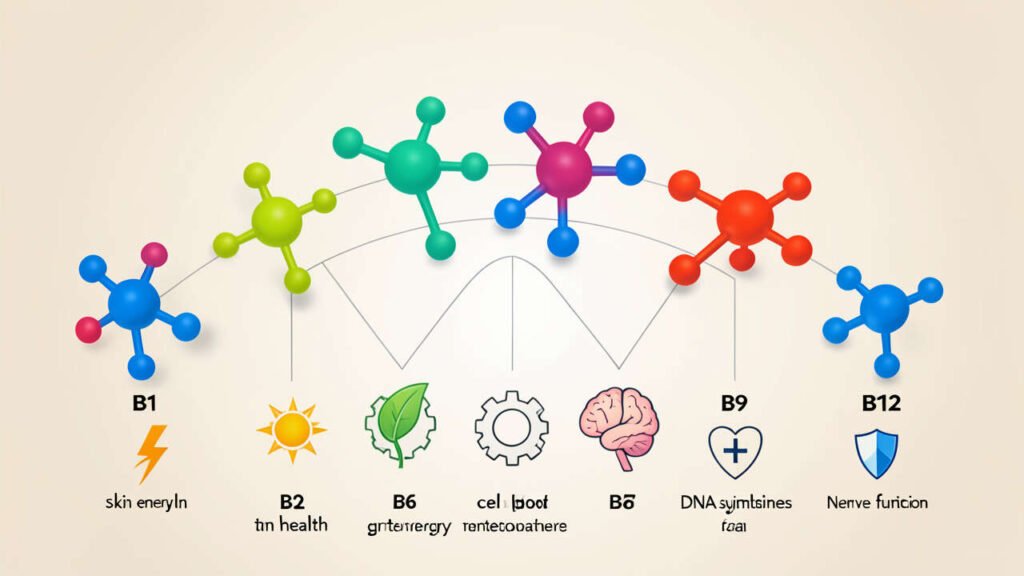
- B1 (Thiamine): Helps convert nutrients into energy; key for heart and nerve function.
- B2 (Riboflavin): Aids in energy production and cellular function; supports healthy skin.
- B3 (Niacin): Supports digestive system, skin, and nerve function; involved in DNA repair.
- B5 (Pantothenic Acid): Essential for synthesizing fatty acids and metabolizing proteins, fats, and carbs.
- B6 (Pyridoxine): Involved in amino acid metabolism, red blood cell creation, and neurotransmitter production.
- B7 (Biotin): Often called the “beauty vitamin” for its role in hair, skin, and nail health.
- B9 (Folate/Folic Acid): Crucial for cell division, DNA formation, and preventing birth defects during pregnancy.
- B12 (Cobalamin): Necessary for nerve tissue health, brain function, and the production of red blood cells.
How Do B Vitamins Work in Your Body?
The primary function of B vitamins is to act as coenzymes in the body’s metabolic machinery. A coenzyme is a helper molecule that enables a protein enzyme to do its job. Without B vitamins, many critical chemical reactions would slow down or stop entirely.
The most central role is in cellular energy production. B vitamins help break down macronutrients (carbohydrates, proteins, and fats) from your food into a form of energy your cells can use, called ATP. This process happens inside the mitochondria, the powerhouse of the cell.
| B Vitamin | Primary Energy Role | Key Enzyme/Process |
|---|---|---|
| B1 (Thiamine) | Converts carbs to energy | Pyruvate dehydrogenase complex |
| B2 (Riboflavin) | Electron carrier in energy cycle | Flavin adenine dinucleotide (FAD) |
| B3 (Niacin) | Electron carrier in energy cycle | Nicotinamide adenine dinucleotide (NAD+) |
| B5 (Pantothenic Acid) | Core component of Coenzyme A | Citric acid (Krebs) cycle |
| B6 (Pyridoxine) | Amino acid metabolism | Glycogen phosphorylase |
| B7 (Biotin) | Gluconeogenesis, fatty acid synthesis | Carboxylase enzymes |
| B9 (Folate) | Amino acid metabolism, DNA synthesis | One-carbon transfer reactions |
| B12 (Cobalamin) | Amino acid metabolism, red blood cell formation | Methionine synthase, methylmalonyl-CoA mutase |
Beyond energy, they are vital for creating neurotransmitters like serotonin and dopamine, building healthy red blood cells, maintaining the myelin sheath that protects your nerves, and synthesizing DNA for new cell growth.
Why Are There So Many Different B Vitamins?
The existence of multiple B vitamins comes down to biochemical specificity. Evolution designed a highly efficient system where one specific molecule catalyzes one particular reaction. This ensures control, precision, and the ability to regulate different pathways independently.
If one vitamin tried to do everything, the body couldn’t fine-tune its processes. For instance, you might need to ramp up fat metabolism without affecting DNA synthesis. Having separate B vitamins for separate jobs allows for this precise biological control.
Important: While they work as a complex, you can become deficient in just one B vitamin. The symptoms of a B12 deficiency (nerve damage) are very different from those of a B1 deficiency (heart and nerve problems), which is why we need to identify and address each one specifically.
Their separate identities also explain why they are found in varying amounts in different foods. Pork is a top source of thiamine (B1), liver is packed with B12, and leafy greens are rich in folate (B9). A varied diet helps ensure you get all the different B vitamins you need.
What Happens If You Lack a B Vitamin?
B vitamin deficiencies are relatively uncommon in developed countries with varied diets, but they can occur due to restrictive eating patterns, certain medical conditions, or age-related absorption issues. Each deficiency presents with unique symptoms.
- B1 (Thiamine) Deficiency: Can lead to beriberi, affecting the heart and nervous system. Wernicke-Korsakoff syndrome is a severe neurological complication, often linked with chronic alcohol use.
- B2 (Riboflavin) Deficiency: Known as ariboflavinosis, symptoms include cracked lips, a sore throat, and hyper-sensitivity to light.
- B3 (Niacin) Deficiency: Causes pellagra, characterized by the “four D’s”: dermatitis, diarrhea, dementia, and, if untreated, death.
- B5 (Pantothenic Acid) Deficiency: Very rare. Known as the “panting” vitamin, deficiency may cause fatigue, irritability, and numbness.
- B6 (Pyridoxine) Deficiency: Can cause anemia, skin inflammation, depression, and confusion.
- B7 (Biotin) Deficiency: Rare but can cause thinning hair, skin rashes (especially around eyes, nose, mouth), and brittle nails.
- B9 (Folate) Deficiency: Leads to megaloblastic anemia (large, immature red blood cells) and is critical to prevent neural tube defects in developing fetuses.
- B12 (Cobalamin) Deficiency: Causes pernicious anemia, fatigue, weakness, constipation, and can lead to irreversible nerve damage if prolonged. Common in strict vegans and older adults with reduced absorption.

What Are the Best Food Sources of B Vitamins?
The most reliable way to get your B vitamins is through a balanced diet. Because they are water-soluble, they aren’t stored in large amounts, so a consistent dietary supply is key. Animal products are particularly rich in several B vitamins, but plenty of plant-based options exist as well.
| B Vitamin | Excellent Animal Sources | Excellent Plant Sources |
|---|---|---|
| B1 | Pork, fish, seeds | Legumes, whole grains, fortified cereals |
| B2 | Lean meats, eggs, dairy | Almonds, spinach, fortified breads |
| B3 | Tuna, chicken, turkey | Mushrooms, green peas, fortified cereals |
| B5 | Organ meats (liver), chicken | Avocados, mushrooms, sunflower seeds |
| B6 | Chickpeas (tuna), poultry, salmon | Potatoes, bananas, fortified cereals |
| B7 | Egg yolks, organ meats | Sweet potatoes, spinach, broccoli |
| B9 | Liver, eggs, beef | Dark leafy greens (spinach, kale), lentils, asparagus |
| B12 | Clams, liver, trout, salmon | Fortified nutritional yeast, fortified plant milks, fortified cereals (naturally absent in plant foods) |
For those following a vegan or vegetarian diet, special attention should be paid to B12, which is naturally found only in animal products. Relying on fortified foods or a supplement is essential for this group.
Should You Take a B-Complex Supplement?
For most healthy adults eating a varied diet, a separate B-complex supplement is unnecessary. The body is efficient at utilizing what it needs, and excess B vitamins are excreted in urine. However, certain populations may benefit from targeted supplementation.
- Pregnant or Breastfeeding Women: Increased needs for folate (B9) to prevent birth defects and support fetal development are well-established.
- Older Adults (Over 50): Absorption of B12 naturally declines with age due to reduced stomach acid. Supplements or fortified foods are often recommended.
- People with Certain Medical Conditions: Conditions like celiac disease, Crohn’s disease, alcoholism, or pernicious anemia can impair absorption of specific B vitamins.
- Individuals on Restrictive Diets: Strict vegans must supplement B12. Those on very low-calorie diets may also lack sufficient intake.
- People Taking Certain Medications: Some drugs, like proton pump inhibitors and metformin, can interfere with B12 or folate absorption.
Warning: Do not assume more is better. Mega-doses of B vitamins can cause side effects. High-dose B6 supplements, for example, can lead to nerve damage. Always consult a healthcare provider before starting a high-potency supplement regimen.
A standard B-complex supplement contains all eight B vitamins in a single capsule. Look for one that provides 100% of the Daily Value (DV) for each, not significantly more. A healthcare professional or registered dietitian can help you determine if you truly need a supplement and at what dosage.

How Does Cooking and Processing Affect B Vitamins?
B vitamins are sensitive to heat, light, and water. This means some can be lost during cooking, especially through boiling. The longer you cook a food and the more water you use, the greater the potential loss.
- Boiling: This method causes the greatest loss as B vitamins leach into the cooking water. If you boil vegetables, try using the cooking water in soups or sauces to reclaim some lost nutrients.
- Steaming, Microwaving, Stir-Frying: These methods use less water and shorter cooking times, helping preserve more B vitamins.
- Pressure Cooking: While it uses high heat, the short cooking time can actually be better for retaining some nutrients than prolonged boiling.
- Processing: Refining grains removes the bran and germ, stripping away many B vitamins. This is why enriched flour has B1, B2, B3, and iron added back in.
Storing foods in cool, dark places and eating them relatively fresh also helps maintain their B vitamin content. For example, sunlight can degrade riboflavin (B2) in milk, which is why it is often sold in opaque containers.

Common Myths and Misconceptions About B Vitamins
Misinformation about B vitamins is widespread, especially regarding energy and supplements. Let’s clarify some common myths.
Myth: B-complex supplements give you an energy boost like caffeine.
Reality: They do not provide energy directly. They help your body convert food into energy. If you are deficient, supplementing will help restore normal energy levels.
If you are not deficient, taking extra B vitamins won’t make you feel more energetic.
Myth: You need to take B vitamins separately for better absorption.
Reality: For most people, taking a B-complex supplement together is perfectly fine. The body can absorb them simultaneously. Unless advised by a doctor for a specific condition, separate doses are not typically required.
Myth: Bright yellow urine means the vitamins are working.
Reality: That bright neon color comes from excreting excess riboflavin (B2), which is a water-soluble vitamin your body doesn’t need in large amounts. It’s a sign of excess, not enhanced effectiveness.
Myth: Plant foods cannot provide all B vitamins.
Reality: With the exception of B12, a well-planned vegan diet can provide all other B vitamins. The key is variety, including legumes, whole grains, nuts, seeds, fruits, and vegetables. B12 must come from fortified foods or supplements.
Frequently Asked Questions
What is the most important B vitamin?
No single B vitamin is more important than the others because they each perform unique and essential functions. For example, B12 is critical for nerve health, while folate is vital for preventing birth defects. Deficiency in any one of them can cause specific health problems.
Can you get too many B vitamins from food?
It is virtually impossible to overdose on B vitamins from food alone. Since they are water-soluble, your body excretes any excess through urine. Toxicity is only a concern with very high doses from supplements, not from dietary sources.
Do B vitamins help with stress and anxiety?
B vitamins, particularly B6, B9 (folate), and B12, are necessary for producing neurotransmitters like serotonin that regulate mood. A severe deficiency can worsen anxiety, so correcting it may help. However, they are not a primary treatment for clinical anxiety disorders.
Why is B12 only found in animal products?
B12 is produced by microorganisms, not by plants or animals themselves. Animals get B12 from eating contaminated food or through bacterial synthesis in their guts. Since plants don’t have a need for B12, they don’t produce or store it, which is why fortified foods or supplements are essential for vegans.
How long does it take to correct a B vitamin deficiency?
The timeline varies based on the severity of the deficiency and the type of B vitamin. For example, symptoms of a B12 deficiency may improve within days with injections, but full nerve recovery can take months. Consistent supplementation and dietary changes are key, and your doctor can monitor progress with blood tests.
Final Thoughts
The B vitamin complex is a powerful team of eight essential nutrients, each playing a distinct role in everything from energy production to brain function. Their specificity is why there are so many – it allows your body to finely tune complex metabolic processes. Prioritizing a varied, whole-food diet is the best way to meet your needs, and targeted supplements can be a helpful safety net for specific groups.
Understanding these vitamins helps you make informed choices for your long-term health.