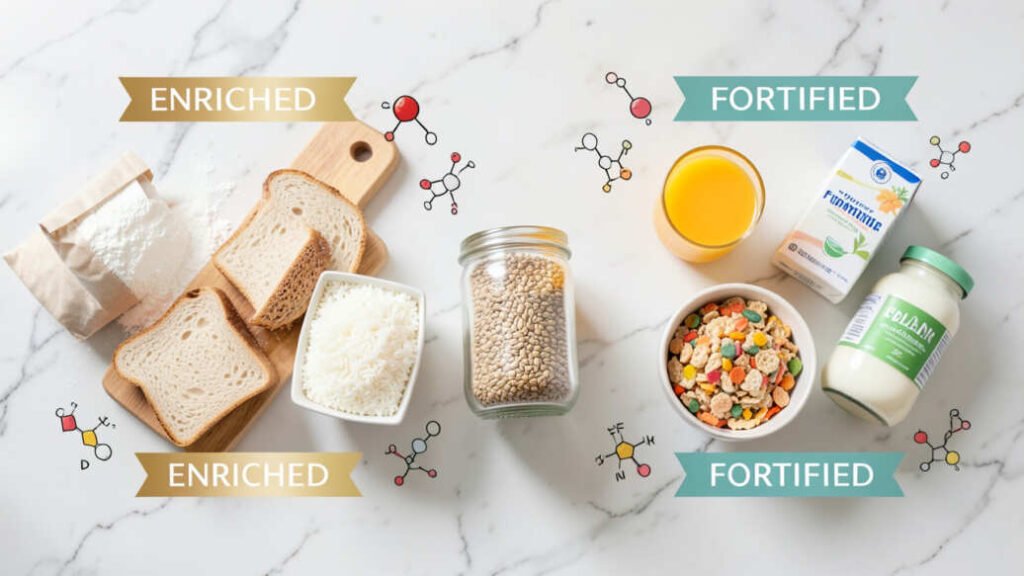
Enriched foods restore nutrients removed during processing, while fortified foods introduce additional nutrients not originally present. The FDA regulates both processes, with enrichment commonly applied to refined grains such as white bread and pasta, and fortification used to add nutrients like vitamin D to milk or folic acid to cereal. This clear distinction enables consumers to read nutrition labels accurately and make informed dietary decisions to meet their health goals.
Enriched vs fortified foods are two terms often used interchangeably on nutrition labels, but they actually describe distinct processes. Many people assume they mean the same thing, which can lead to confusion when making dietary choices. Understanding the clear difference between these two methods helps you become a more informed consumer and better manage your nutritional intake.
This guide breaks down exactly what each term means, how they are regulated, and which foods typically undergo these processes. You will learn the specific nutrients added in each case and why manufacturers choose one method over the other. By the end, you will know how to read labels with confidence and understand what you are truly buying.
Simply put, enriched foods
Key Takeaways
- Enriched vs fortified foods differ primarily in their starting point: enrichment restores what was removed, fortification adds something new.
- The FDA regulates both processes but uses different terminology and guidelines for each.
- Common enriched foods include refined grains like white bread and pasta, while fortified foods often include plant-based milk and breakfast cereals.
- Both methods aim to improve public health by addressing common nutritional gaps in diets.
- Checking the nutrition label and ingredient list is the best way to identify whether a food is enriched or fortified.
What is Enriched Food?
Enrichment is the process of adding back specific nutrients to a food product that were lost during its manufacturing. This process is most common with refined grains. When whole grains are processed into white flour, the bran and germ are removed, stripping away fiber, vitamins, and minerals.
Enrichment restores some of these lost nutrients.
The primary goal of enrichment is to return the food to a nutritional state closer to its original form. It does not typically add nutrients beyond what was naturally present. The practice became widespread after public health officials noticed rising rates of nutrient deficiencies in the early 20th century.
Aspect of Enrichment Description Purpose To replace nutrients lost during processing. Common Nutrients Added B vitamins (thiamin, riboflavin, niacin, folic acid) and iron. Typical Foods Refined grains: white flour, white rice, white bread, pasta, and cornmeal. Regulation Mandatory in the U.S. for refined grain products to help prevent nutrient deficiencies. Key Nutrient Example Folic acid added to refined grains to prevent neural tube defects in newborns. The list of nutrients added during enrichment is generally fixed and mandated by food authorities like the U.S. Food and Drug Administration (FDA). You will often see “enriched” on packages of white bread, white rice, and breakfast cereals made from refined grains.
The ingredient list will specify which vitamins and minerals have been added back.
What is Fortified Food?
Fortification is the deliberate addition of nutrients to a food that did not originally contain them or contained them only in negligible amounts. The primary aim is to improve the nutritional profile of the food to address public health concerns or consumer dietary gaps. It is a proactive measure, not a restorative one.
This process was pioneered to combat widespread deficiency diseases. A classic example is the addition of iodine to salt to prevent goiter and cognitive issues. Today, fortification is used to add a wide range of nutrients like vitamin D, calcium, omega-3 fatty acids, and various B vitamins to foods that are not natural sources.
How Fortification Differs from Enrichment
- Nutrient Origin: Fortification adds nutrients the food lacked entirely. Enrichment restores nutrients lost.
- Scope: The range of nutrients added in fortification is much broader and can be tailored to specific health goals.
- Target Foods: Fortification is common in foods that are naturally low in certain nutrients, like plant-based milks or water.
- Voluntary vs. Mandatory: Some fortification is mandatory (e.g., iodized salt), while much of it is a voluntary decision by manufacturers to enhance products.
When you buy almond milk with added calcium and vitamin D, you are buying a fortified product. These nutrients were not present in meaningful amounts in the original almonds. Similarly, many breakfast cereals are fortified with a cocktail of vitamins and minerals far exceeding what is naturally in the grain.
Common Fortified Foods Nutrients Typically Added Plant-Based Milks (Soy, Almond, Oat) Calcium, Vitamin D, Vitamin B12, Vitamin A Breakfast Cereals Iron, Zinc, B Vitamins, Vitamin A, Vitamin D Iodized Table Salt Iodine Flour (for home baking) Folic Acid, Iron, B Vitamins Some Fruit Juices Calcium, Vitamin C Tip: When comparing fortified plant milks, check the labels. Some brands add more calcium and vitamin D than others, and not all contain vitamin B12, which is crucial for vegans.
How Do Enrichment and Fortification Impact Health?
Both processes are powerful public health tools. The fortification of salt with iodine is credited with virtually eliminating iodine deficiency disorders in many countries. Similarly, the mandatory enrichment of refined grain products with folic acid has led to a significant reduction in neural tube birth defects.
These interventions help ensure populations receive baseline levels of critical micronutrients, especially when dietary variety is limited. For individuals who consume a lot of processed foods, enrichment can prevent serious deficiencies like pellagra (niacin deficiency) or beriberi (thiamin deficiency).
- Prevention of Deficiency Diseases: The most direct and significant health impact, addressing population-wide nutritional gaps.
- Improved Dietary Quality: Adds nutrients to foods people already eat, making it an easier strategy than changing eating habits.
- Support for Specific Life Stages: Folic acid fortification is critical for women of childbearing age, even before pregnancy is known.
- Market-Driven Nutrition: Allows manufacturers to create products that meet consumer demand for nutrient-dense options.
However, some critics argue that fortification can be used to mask the poor nutritional quality of highly processed foods. A sugary cereal fortified with vitamins is still a sugary cereal. It is important to look at the entire food matrix, not just the added nutrients.
Health Aspect Enriched Foods Fortified Foods Primary Benefit Prevents deficiencies from refined foods. Proactively adds nutrients for general health. Consideration Restores some, but not all, lost nutrients (e.g., fiber is not restored). Can create a “health halo” around otherwise unhealthy products. Best Practice Choose enriched grains as part of a balanced diet. Use fortified foods strategically, like plant milks for vegans. How Are Enrichment and Fortification Regulated?
In the United States, the FDA and the U.S. Department of Agriculture (USDA) oversee the fortification and enrichment of food products. Regulations exist to ensure consistency, safety, and labeling accuracy.
These rules prevent manufacturers from adding nutrients in unsafe amounts or making misleading claims.
For enrichment, the FDA mandates which nutrients must be added back to specific refined grain products. The standards are precise. For example, enriched flour must contain specific levels of thiamin, riboflavin, niacin, folic acid, and iron.
Failure to comply means the product cannot be labeled as “enriched.”
Warning: Fortification levels are not always standardized across products. A serving of one brand of cereal may provide 100% of the Daily Value for iron, while another provides only 25%. Always check the Nutrition Facts panel.
Fortification, on the other hand, is more varied. Some is mandatory, like the iodization of salt. Most is voluntary.
When manufacturers choose to fortify, they must adhere to good manufacturing practices and ensure the nutrients are stable in the product and bioavailable for absorption. They also must list all added nutrients on the label.
- FDA Role: Sets standards of identity for “enriched,” approves nutrient fortification levels, and monitors safety.
- Labeling Requirements: Both processes require disclosure in the ingredient list and often in the product name (e.g., “Enriched Macaroni Product”).
- Daily Value (DV) References: The Nutrition Facts panel shows the % DV for each added nutrient, helping consumers understand its contribution to their daily intake.
- International Variation: Regulations differ by country. What is considered fortified or enriched in the U.S. may not be in the EU or elsewhere.
What are the Most Common Enriched and Fortified Foods?
Identifying these products in the grocery store becomes easier once you know where to look. Enrichment is almost exclusively a grain-processing story, while fortification is found across many food categories. Here is a practical guide to the items you will most frequently encounter.
Foods Commonly Enriched
- White Bread and Rolls: Made from enriched wheat flour.
- White Rice: Often enriched with B vitamins and iron.
- Pasta: Most white pasta in the U.S. is made from enriched semolina flour.
- Cornmeal and Grits: Many are enriched, especially quick-cooking varieties.
- All-Purpose Flour: The standard white flour in most stores is enriched.
Foods Commonly Fortified
- Breakfast Cereals: One of the most heavily fortified food categories.
- Plant-Based Milks: Soy, almond, oat, and rice milks are routinely fortified.
- Orange Juice: Many brands offer calcium and vitamin D fortified versions.
- Flour: Some flours, especially all-purpose, are fortified with folic acid.
- Nutritional Yeast: Often fortified with B12, crucial for vegan diets.
- Infant Formula: Precisely fortified to mimic breast milk nutrition.
The ingredient list is your best clue. It will explicitly state “enriched with” or “fortified with” followed by the list of added vitamins and minerals. Words like “added calcium” or “with 12 essential vitamins” on the front of the box signal fortification.
Why Do Manufacturers Choose Enrichment or Fortification?
Manufacturers use these processes for a combination of regulatory, economic, and marketing reasons. The decision is strategic and ties into the product’s role in the market and the nutritional needs of the target consumer.
Enrichment is often a regulatory requirement for refined grain products in many countries. It is a cost of doing business with these staple foods. For manufacturers, it ensures their products meet baseline nutritional standards and remain eligible for certain government food programs like school lunches.
Fortification is frequently a market-driven choice. It allows a brand to enhance a product’s nutritional appeal, differentiate it from competitors, and sometimes charge a premium. Adding calcium to orange juice or protein to oatmeal makes the product more attractive to health-conscious shoppers.
It also helps food companies meet public health goals and improve their corporate social responsibility profile.
- Regulatory Compliance: Meeting mandatory enrichment laws for certain staples.
- Public Health Responsibility: Contributing to population health by addressing common deficiencies.
- Product Innovation & Marketing: Creating value-added products that appeal to specific consumer needs (e.g., keto, vegan, heart-healthy).
- Competitive Edge: Offering a “more nutritious” version of a common food to stand out on the shelf.
Manufacturer’s Goal Process Likely Used Example Meet legal standards for white bread Enrichment Adding folic acid back to refined flour. Market a dairy-free milk alternative Fortification Adding calcium and vitamin D to almond milk. Create a “high-protein” cereal Fortification Adding protein isolate to oat flakes. How Can You Tell the Difference at the Grocery Store?
Becoming a savvy label reader is the key to distinguishing between enriched and fortified foods. The clues are right there on the packaging if you know what to look for. Do not just rely on front-of-box marketing claims.
Start with the product name or description. The word “enriched” is often part of the official name, such as “Enriched Spaghetti” or “Enriched Wheat Flour.” Fortification is less likely to be in the product name but may be highlighted in marketing phrases like “with added calcium.”
The ingredient list is your most reliable source. An enriched product will list the enriched grain first (e.g., “enriched wheat flour”) and then detail the added nutrients later. A fortified product will list its base ingredients and then a separate line saying “fortified with” or “added vitamins and minerals” followed by the specifics.
Important: The % Daily Value (%DV) on the Nutrition Facts panel tells you how much a nutrient in a serving contributes to your daily diet. High %DVs for several vitamins often indicate heavy fortification.
- Look for “Enriched”: Check the ingredients for “enriched flour” or “enriched rice.”
- Scan for “Fortified”: Look for phrases like “fortified with ” or “a good source of ” for nutrients not naturally abundant.
- Examine the %DV: If a single food provides 25% or more of the DV for many vitamins, it’s likely fortified.
- Consider the Food Type: Is it a refined grain? It’s probably enriched. Is it a plant milk, juice, or cereal? It’s probably fortified.
Frequently Asked Questions
Is enriched food less healthy than fortified food?
Neither is inherently “less healthy.” Their health value depends on the specific food and the overall diet. Enriched white bread is nutritionally superior to unenriched white bread. Fortified almond milk is a better source of calcium than unfortified almond milk.
The key is to use them appropriately and not to rely on them as sole sources of nutrition.
Can a food be both enriched and fortified?
Yes, it is possible but uncommon. A product like a breakfast cereal made from enriched flour could also be fortified with additional vitamins beyond what was restored. In such cases, the label will reflect both processes in the ingredient list and nutrition panel.
Do enriched foods have more nutrients than their whole grain counterparts?
No. Whole grains naturally contain all parts of the kernel, including the bran and germ, which are rich in fiber, healthy fats, and a full spectrum of vitamins and minerals. Enrichment only adds back a select few nutrients lost in refining, so whole grains remain more nutritionally complete.
Is fortified food considered processed food?
Yes, almost all fortified foods are processed to some degree. Fortification is an additional step in food processing. However, this does not automatically make them unhealthy.
Many minimally processed foods like salt and flour are fortified as part of public health policy.
How do I avoid getting too many added vitamins?
For healthy individuals with balanced diets, consuming excess added vitamins from food is rarely a concern, as the body excretes what it doesn’t need. However, people taking supplements should be mindful of their total intake to avoid exceeding the Tolerable Upper Intake Level (UL), particularly for fat-soluble vitamins like A, D, E, and K.
Final Thoughts
Understanding the difference between enriched vs fortified foods empowers you to make better choices at the store. Remember, enrichment restores what processing took away, while fortification adds something new for a health boost. Both are regulated methods used to improve the nutrient quality of the food supply.
Use the ingredient list and Nutrition Facts panel as your guides. By identifying these processes, you can align your food choices more closely with your personal health goals and dietary needs. An informed consumer is a healthier consumer.