
A smell suddenly brings back a strong memory because the olfactory system has a direct neural pathway to the brain's amygdala and hippocampus, which are central to emotion and memory processing. This anatomical connection makes scent-triggered recall more vivid and instant than memories cued by other senses, as it bypasses the thalamus. Consequently, individuals can intentionally use familiar scents to enhance their mood, focus, or ability to recall specific personal events.
Why can a smell suddenly bring back a strong memory so vividly that you feel transported back in time? The scent of fresh bread, a particular perfume, or rain on hot pavement can instantly trigger a flood of emotions and images. This phenomenon, known as the Proust effect, happens because your brain hardwires smells directly to memory and emotion centers.
In this post, we will unpack the neuroscience behind scent-triggered memories, explain why smell beats other senses at recall, and share practical ways you can use this connection. By the end, you will understand exactly why a whiff of something familiar can stop you in your tracks.
Simply put, smells trigger strong memories because the olfactory system has a direct express lane to the amygdala and hippocampus, the brain regions that process emotion and memory. Unlike other senses, smell bypasses the brain’s relay station, so the experience feels instant, intense, and deeply personal.
Key Takeaways
- A smell can suddenly bring back a strong memory because olfactory signals bypass the thalamus and connect directly to the limbic system.
- The Proust effect explains why scent memories feel more emotional and vivid than memories triggered by sight or sound.
- Your brain forms odor associations through a single exposure, which is why one scent can encode a whole life moment.
- Practical techniques, like scent journaling and exposure therapy, can help you harness or manage smell-triggered memories.
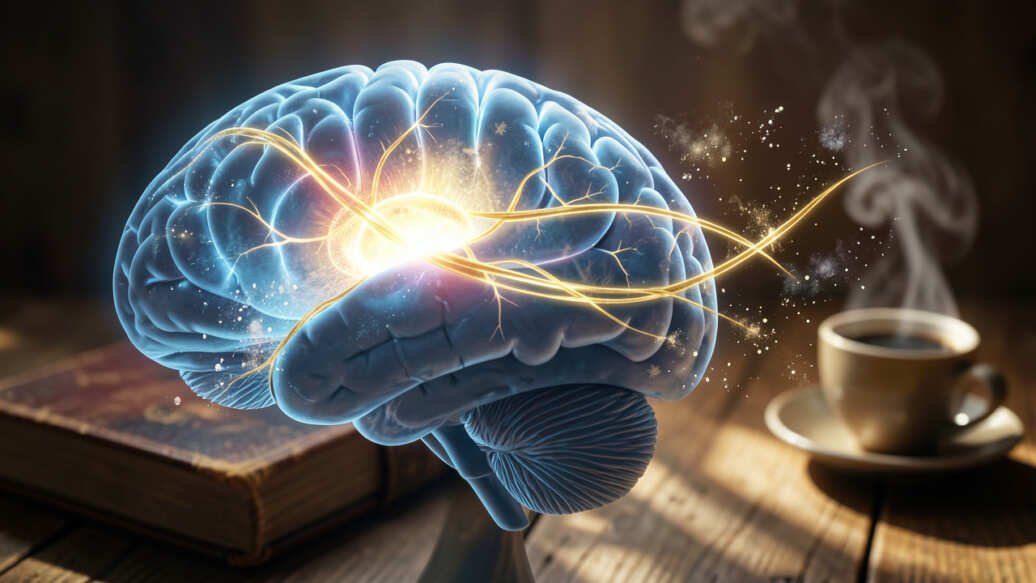
What Happens in Your Brain When a Scent Triggers a Memory?
When you inhale a scent, odor molecules travel up your nasal cavity and bind to olfactory receptors. Those receptors send electrical signals straight to the olfactory bulb, which sits at the base of the brain. From there, the signal fans out to several regions, but the critical destinations are the amygdala and the hippocampus.
Here is the key difference between smell and your other senses. Sight, sound, touch, and taste all pass through the thalamus, which acts like a switchboard that sorts and routes information before it reaches higher brain areas. Smell does not wait for that routing.
It goes directly to the emotional and memory centers, which makes the response faster and much more visceral.
According to research published in Nature Reviews Neuroscience, the olfactory bulb connects directly to the amygdala (emotion processing) and the hippocampus (memory formation). That is why a smell can suddenly bring back a strong memory before you even consciously identify what the scent is.
- The amygdala assigns emotional weight to the incoming smell.
- The hippocampus retrieves the contextual memory linked to that odor.
- The orbitofrontal cortex helps you name the smell after the memory has already surfaced.
- The insula processes the physical or visceral reaction you feel.
- The entire loop happens in milliseconds, faster than conscious thought.
| Sensory Pathway | Route to Memory Centers | Speed of Recall |
|---|---|---|
| Smell | Direct: olfactory bulb to amygdala and hippocampus | Instant, automatic |
| Vision | Thalamus, then visual cortex, then memory areas | Slightly delayed, more processed |
| Hearing | Thalamus, then auditory cortex, then memory areas | Slightly delayed, more processed |
This neural shortcut explains why you can smell a specific laundry detergent in a store and suddenly think of your grandmother’s house. You are not choosing to remember. Your brain simply does the association work before your conscious mind catches up.
Important: The olfactory nerve is the only cranial nerve that directly connects to the brain’s external environment. That unique access is exactly why smell memories feel so raw and unfiltered.

Why Is the Proust Effect So Powerful Compared to Other Senses?
The term “Proust effect” comes from French writer Marcel Proust, who described how dipping a madeleine cake into tea unleashed a flood of childhood memories in his novel In Search of Lost Time. Modern neuroscience confirms that his literary observation was spot on.
Scent-evoked memories tend to be older than memories triggered by words, images, or sounds. Researchers at the University of Liverpool found that memories triggered by odors are more likely to come from the first decade of life, while memories triggered by other cues peak in young adulthood. That means smells often connect you to your earliest, most formative experiences.
These odor-linked memories also feel different. Participants in multiple studies rate scent-triggered memories as more emotional, more positive, and more immersive than memories triggered by visual or verbal cues. You do not just remember the event.
You feel the weather, the lighting, the people, and your own mood from that exact moment.
- Age of memories: Smell brings back childhood memories more often than sight or sound.
- Emotional intensity: Scent memories score higher on vividness and emotional arousal scales.
- Feeling of reliving: People report a stronger sense of being “back there” with smell cues.
- Positive bias: Odor memories skew more positive, even when the scent itself is neutral.
- Automatic retrieval: You do not search for the memory. It arrives whole and uninvited.
| Cue Type | Memory Age | Emotional Intensity | Immersive Quality |
|---|---|---|---|
| Smell | Childhood (under 10) | Very high | High, feels like reliving |
| Visual | Teens to twenties | Moderate | Moderate, more detached |
| Verbal | Teens to twenties | Lower | Low, more factual |
One reason for this intensity is that olfactory information reaches the amygdala directly, while visual and auditory cues pass through multiple processing stages first. Each stage acts like a filter that strips away some emotional charge. Smell retains all of it.
Tip: If you want to experience the Proust effect deliberately, choose a scent you encountered during a significant life event. Revisit that scent after a few years, and notice how much detail rushes back compared to looking at an old photo.
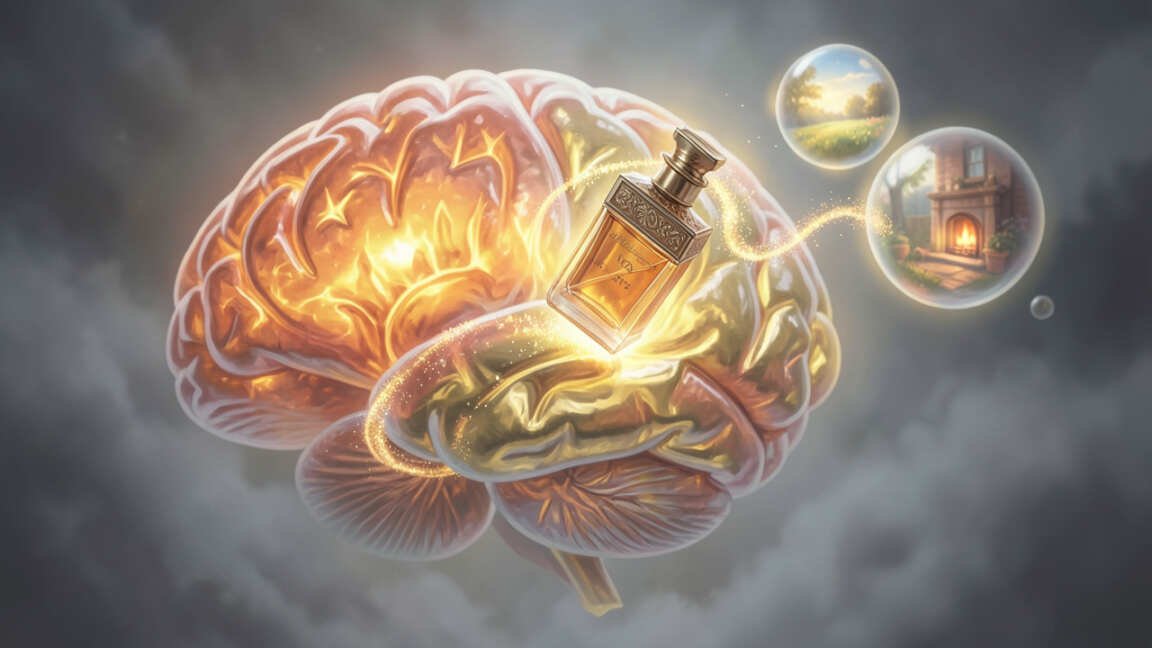
What Are the Brain Regions Responsible for Odor Memory?
Three brain regions work together to turn an odor into a memory. The olfactory bulb acts as the entry point. The amygdala stamps the experience with emotion.
The hippocampus binds the details into a story. When you encounter the same odor again, this entire network fires as one unit.
Scientists call this process pattern completion. A single odor component can activate the whole neural ensemble that was active when the original memory formed. That is why you do not need the full context, just the scent, to reconstruct an entire scene.
The strength of this system depends partly on the brain’s plasticity and partly on the unique anatomy of the olfactory system.
- Olfactory bulb: Receives odor signals and projects them to the limbic system without thalamic relay.
- Amygdala: Assigns emotional significance and triggers the fight-or-flight or comfort response.
- Hippocampus: Reconstructs the episodic memory, including time, place, and sequence of events.
- Entorhinal cortex: Acts as a bridge between the hippocampus and the neocortex for memory consolidation.
- Prefrontal cortex: Helps evaluate the memory and decide whether the smell is currently relevant or just nostalgic.
A Nature Communications study on mice demonstrated that olfactory memories are encoded in a single trial. That means one exposure to a scent paired with an event is enough to create a durable association. Other sensory systems usually require repeated exposures to build strong memories.
Your brain treats smells as high-priority survival data. If a particular odor signals food, danger, or safety, remembering it instantly is adaptive. The emotional punch comes from that survival wiring.
Warning: Because smell memories encode so quickly, a single traumatic event involving a specific odor can leave a lasting trigger. This is common in PTSD, where certain smells flash people back to the traumatic moment without warning.
How Does Emotional Intensity Shape Scent Associations?
Emotion acts like a glue for memory. The stronger the emotional state when you first encounter a scent, the more robust the memory trace becomes. Your amygdala releases stress hormones and neuromodulators that help the hippocampus write the memory more permanently.
This is why you remember the smell of your first apartment, a breakup conversation, or a loved one’s kitchen with stunning clarity. The emotions present at the time of encoding essentially flag the memory for priority storage.
The connection works in both directions. A pleasant scent linked to a happy event can boost your mood instantly. A smell associated with stress can make your shoulders tense before you even know why.
- Positive emotions release dopamine, which strengthens the olfactory-memory link.
- Stress hormones like cortisol enhance encoding of context-rich memories.
- Novel odors paired with strong emotions form stronger traces than familiar ones.
- Repeated re-exposure to the scent without the emotion can weaken the association over time.
- Verbal labels given to an odor can shift your emotional response to it.
| Emotional State During Encoding | Memory Strength | Example |
|---|---|---|
| High intensity (joy, fear, awe) | Very strong, vivid | Smell of sunscreen at a wedding |
| Moderate (routine, calm) | Moderate, fuzzy | Smell of office coffee on a normal Tuesday |
| Low intensity (boredom, fatigue) | Weak, easily forgotten | Smell of a waiting room during a dull appointment |
Researchers at the Monell Chemical Senses Center have shown that people can often identify the exact person, place, and year associated with a smell even if they cannot name the odor itself. The emotional tag is so strong that it guides retrieval better than the sensory label.
Tip: You can intentionally create positive scent anchors. Use a specific perfume or candle during joyful events, then avoid using it daily. When you revisit that scent later, it will resurrect those happy memories more efficiently than any photo album.

Why Does Smell Activate the Past But Not the Present?
There is a curious asymmetry in smell and time. Smell seems to pull memories from the past much more often than it helps you remember what happened yesterday. Scientists believe this is because odor memories are encoded slowly and resisted by higher-order processing, so the earliest associations formed in childhood stay dominant.
One theory, called the olfactory processing advantage, suggests that odor memories resist interference from language. Because smells are hard to describe and rarely verbalized, the original memory trace remains untouched by later cognitive edits. Your brain does not rewrite the smell memory the way it rewrites verbal or visual memories.
Another factor is neurogenesis. The olfactory bulb and hippocampus generate new neurons throughout life. This constant turnover may be why older scent memories, encoded before many cycles of neuron replacement, remain vivid while more recent ones fade.
- Odor memories from ages 6 to 10 are the most stable.
- Verbal descriptions of smells interfere with memory retrieval, so unlabeled memories survive better.
- The olfactory bulb has direct projections to the hippocampus, giving it privileged access to episodic memory storage.
- Everyday exposure to new smells tends to push older memories deeper but makes them more resistant to forgetting.
- Sleep consolidates odor memories, shifting them into long-term stores without much conscious rehearsal.
This explains an everyday experience. You may struggle to remember the name of someone you met last week, but one breath of a childhood bakery scent brings your grandmother’s face, voice, and kitchen layout into crystal focus.
Important: The age of odor memories is one of the strongest scientific findings in olfactory research. A 2020 review in Chemical Senses confirmed that childhood odors remain the most potent triggers across adulthood.

How Can You Use Scent Memory to Improve Your Daily Life?
You do not have to be a passive passenger on the smell-memory train. You can use this brain wiring to improve learning, manage stress, and create richer personal rituals. The key is intentional pairing of scents with states you want to recall.
Students, professionals, and therapists all use this technique in different forms. Context-dependent memory research suggests that if you smell the same scent during studying and during a test, your recall improves. A 2018 study at Northwestern University found that participants who studied with a rose scent and then smelled it during a memory test scored higher than those who did not.
- Choose a scent: Use a single distinctive smell, like peppermint or citrus, only while studying.
- Keep it exclusive: Do not use the same scent in other environments.
- Trigger it later: Take the scent with you to the exam or presentation and inhale it before starting.
- Pair emotions: Use a comforting scent during relaxation practices like meditation or journaling.
- Refresh anchors: Reapply the scent during the memory-encoding moment, not during recall.
- Memory boosting: Use a unique scent while learning new material.
- Stress relief: Create a calm scent anchor and use it before high-pressure moments.
- Mood regulation: Pair upbeat music with bright citrus to build a quick pickup ritual.
- Storytelling: Add smell cues to presentations to make your point unforgettable.
- PTSD support: Work with a clinician to reduce the power of trauma-laden odors through exposure-based therapy.
- Scent journaling: Write down odors you notice and the memories they trigger to discover your personal patterns.
Warning: Do not try to use scent exposure by yourself if the memories cause panic or severe distress. Work with a licensed psychologist or counselor who specializes in trauma and olfactory-triggered memories.
For creative professionals, scent can unlock autobiographical memory for writing or art. Many authors intentionally collect smells from different places and time periods as a memory kit. You can build the same toolkit for your own projects.
What Are the Limits of Scent Memory Research?
Scent memory is real, but science still has gaps. Most laboratory studies use a small set of odors like citrus, lavender, or peanuts. Real-world environments contain hundreds of odor molecules mixing at once, so the laboratory picture may be simpler than your actual perceptual experience.
Individual differences matter too. Some people are super smellers with heightened olfactory sensitivity, while others have a reduced ability to detect odors. Age, smoking history, nasal congestion, genetics, and even gender all affect how strongly a smell can suddenly bring back a strong memory.
There are also questions about whether odor memories are truly more accurate than other memories. The vividness is real, but accuracy is not guaranteed. Like all memory, scent memories can contain distortions, false details, or emotional embellishments.
- Most studies rely on self-report, which can inflate perceived vividness.
- Odor identification ability declines with age, weakening the triggering process.
- Cultural differences change how smells are labeled and categorized.
- Environmental exposure to pollution can impair olfactory function.
- Not all odors are equally effective: biologically relevant odors like food and body scents have stronger effects.
| Factor | Effect on Scent Memory |
|---|---|
| Age | Older adults show weaker odor identification but strong childhood memories |
| Smoking | Reduces olfactory receptor function and weakens triggers |
| Genetics | Hundreds of receptor genes vary between individuals |
| Early life exposure | Forms the strongest and most lasting odor associations |
Despite these limitations, the core finding is consistent: smell is the most emotionally evocative sense you have. The biology of the olfactory system guarantees that the link between smell, memory, and emotion is tighter than any other sensory connection.
Frequently Asked Questions
Why does a certain smell trigger a memory instantly?
A certain smell triggers a memory instantly because olfactory signals bypass the thalamus and connect directly to the amygdala and hippocampus. These brain regions process emotion and memory without the need for higher-order filtering, so the recall begins before you consciously recognize the odor.
What is the Proust effect in psychology?
The Proust effect is the phenomenon where an odor evokes an intense, vivid, and emotionally rich autobiographical memory. It gets its name from Marcel Proust’s literary description of a madeleine dipped in tea, which unlocked a flood of childhood memories. Modern research confirms that scent cues outperform other sensory cues in producing immersive memories.
Can smell trigger memories from early childhood?
Yes, smell often triggers memories from the first decade of life. Research from the University of Liverpool found that odor-evoked memories peak between ages 6 and 10, while visual and verbal cues peak later in young adulthood. This is likely because early-life odors are encoded without competing verbal labels.
Why are scent memories stronger than visual memories?
Scent memories are stronger because the olfactory system has direct anatomical connections to emotional and memory centers. Visual information passes through several processing stages that dilute the emotional charge, while smell arrives at the limbic system almost untouched. The result is a more visceral and immersive memory experience.
Can you reduce the impact of unpleasant smell-triggered memories?
Yes, through a process called odor association therapy, you can pair an unpleasant scent with neutral or positive experiences over time. Repeated exposure in a safe context can weaken the distress response. For trauma-related smells, working with a professional therapist is strongly recommended.
Final Thoughts
Your sense of smell is a direct portal to your most emotional and deeply stored memories. The science is clear: the amygdala and hippocampus create a fast, unfiltered pathway that makes scent one of the most powerful memory triggers you have. Next time a smell suddenly brings back a strong memory, pause and appreciate what your brain just did in milliseconds.
You can even start using this connection intentionally to study better, manage stress, and enrich your life with meaningful scent anchors.