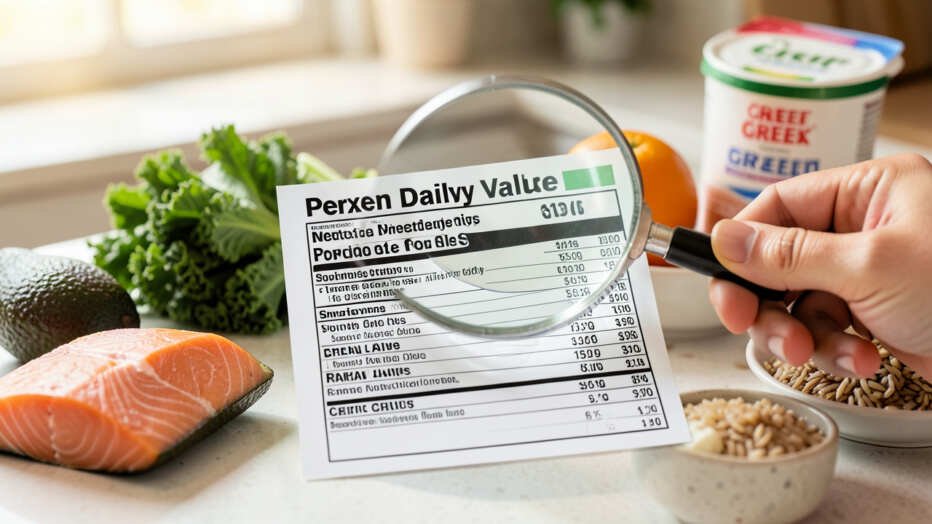
Percent Daily Value is a standardized reference on nutrition labels that indicates how much a nutrient in a serving of food contributes to a total daily diet, typically based on a 2,000-calorie intake. This percentage helps consumers quickly assess whether a serving is high or low in a specific nutrient and allows for easy comparison between similar food products. Understanding and using these values is a practical tool for making informed dietary choices and building a balanced eating plan.
Percent Daily Value is the key to understanding the nutritional information printed on your food packaging. It tells you how much a nutrient in a serving of food contributes to your total daily diet. This information helps you compare food products and build a balanced eating plan.
This guide breaks down everything you need to know about Percent Daily Value. You will learn how to read the numbers, why they matter for your health, and how to use them for smarter grocery shopping. We cover the calculations, common misconceptions, and practical tips for applying this data to your everyday life.
Simply put, Percent Daily Value (%DV) is a reference value used on nutrition labels to help consumers understand how a specific amount of a nutrient in a food fits into an overall daily diet. It is based on a 2,000-calorie daily intake and shows whether a serving is high or low in a particular nutrient.
Key Takeaways
- Percent Daily Value is a general guide, not a precise target for every individual.
- A %DV of 5% or less is considered low for a nutrient, while 20% or more is high.
- You can use %DV to compare similar products and choose the option that best fits your dietary goals.
- The %DV helps you see if a food is making a significant contribution to your total daily intake of sodium, fiber, sugar, or vitamins.
- Food manufacturers must list %DV for vitamins A, C, calcium, and iron, but it is voluntary for others unless a claim is made.
What Is Percent Daily Value (%DV) and How Is It Calculated?
Percent Daily Value is a standardized reference developed by the U.S. Food and Drug Administration (FDA). It represents the percentage of the recommended daily amount of a nutrient found in one serving of that food.
The calculation uses two main numbers: the amount of a nutrient per serving and the Daily Value (DV) for that nutrient.
The Daily Value is a set of reference amounts. These are the daily intake levels considered adequate for healthy individuals. The %DV is then calculated with this formula: (Amount per serving / Daily Value) x 100 = %DV.
For example, if a cereal provides 2 grams of fiber per serving and the DV for fiber is 28 grams, the %DV is about 7%.
| Nutrient | Daily Value (DV) Reference | Context |
|---|---|---|
| Total Fat | 78 grams | Based on a 2,000-calorie diet. |
| Sodium | 2,300 milligrams | The maximum recommended limit. |
| Dietary Fiber | 28 grams | Target for healthy adults. |
| Added Sugars | 50 grams | The maximum you should consume. |
The FDA updated the Nutrition Facts label in 2016 to make the %DV easier to use. The values are based on current scientific evidence and dietary recommendations from expert groups. It is important to remember that the DV for a nutrient is a general standard.
Your specific needs may differ based on age, gender, activity level, and health conditions.
How Does Percent Daily Value Help You Read a Food Label?
The %DV column on the Nutrition Facts panel is your shortcut for evaluating a food quickly. Instead of just looking at grams or milligrams, the percentage puts that number into the context of your entire day. This helps you see whether a single serving is making a big dent in your daily allowance for something like sodium or sugar.
Think of the %DV as a traffic light system for nutrients. The FDA provides a simple rule of thumb: 5% DV or less is low, while 20% DV or more is high. This rule helps you make immediate judgments.
You want to limit nutrients like saturated fat, sodium, and added sugars, so a high %DV in those is a red flag. Conversely, for beneficial nutrients like fiber, vitamins, and minerals, a high %DV is a positive sign.
- Nutrients to limit (aim for low %DV): Saturated fat, trans fat, cholesterol, sodium, and added sugars.
- Nutrients to get enough of (aim for high %DV): Dietary fiber, vitamin D, calcium, iron, and potassium.
- Total Fat: Do not fear all fat. The %DV for total fat is less important than the types. Focus on limiting saturated and trans fats.
- Carbohydrates: Look at the breakdown. High %DV for fiber is great; high %DV for added sugars is not.
- Protein: The %DV for protein is rarely listed unless a claim is made. Most people get enough protein, but check the quality.
Tip: Use the %DV to compare two brands of the same food. Choose the one with a lower %DV for nutrients you want to limit (like sodium) and a higher %DV for nutrients you want more of (like calcium).
Why Does Percent Daily Value Matter for Your Health?
Using the %DV empowers you to make informed dietary choices. Chronic diseases like heart disease, high blood pressure, and type 2 diabetes are linked to diets high in sodium, added sugars, and unhealthy fats. The %DV gives you a practical tool to monitor and reduce your intake of these problematic nutrients over the course of a day.
For instance, knowing that one frozen meal contains 60% of the daily value for sodium tells you that you need to choose very low-sodium options for your other meals that day. This prevents you from unknowingly consuming double or triple the recommended limit. It turns abstract numbers into actionable information for your specific meal plan.
| Health Goal | Nutrients to Monitor with %DV | How to Use %DV |
|---|---|---|
| Heart Health | Saturated fat, sodium, trans fat | Choose items with %DV of 5% or less per serving. |
| Blood Pressure Control | Sodium, potassium | Limit sodium to under 100% DV daily; seek higher potassium. |
| Digestive Health | Dietary fiber | Select foods with %DV of 20% or more for fiber. |
| Weight Management | Added sugars, calories | Keep added sugar %DV very low; be aware of serving size impact. |
Research from the Centers for Disease Control and Prevention (CDC) shows that most Americans consume too much sodium and added sugars. The %DV is a direct response to this public health issue. It translates the scientific dietary guidelines into a format that fits on a product label.
This accessibility is crucial for widespread public health improvement.
What Are the Common Misconceptions About Percent Daily Value?
Many people misunderstand what the %DV actually represents. One major misconception is that it is a personal prescription. It is not.
The %DV is based on a single, standardized 2,000-calorie diet. A very active person or a small child will have different daily needs. Use it as a general guide, not an absolute rule.
Another confusion is around the “less than 5% is low” rule. People sometimes think any nutrient with a %DV under 5% is insignificant. That is not true.
Every bit of nutrition counts, especially for micronutrients. A food providing 3% of the DV for iron still contributes to your daily intake. The rule is more about identifying foods that are very poor sources of a nutrient.
Warning: Do not be fooled by products marketed as “low-fat” or “reduced-sugar.” Check the %DV for added sugars and saturated fat. They can still be high. Also, the serving size listed may be smaller than what you actually eat, which affects all the %DV calculations.
The %DV for added sugars is a relatively new requirement on the label. Some people mistake it for the total sugar %DV. Remember, “added sugars” are only those put in during processing, not the natural sugars in fruit or milk.
This distinction is important for managing your intake of processed foods.
How Can You Use Percent Daily Value for Smarter Grocery Shopping?
Turn your grocery trip into a strategic mission using the %DV column. Before you even head to the store, know your personal priorities. Maybe you are watching your sodium intake for blood pressure, or you want to increase your fiber for gut health.
Let these goals guide your label comparisons in the aisle.
When comparing two brands of canned soup, pick them up and look at the %DV for sodium. One might have 45% DV per serving, while the other has 25% DV. The choice becomes obvious if sodium is a concern.
Apply the same logic to pasta sauce for added sugars, or yogurt for protein and calcium.
- Before Shopping: Identify 1-2 nutrients you want to limit (e.g., sodium, added sugars) and 1-2 you want to increase (e.g., fiber, calcium).
- In the Store: Make the %DV your primary comparison tool for similar products. Ignore marketing claims on the front of the package first.
- Check Serving Size: Confirm the %DV is based on a serving size you would realistically eat. Adjust your mental math if you eat double that amount.
- Build Your Cart: Aim for a mix of foods. If one item is high in sodium, ensure your other choices for that meal or day are low.
- At Home: Use the %DV to help you plan balanced meals throughout the day, balancing out high and low nutrient contributions.
According to the International Food Information Council Foundation, a significant portion of consumers report using the Nutrition Facts label to make food choices. The %DV is the part of that label designed for the quickest, most effective decision-making. Practice it a few times, and it will become second nature.
What Is the Difference Between %DV and Other Nutrition Claims?
Food packages are full of claims like “low in fat,” “excellent source of fiber,” or “reduced sodium.” These claims are regulated by the FDA, but they tell you something slightly different than the %DV. Claims are often based on the amount of a nutrient per serving, while %DV puts that amount in the context of your entire day.
For example, a food can be labeled “low sodium” if it has 140 milligrams or less per serving. That is a fact about the serving. The %DV then shows you what percentage of your daily 2,300 milligram limit that 140 mg represents (about 6%).
Both pieces of information are useful, but the %DV gives you the broader dietary context.
| Label Claim | What It Means (FDA Definition) | How It Relates to %DV |
|---|---|---|
| “Low Sodium” | 140 mg or less per serving. | Typically results in a %DV of 6% or less. |
| “High in Fiber” | 5 grams or more per serving. | Results in a %DV of about 18% or more (based on 28g DV). |
| “Reduced Sugar” | At least 25% less sugar per serving compared to a reference food. | The %DV will be lower than the original product, but may still be high. |
| “Excellent Source of Calcium” | 20% or more of the DV per serving. | Directly corresponds to a %DV of 20% or higher. |
Claims can be misleading if you do not understand them. A “reduced-fat” cookie might still be high in added sugars. Always check the %DV column to get the full picture and see how the food fits into your overall dietary pattern for the day.
How Does Percent Daily Value Change for Different Dietary Needs?
The standard %DV is based on a 2,000-calorie diet, which is an average for sedentary to moderately active adults. Your needs are unique. An elite athlete may require 3,000+ calories, while a smaller, less active person might need 1,600.
The %DV remains a useful starting point, but you must interpret it with your personal context in mind.
For individuals with specific medical conditions, like kidney disease or hypertension, a doctor or dietitian will provide specific daily limits for nutrients like potassium, phosphorus, or sodium. In these cases, the %DV on the label is a reference point, but you would track your actual milligram intake against your prescribed limit. You might need to limit sodium to 1,500 mg, not the DV of 2,300 mg.
Important: Pregnant or breastfeeding women, children, and athletes have increased needs for certain nutrients like iron, folate, and protein. The standard %DV may underestimate their requirements. Consult a healthcare professional for personalized advice.
Vegetarians and vegans may need to pay extra attention to the %DV for nutrients like vitamin B12, iron, and calcium. They can use the label to strategically choose fortified foods that help meet these needs. The %DV makes it easy to spot which products are contributing meaningfully to their daily targets for these critical nutrients.
What Are Practical Tips for Applying Percent Daily Value Daily?
Integrate %DV into your routine with these actionable strategies. First, focus on the “per serving” amount, but be honest about your actual consumption. If you drink the whole bottle of soda, you need to multiply the %DV by the number of servings in that container.
This simple step prevents major miscalculations of your intake.
Use the %DV to build “balanced plates.” When planning a meal, consider the nutrients from each component. If your main dish is high in sodium (like a seasoned protein), choose a side dish that is low in sodium and high in fiber (like steamed vegetables). Aim to keep your cumulative intake of nutrients you want to limit well below 100% DV by the end of the day.
- Start Small: Pick one nutrient to focus on this week, like sodium. Practice checking its %DV on everything you buy.
- Read the Entire Column: Do not just look at calories. Scan down to fiber, sugars, and sodium. This gives a complete nutritional snapshot.
- Compare Apples to Apples: Ensure you are comparing the same serving sizes. A 1-cup serving vs. a 2-cup serving makes the %DV non-comparable at a glance.
- Use Technology: Many grocery store apps or nutrition tracking apps allow you to scan a barcode and instantly see the %DV data in a clear format.
- Teach Your Family: Make it a game with kids to find the food with the highest %DV for fiber or the lowest %DV for added sugar in a category.
According to the USDA, consistent use of the Nutrition Facts label is associated with better diet quality and lower intakes of calories, saturated fat, and sodium. Making the %DV your go-to metric is one of the most effective ways to leverage this tool for long-term health benefits.
Frequently Asked Questions
Is a high %DV always good?
Not necessarily. A high %DV is good for nutrients you need more of, like fiber, vitamin D, and calcium. However, a high %DV for nutrients you should limit, such as sodium, saturated fat, and added sugars, is a warning sign.
Always check which nutrient the percentage refers to.
What does 0% Daily Value mean on a label?
A 0% DV means the food provides a negligible amount of that nutrient per serving. It is less than 0.5% of the Daily Value, which rounds down to zero. This is common for nutrients not naturally present in the food, like vitamin C in meat products.
Should I aim for 100% DV of every nutrient in one day?
No. The %DV is not a daily target for each nutrient you should hit precisely with every food. Your overall diet over the course of a day or week should provide adequate nutrition.
Some days you may exceed the DV for certain vitamins from food, and other days you may be under. Variety is key.
Why don’t all nutrients have a %DV listed?
The FDA requires %DV for nutrients with public health significance, like sodium, fiber, and added sugars. For other nutrients, like total fat or protein, the %DV is considered less helpful for consumer choice or is not mandatory unless a specific claim is made on the package. Trans fat is not listed because the goal is zero consumption.
How does the %DV on the new label differ from the old one?
The updated Nutrition Facts label uses updated Daily Values based on newer scientific evidence. Notably, the DV for sodium was lowered from 2,400 mg to 2,300 mg. The label also now requires %DV for added sugars and potassium, which were previously voluntary.
This reflects current dietary guidelines.
Final Thoughts
The Percent Daily Value is a powerful yet underutilized tool on food labels. It simplifies complex nutritional data into a quick, comparative guide for your daily choices. By focusing on the %DV for key nutrients you want to limit or increase, you can navigate the grocery store more effectively and build a balanced diet.
Remember to use it as a general framework. Your personal dietary needs and the overall pattern of your eating matter most. Start by picking one or two nutrients to watch using %DV, and soon it will become an instinctive part of how you read labels and plan your meals.