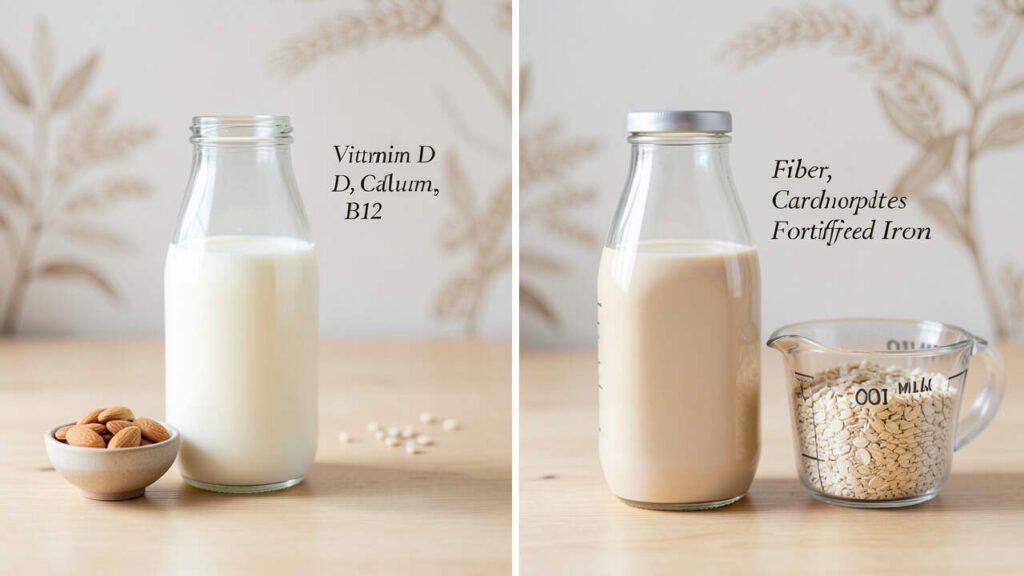
Dairy milk and plant milk differ fundamentally in their nutritional origins, with dairy providing complete animal protein and naturally occurring calcium, while plant milks are variable beverages made from grains, nuts, or legumes. Key differences include lower calories and zero cholesterol in many plant milks, though they often require fortification to match dairy's calcium and vitamin D levels. Your optimal choice depends on specific dietary needs, such as managing calorie intake, addressing lactose intolerance, or adhering to a vegan lifestyle.
Plant milk vs dairy milk presents one of the most common nutritional debates for grocery store shoppers. People choose plant-based alternatives for many reasons, but the nutritional profiles are fundamentally different. Understanding these differences helps you make the best choice for your specific health goals and dietary needs.
This guide breaks down exactly how plant milk and dairy milk compare across every key nutrient. You’ll see where they match, where they differ, and which one might be better for you. We’ll cover protein, fats, vitamins, and practical considerations like taste and cost.
Simply put, dairy milk is a natural animal product with inherent nutrients, while plant milks are processed beverages made from grains, nuts, or legumes. Their nutritional differences stem from their completely different origins, with dairy offering more complete protein and calcium, and many plant milks providing lower calories and no cholesterol.
Key Takeaways
- Dairy milk naturally contains high-quality complete protein, calcium, and vitamin D, while most plant milks require fortification to match these nutrients.
- Plant milks are often lower in calories and saturated fat, making them popular for weight management and heart health.
- The protein content varies dramatically by plant source – soy milk is closest to dairy, while almond and rice milk are much lower.
- Fortification is key for plant milks – without added vitamins and minerals, they are nutritionally inferior to dairy.
- Your choice depends on individual needs: allergies, ethical concerns, digestive issues, and specific nutritional priorities.
What Is the Fundamental Difference Between Plant Milk and Dairy Milk?
The core distinction lies in their source and composition. Dairy milk comes from mammals, primarily cows, as a complete food designed to nourish young. Plant milk is a processed extract from plants, created to mimic the texture and use of dairy milk.
This origin difference creates their inherent nutritional profiles. Dairy milk contains naturally occurring nutrients in specific ratios. Plant milks start with a plant base (like almonds or oats) and water, then manufacturers often add vitamins, minerals, and stabilizers.
| Characteristic | Dairy Milk | Plant Milk |
|---|---|---|
| Source | Animal (cow, goat, sheep) | Plant (almond, soy, oat, rice) |
| Processing | Pasteurization, homogenization | Blending, straining, fortification |
| Natural Nutrients | Protein, fat, calcium, vitamins | Mainly carbohydrates, some fiber |
| Fortification | Usually vitamin D only | Often calcium, vitamin D, B12 |
This table shows why comparing them isn’t straightforward. You’re comparing a naturally complete food to a product engineered to serve a similar culinary purpose. Understanding this helps explain why nutrition labels can look so different.
How Does the Protein Content Compare Between Plant and Dairy Milk?
Protein is where the biggest nutritional gap often appears. Dairy milk contains about 8 grams of high-quality, complete protein per cup. This means it has all nine essential amino acids your body needs.
Plant milk protein varies enormously by source. Soy milk is the only major plant milk that matches dairy’s protein content and quality. Other plant milks fall far short, with almond milk having just 1-2 grams per cup.
Important: If you rely on plant milk as your primary milk, choose a high-protein variety like soy or pea milk to avoid protein deficiency, especially for children and athletes.
Here’s how the protein stacks up across common options:
- Dairy Milk (whole, 2%): 8g protein – complete protein with all essential amino acids
- Soy Milk: 7-9g protein – complete protein, very similar to dairy
- Pea Milk: 8g protein – complete protein from yellow split peas
- Almond Milk: 1-2g protein – incomplete protein, very low
- Oat Milk: 2-4g protein – incomplete, grain-based protein
- Rice Milk: 0.7g protein – extremely low, not a protein source
- Coconut Milk Beverage: 0-1g protein – negligible protein content
This difference matters most for specific groups. Growing children, pregnant women, and athletes need adequate protein. If you choose low-protein plant milks, you’ll need to get protein elsewhere in your diet.
What Are the Fat and Calorie Differences?
Fat content is another major differentiator. Dairy milk contains naturally occurring saturated fat. A cup of whole dairy milk has about 8 grams of saturated fat, while skim milk has virtually none.
Plant milks are typically much lower in saturated fat. Many are virtually fat-free or contain only small amounts of unsaturated fats from their plant source. This makes them attractive for heart health and calorie reduction.
| Milk Type (1 cup) | Calories | Total Fat | Saturated Fat |
|---|---|---|---|
| Whole Dairy Milk | 150 | 8g | 5g |
| 2% Dairy Milk | 120 | 5g | 3g |
| Unsweetened Almond | 30-40 | 2.5g | 0g |
| Unsweetened Soy | 80 | 4g | 0.5g |
| Unsweetened Oat | 90-120 | 2-5g | 0-1g |
Notice the dramatic calorie difference. Unsweetened almond milk has about one-quarter the calories of whole dairy milk. However, this comes with a trade-off – you’re also getting much less protein and fewer natural nutrients.
Warning: Many flavored and “original” plant milks contain added sugars. Always check labels – a sweetened almond milk can have as much sugar as a soda, negating its calorie advantage.
How Do Calcium and Vitamin D Levels Compare?
Calcium is crucial for bone health, and dairy milk is an excellent natural source. One cup provides about 300mg, roughly 30% of your daily needs. The calcium in dairy is also highly absorbable.
Most plant milks contain almost no natural calcium. Manufacturers add calcium carbonate or tricalcium phosphate to fortify them. This fortified calcium can be just as absorbable as dairy calcium if shaken well before pouring.
- Dairy Milk: ~300mg calcium (naturally occurring, highly absorbable)
- Fortified Soy Milk: ~300mg calcium (added, absorbable when shaken)
- Fortified Almond Milk: ~450mg calcium (added, but often settles at bottom)
- Unfortified Plant Milks: 0-20mg calcium (virtually none)
Vitamin D follows a similar pattern. Dairy milk is often fortified with vitamin D in many countries. Plant milks are also routinely fortified.
The key is checking labels – some “natural” or organic versions may lack fortification.
Tip: Always shake your plant milk carton before pouring. Calcium and vitamin D settle at the bottom, and you won’t get full nutrition if you pour from the top without mixing.
What About Added Sugars and Other Ingredients?
Plain dairy milk contains only one ingredient: milk. It has naturally occurring lactose (milk sugar) but no added sugars. Plant milks, however, often have lengthy ingredient lists.
Even “plain” plant milks may contain added oils for creaminess, gellan gum for thickness, and salt for flavor. Flavored varieties add significant sugar – sometimes 10-15 grams per cup. This makes them nutritionally poor choices.
- Check the ingredients list – fewer ingredients generally means less processing
- Look for “unsweetened” versions – these have no added sugars
- Compare sugar content – aim for less than 5g per serving
- Watch for added oils – some use canola or sunflower oil
- Consider fortification – added vitamins are beneficial, but added sugars are not
The American Heart Association recommends limiting added sugars to 25g daily for women and 36g for men. A single cup of sweetened plant milk can use up half your daily allowance.
Which Milk Is Better for Specific Dietary Needs?
Different people have different priorities when choosing milk. Your best choice depends on your health goals, restrictions, and preferences. Let’s break it down by common needs.
For Muscle Building and Recovery: Dairy milk or high-protein soy/pea milk. The complete protein and natural leucine content support muscle synthesis better than low-protein plant alternatives.
For Weight Management: Unsweetened plant milks, especially almond or cashew, offer fewer calories. However, dairy’s protein may keep you fuller longer.
For Heart Health: Unsaturated plant milks like olive or avocado-based options (less common) or almond milk provide heart-healthy fats with no cholesterol.
- Lactose Intolerance: Any plant milk works, or lactose-free dairy milk
- Dairy Allergy: Soy, pea, oat, or other plant milks (avoid if allergic to that plant)
- Soy Allergy: Oat, almond, rice, or coconut-based milks
- Nut Allergy: Soy, oat, pea, or rice milk
- Gluten Sensitivity: Check labels – oat milk may be cross-contaminated unless certified gluten-free
- Keto Diet: Unsweetened almond or coconut milk (very low carb)
- Vegan Diet: Any plant milk for ethical/vegan reasons
How Does Digestibility and Gut Health Compare?
Dairy milk can cause digestive issues for many people, even without full lactose intolerance. Symptoms include bloating, gas, and discomfort. An estimated 65-70% of the global adult population has reduced ability to digest lactose.
Plant milks are naturally lactose-free, making them easier to digest for most people. However, some contain FODMAPs (fermentable carbs) that can trigger issues in sensitive individuals. Oat and almond milks are generally gentlest.
Interestingly, dairy milk contains prebiotics like lactoferrin that support gut health. Fermented dairy like yogurt and kefir provide probiotics. Most plant milks lack these beneficial components unless specifically added.
What Is the Environmental and Cost Comparison?
Plant milks generally have a lower environmental footprint than dairy milk. They require less water and land, and produce fewer greenhouse gases. Almond milk is an exception due to high water use in drought-prone areas.
Cost varies widely by brand and type. Dairy milk is often subsidized, making it cheaper. Plant milks are typically 20-50% more expensive, with specialized varieties (organic, fortified) costing even more.
| Factor | Dairy Milk | Plant Milk |
|---|---|---|
| Water Use | High (628 liters per liter of milk) | Varies (37-528 liters per liter) |
| Greenhouse Gases | High (3.2 kg CO2e per liter) | Low (0.3-1.0 kg CO2e per liter) |
| Land Use | High (pasture and feed crops) | Lower (varies by crop) |
| Avg. Cost (USD/liter) | $1.00-$2.00 | $2.00-$4.00 |
The cost difference is significant for budget-conscious families. However, some find that using plant milk in recipes (like smoothies or oatmeal) requires less volume than dairy milk.
How Should You Choose Between Plant Milk and Dairy Milk?
Start by identifying your primary reason for choosing one over the other. Are you avoiding dairy for health, ethical, or environmental reasons? This narrows your options immediately.
Next, consider your nutritional priorities. If protein and calcium are concerns, choose fortified soy or pea milk, or stick with dairy. If calories and cholesterol are concerns, unsweetened plant milks offer advantages.
Finally, try different options. Taste varies dramatically between brands and types. What works in coffee might not work in cereal or smoothies.
Experiment to find your perfect match.
Frequently Asked Questions
Is plant milk as healthy as dairy milk?
It depends entirely on the type and fortification. Fortified soy milk comes closest nutritionally, offering similar protein and calcium. However, many plant milks are nutritionally poor without fortification.
Always check labels for protein, calcium, and vitamin content.
Which plant milk has the most protein?
Soy milk and pea milk lead with 7-9 grams of complete protein per cup, matching dairy milk. Other plant milks like almond, oat, and rice contain significantly less protein, often just 1-3 grams per serving.
Can I use plant milk as a 1:1 replacement for dairy milk in recipes?
Sometimes, but not always. Plant milks behave differently when heated, especially almond and rice milk which can curdle. Soy and oat milk hold up better in cooking.
For baking, you may need to adjust other ingredients.
Are plant milks suitable for children?
Only high-protein, fortified varieties like soy or pea milk are nutritionally adequate for children over one year. The American Academy of Pediatrics advises against rice milk for children due to potential arsenic concerns. Always consult a pediatrician.
Why do some plant milks separate in coffee?
Plant milks can curdle when mixed with acidic coffee due to differences in pH and protein content. Using barista blends, which contain added stabilizers, or using plant milks with higher protein content (like soy) can help prevent separation.
Final Thoughts
Plant milk and dairy milk serve different nutritional purposes and suit different lifestyles. Dairy offers complete protein and natural nutrients, while plant milks provide lower-calorie, cholesterol-free alternatives often requiring fortification.
Your choice should align with your health needs, dietary restrictions, and personal values. Read labels carefully, prioritize unsweetened and fortified options if choosing plant milk, and consider your overall diet when making the switch.