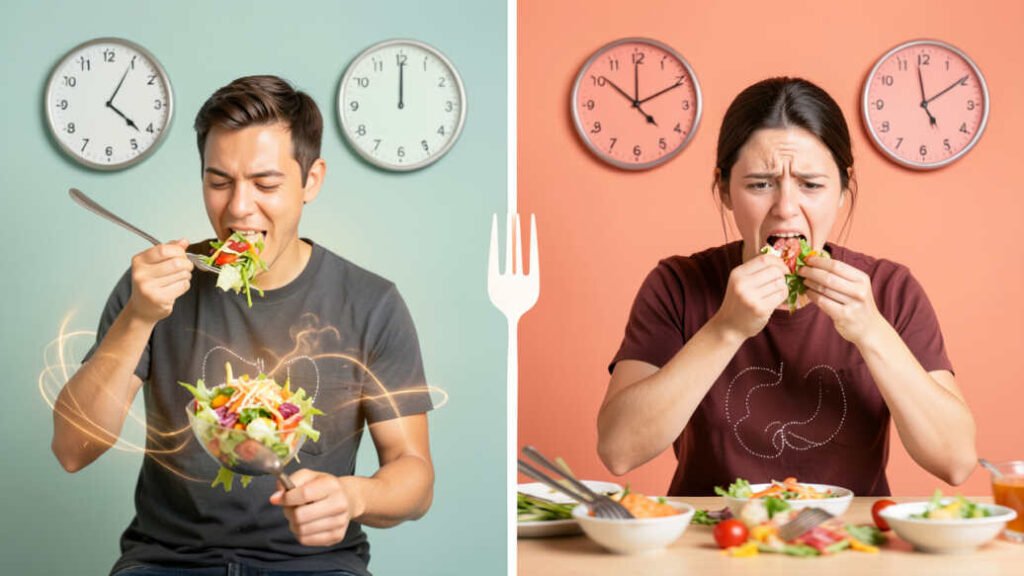
Yes, scientific research confirms that eating speed directly affects feelings of fullness. Slower eating allows the digestive system to produce and send satiety hormones like leptin and peptide YY to the brain, which signal that you are full. This process helps reduce overall calorie intake per meal and prevents the overeating that commonly occurs when rushing through food.
Eating speed has a surprising and direct impact on how full you feel after a meal. Many of us eat quickly without considering how it affects our bodies. This habit can lead to overeating, digestive discomfort, and long-term weight management challenges.
Understanding the connection between pace and satiety is a simple step toward better health.
Research consistently shows that slowing down allows your brain to receive fullness signals from your stomach. When you rush through a meal, you often consume more calories than needed before your body can register that it’s satisfied. This post explores the science behind this phenomenon and provides practical strategies to help you eat more mindfully.
Simply put, yes, eating speed significantly affects fullness. Slower eating gives your body time to produce satiety hormones and send fullness signals to your brain, naturally reducing calorie intake and improving digestion. Faster eating bypasses these signals, often leading to overconsumption.
Key Takeaways
- Eating speed is a major factor in how quickly you feel full during and after a meal.
- Slower eating allows time for gut hormones like GLP-1 and PYY to signal satiety to the brain.
- Rapid eating often leads to consuming 20-30% more calories before feeling satisfied.
- Using simple techniques like chewing thoroughly and putting your fork down can help you slow down.
- The link between eating pace and fullness is supported by extensive research on metabolism and weight management.
What Is Eating Speed and Satiety? A Basic Breakdown
Eating speed refers to the rate at which you consume food, often measured in bites per minute or the time taken to finish a meal. Satiety is the feeling of fullness and satisfaction that stops you from eating more. The two are intricately connected through your body’s physiological feedback system.
This feedback loop relies on a time delay. It takes approximately 15-20 minutes for your stomach to stretch and for specific hormones to travel to your brain. These hormones, including cholecystokinin (CCK), glucagon-like peptide-1 (GLP-1), and peptide YY (PYY), communicate that nutrient absorption is underway.
When you eat quickly, you can consume a large volume of food before this communication channel is fully active. Essentially, you outrun your own body’s natural stop signal. This disconnect is a primary reason why fast eating is linked to overeating and weight gain.
- Key Hormones Involved:
- CCK (Cholecystokinin): Released by the small intestine, it slows stomach emptying and signals fullness.
- GLP-1 (Glucagon-like peptide-1): Promotes insulin secretion and suppresses appetite.
- PYY (Peptide YY): Acts as an appetite suppressant, reducing food intake.
- Leptin: While it works over the long term, its signaling is supported by the acute signals from the hormones above.
| Component | Role in Fullness | Timing |
|---|---|---|
| Stomach Stretching | Mechanical signal of volume | Immediate but requires time to reach brain |
| CCK Release | Slows digestion, signals nutrients present | Begins 5-10 minutes after eating starts |
| GLP-1 & PYY Surge | Strong appetite suppression signals | Peak effect 15-30 minutes post-meal |
This table highlights the critical time lag. Eating a meal in under 10 minutes often means you finish before the most powerful hormonal signals even begin their work.
How Does Eating Speed Affect Your Body’s Fullness Signals?
The mechanism is a race against time. Your brain’s hypothalamus acts as the control center for appetite. It receives conflicting messages from your gut (fast) and your mouth/jaws (slow).
When you eat rapidly, the high-volume, high-speed sensory input can overwhelm the early, weaker satiety signals.
A study published in the Journal of the Academy of Nutrition and Dietetics found that fast eaters had a 3.7-fold increased risk of being overweight compared to slow and normal-speed eaters. The primary culprit was the disrupted hormone signaling. Fast eating leads to a steeper and more rapid spike in blood glucose, which can be followed by a crash, triggering renewed hunger.
Furthermore, the act of chewing itself is a satiety cue. More thorough chewing breaks down food better, increases nutrient exposure to the gut lining, and extends the eating episode, giving your body more time to register fullness. It also reduces the amount of air swallowed, which can cause bloating that masks true stomach fullness.
Tip: Aim for 20-30 chews per bite, especially for fibrous vegetables and dense proteins. This simple habit naturally slows your pace and improves digestion.
Researchers at the University of Bristol used lab-made soups to demonstrate this. Participants ate identical soups, but some contained a hidden thickening agent that slowed gastric emptying. Those who ate the thicker soup consumed significantly fewer calories and reported greater fullness, even though the sensory experience of eating felt the same.
This proves that the internal, slower digestive process is key.
What Happens When You Eat Too Quickly? The Consequences
Eating too fast is more than just a bad habit; it triggers a cascade of negative physiological events. The immediate consequence is overconsumption. Because your brain doesn’t get the “stop” signal in time, you pass your ideal caloric intake point, leading to physical discomfort, lethargy, and guilt.
Over the long term, this pattern contributes significantly to weight gain and obesity. A 2021 meta-analysis published in BMJ Open reviewed 23 studies and concluded that faster eating speed was associated with higher odds of developing obesity. The excess calorie intake, meal after meal, compounds over time.
There are also digestive consequences. Inhaling air while eating quickly (aerophagia) causes gas, bloating, and indigestion. Insufficient chewing leaves larger food particles, which are harder for the stomach to break down.
This can exacerbate conditions like acid reflux or irritable bowel syndrome (IBS).
- Short-Term Effects of Fast Eating:
- Overeating and immediate physical discomfort
- Bloating and increased gas
- Sluggishness and post-meal energy crash
- Reduced enjoyment and mindfulness of food
The psychological impact is also noteworthy. Fast eating is often done while distracted-on a computer, in the car, or watching TV. This disconnect from the meal reduces satisfaction, making you more likely to seek out more food soon after.
Warning: If you frequently experience heartburn, acid reflux, or chronic bloating, eating speed is a primary factor to address before assuming a more serious condition. Slowing down can provide significant relief.
How Do You Measure and Define a “Fast” Eating Speed?
There isn’t one universal number, as “fast” is relative, but research provides useful benchmarks. Speed is often measured in kilocalories per minute (kcal/min) or by the duration of the meal. A standard meal should ideally take 20 minutes or more to complete.
Studies categorize eaters into groups. Fast eaters typically finish a meal in less than 10 minutes and may consume over 120 kcal/min during the meal. Normal-speed eaters take 10-20 minutes.
Slow eaters take over 20 minutes. One practical assessment tool is the “bite-and-set-down” test: if you never put your utensil down between bites, you are likely eating too fast.
A simple self-assessment can be revealing. Set a timer for your next meal. Note the time from first bite to when you feel comfortably full (not stuffed).
If it’s under 15 minutes, you would benefit from consciously slowing down. The goal isn’t to make eating a timed chore but to develop a natural, slower rhythm.
| Category | Approx. Meal Duration | Typical Calorie Consumption Rate | Health Implication |
|---|---|---|---|
| Fast Eater | Under 10 minutes | High (>120 kcal/min) | High risk of overeating & weight gain |
| Normal Eater | 10 – 20 minutes | Moderate | Aligned with healthy satiety signaling |
| Slow Eater | Over 20 minutes | Low (<80 kcal/min) | Often associated with lower BMI and better digestion |
These benchmarks are not rigid rules but useful guidelines for understanding where you might fall on the spectrum.
Why Does Slowing Down Make You Feel Fuller with Less Food?
The answer lies in biology and neuroscience. When you slow down, you allow for a synchronized communication process between your gut and brain. The mechanical and chemical sensors in your stomach and intestines have adequate time to generate a strong, clear signal that is relayed via the vagus nerve to the brainstem and then to the hypothalamus.
This process is not just about hormones. The sensory experience of eating-the tastes, smells, and textures-is processed in the brain’s reward centers. Slower eating enhances this experience, increasing the pleasure derived from the meal.
Studies show that mindful eating, a practice centered on slow, deliberate consumption, significantly improves feelings of satisfaction and reduces cravings.
From an energy balance perspective, slower eating naturally leads to a lower caloric intake for the same level of fullness. Your body uses the received signals to adjust food intake in real-time. By the time your brain gets the fullness signal, a slow eater has consumed just enough, whereas a fast eater has already overshot the mark.
Important: The type of food matters. High-fiber, high-protein meals produce stronger satiety signals and empty from the stomach more slowly, making it easier to eat at a moderate pace. Pair slowing-down strategies with nutrient-dense foods for maximum effect.
In essence, slow eating aligns your behavioral pace with your physiological capacity to feel full. It turns eating from a race into a conversation with your body.
How Can You Practically Slow Down Your Eating Speed?
Changing a lifelong habit requires conscious effort and specific strategies. The goal is to make slow eating the default, not a constant battle. Start with one or two techniques and build from there.
Consistency is more important than perfection.
Here are some of the most effective, evidence-based methods to eat more slowly:
- Put Your Utensil Down Between Every Bite. This is the single most effective trick. Take a bite, chew, swallow, and then pick up your fork or spoon again. It creates a mandatory pause.
- Chew Each Bite Thoroughly. Aim for 20-30 chews before swallowing. This breaks food down better and extends the time per bite. Choose soft, easy-to-chew foods as you build this habit.
- Take Sips of Water Between Bites. This naturally slows you down and helps with fullness. Be careful not to overfill your stomach with liquid, which can dilute digestive juices.
- Engage in Conversation. If eating with others, make it a point to talk. It’s hard to eat fast when you’re listening and speaking. This also makes meals more enjoyable and social.
- Use Smaller Plates and Portions. A smaller plate makes a standard portion look larger, and a smaller portion is consumed more slowly. It also prevents the “clean your plate” mentality from overriding fullness signals.
- Eliminate Distractions. Turn off the TV, step away from the computer, and put your phone away. Focus entirely on the meal, its flavors, and your body’s responses.
- Set a Meal Timer. Use your phone to set a 20-minute timer at the start of your meal. Your goal is to still be eating when it goes off. It provides a clear, objective measure.
It helps to start with the meal you are most in control of, often lunch or a weekend breakfast. Practice the “utensil down” rule for just that one meal until it feels natural, then apply it to others.
Are There Situations Where Eating Faster Might Be Necessary?
Yes, there are specific, less common scenarios where eating speed is less critical or where faster consumption is practical. However, these are exceptions, not the rule for daily meals.
Athletes in the middle of an endurance event may need to consume calories quickly for immediate energy. In these cases, they use easily digestible gels or drinks specifically designed for rapid absorption. This is about fueling performance, not a normal meal.
For individuals recovering from certain medical conditions or those with severe dysphagia (swallowing difficulties), speech-language pathologists may actually recommend techniques to eat more efficiently or with specific pacing to ensure safety. The context here is clinical, not about promoting general overeating.
In time-critical work environments, a very quick, nutrient-dense snack might be consumed to maintain energy without taking a full break. Again, this is a tactical decision, not a habitual pattern for primary meals.
Tip: For these occasional fast-eating scenarios, focus on high-quality, easily digestible foods (like a banana or a protein shake) and compensate by practicing slow eating for all other meals.
The vast majority of people do not fall into these categories. For the general population seeking better health, weight management, and digestion, the evidence overwhelmingly supports cultivating a slower eating pace as a daily practice.
What Does the Scientific Research Conclusively Show?
The body of research is robust and consistent. Multiple meta-analyses and randomized controlled trials confirm the link. A landmark study in The American Journal of Clinical Nutrition showed that slow eating led to a 58% higher feeling of fullness at the end of the meal compared to fast eating, with calorie intake being 88 kcal lower on average.
The research also looks at long-term outcomes. Data from large cohort studies, like the one from the Chinese Longitudinal Healthy Longevity Survey, which followed over 600 older adults for 3 years, found that fast eaters had a significantly higher risk of developing obesity. The trend holds across different cultures and age groups.
Emerging research even explores the gut microbiome. Slower eating may promote a healthier gut environment by allowing better digestion and nutrient absorption, potentially influencing the bacteria that play a role in metabolism and appetite regulation. While this area is still developing, it adds another layer to the importance of eating pace.
The conclusion is clear from a scientific standpoint: eating speed is a modifiable behavioral risk factor for metabolic dysfunction. Adjusting this single behavior can have a positive ripple effect on hunger control, calorie intake, and digestive health.
| Study Source | Key Finding | Implication |
|---|---|---|
| American Journal of Clinical Nutrition | Slow eaters reported 58% greater fullness and consumed 88 fewer kcal. | Direct link between pace, satiety hormones, and calorie intake. |
| BMJ Open (Meta-Analysis) | Fast eating speed associated with 3.7x increased risk of obesity. | Long-term weight management risk factor. |
| Chinese Longitudinal Study | Fast eaters had higher odds of developing central obesity over 3 years. | Pace affects fat distribution and metabolic health. |
These studies provide the concrete data that supports all the practical advice on slowing down.
Frequently Asked Questions
Does eating speed affect weight loss?
Absolutely. By slowing your eating speed, you allow your satiety hormones to communicate effectively with your brain, preventing overeating. This natural reduction in calorie intake, without restrictive dieting, is a sustainable strategy for weight loss and long-term weight maintenance.
How long does it take to feel full after eating?
It typically takes 15-20 minutes for the primary satiety hormones to be released and signal your brain that you are full. This is why finishing a large meal in less than 10 minutes almost guarantees you will eat past the point of comfortable fullness.
Is there a specific number of times I should chew each bite?
While there’s no magic number, chewing each bite 20-30 times is a commonly recommended guideline. The key is to chew until the food is liquefied and the flavor has faded, which naturally slows your pace and improves digestion.
Can eating too slowly be a problem?
Eating extremely slowly (taking over 45 minutes for a small meal) is generally not a health concern but may indicate distraction or anxiety around food. For most people, the challenge is not eating too slowly, but rather finding a moderate, mindful pace that supports satiety.
Does drinking water while eating slow you down and help with fullness?
Yes, sipping water between bites can physically slow your eating rhythm and contribute to a feeling of volume and fullness in the stomach. However, avoid drinking large amounts during a meal as it can dilute digestive enzymes and potentially cause bloating.
Final Thoughts
The science is clear: eating speed is a powerful lever you can pull to influence how full you feel and how much you eat. By slowing down, you work with your body’s natural biology instead of against it. This simple behavioral shift requires no special equipment or restrictive diets, just mindful practice.
Start today by picking one strategy, like putting your fork down between bites, and notice the difference in your post-meal satisfaction. Over time, this mindful approach to eating can lead to better digestion, healthier weight management, and a more enjoyable relationship with food.