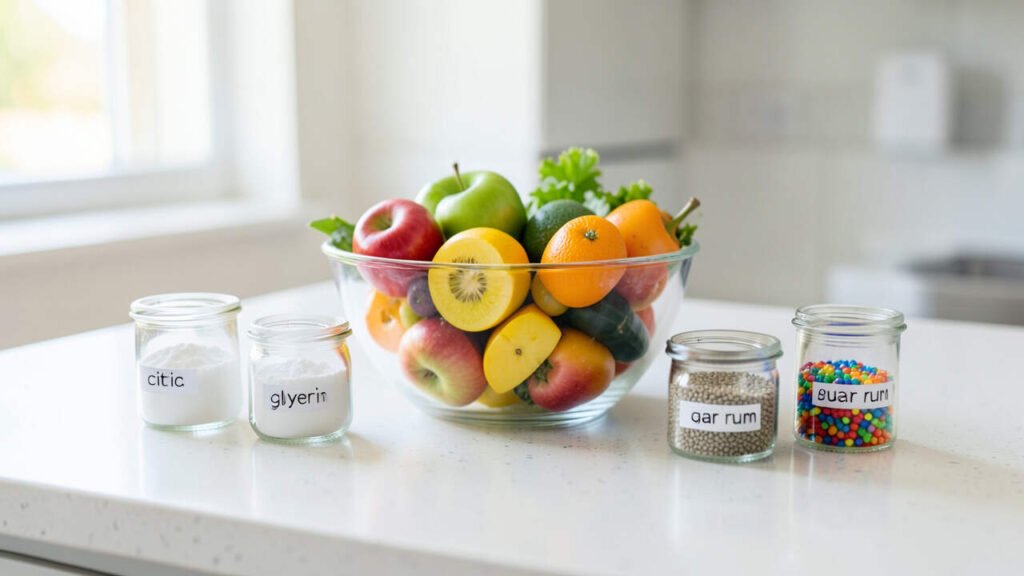
Food additives are substances added to food to preserve it, enhance its taste or appearance, improve texture, and maintain nutritional quality. The primary types include preservatives, flavorings, colorings, and emulsifiers, and their safety is strictly regulated by agencies such as the FDA and EFSA. Understanding these common ingredients empowers you to read labels effectively and make informed choices about the processed foods you consume.
Food additives are substances added to foods to preserve flavor, enhance taste, improve appearance, or extend shelf life. They play a massive role in the modern food supply chain, ensuring products are safe, appealing, and available year-round.
Understanding what these ingredients are and why they are used can help you make more informed choices at the grocery store. This guide breaks down the different categories of food additives, explains their specific functions, and addresses common safety concerns.
Simply put, food additives are ingredients with specific technical functions in a food product. They are used to prevent spoilage, maintain nutritional value, make food look better, or improve its taste and texture. Their use is tightly regulated by agencies like the FDA and EFSA to ensure they are safe for consumption.
Key Takeaways
- Food additives serve four primary purposes: preservation, enhancing taste/appearance, improving texture, and maintaining nutritional quality.
- Additives are categorized into functional groups like preservatives, flavor enhancers, colorings, and emulsifiers, each with a distinct job.
- The safety of approved food additives is determined through rigorous testing by global regulatory bodies before they reach the market.
- Reading ingredient labels and understanding numbers (like E-numbers in the EU) can help you identify and understand the additives in your food.
- Natural versus synthetic origin does not automatically determine an additive’s safety or function; both types undergo the same strict evaluation.
What Are Food Additives? A Clear Definition
Food additives are any substances intentionally added to food during processing, packaging, or storage. Their purpose is not to be consumed as food themselves, but to achieve a specific technical effect in the final product.
This technical effect can range from preventing mold growth in bread to giving yogurt its smooth texture. According to the U.S. Food and Drug Administration (FDA), an additive includes any substance that may become a component of a food or otherwise affect the food’s characteristics.
| Key Characteristic | Description |
|---|---|
| Intentionally Added | They are put into food on purpose, not by accident. |
| Technical Function | They serve a specific purpose like preservation or coloring. |
| Not a Nutritional Component | They are not consumed for nourishment (e.g., calories, vitamins). |
This definition separates additives from incidental traces of substances that come into food through soil, water, or packaging. It also includes both synthetic and naturally-derived substances that are used for a technical purpose.
Why Are Food Additives Used? The Core Reasons
The use of food additives is driven by consumer demand for safe, tasty, and consistent food. They solve practical problems that arise in large-scale food production and global distribution. Without them, many modern food products would not be possible.
The primary reasons for their use fall into four main categories, each addressing a critical challenge in getting food from farm to table.
- Safety and Preservation: Preventing the growth of harmful bacteria (like botulism in canned goods) and spoilage organisms. This extends shelf life and reduces foodborne illness.
- Quality and Consistency: Ensuring a product tastes, looks, and feels the same every time you buy it. This stabilizes flavor, color, and texture against natural variations.
- Convenience: Enabling processed foods that are ready to eat or easy to prepare. Additives make products like instant soups, frozen meals, and shelf-stable sauces work.
- Cost-Effectiveness: Reducing food waste through preservation and allowing for the use of more affordable ingredient alternatives without sacrificing quality.
Tip: Consider this: without preservatives like salt or sodium benzoate, many of your pantry staples (like ketchup or mustard) would spoil very quickly after opening, leading to more waste and potential health risks.
What Are the Different Types of Food Additives?
Food additives are classified by their function. The European Union uses a numerical system (E-numbers) that is widely recognized, while the FDA requires the specific name to be listed on labels in the U.S. Knowing the types helps you understand the ingredient list.
The most common categories include preservatives, colorings, flavorings, and texturizers. Each category contains numerous individual additives, both synthetic and natural.
| Additive Category | Primary Function | Common Examples |
|---|---|---|
| Preservatives | Inhibit microbial growth (bacteria, mold, yeast). | Sodium benzoate, Potassium sorbate, Nitrates. |
| Color Additives | Restore, intensify, or add color to food. | Carmine, Beta-carotene, Tartrazine (Yellow 5). |
| Flavor Enhancers | Intensify a food’s existing flavor. | Monosodium glutamate (MSG), Yeast extracts. |
| Emulsifiers & Stabilizers | Prevent separation and improve texture. | Lecithin, Guar gum, Xanthan gum. |
| Acidity Regulators | Control pH to preserve flavor and color. | Citric acid, Acetic acid (vinegar), Lactic acid. |
How Are Food Additives Regulated for Safety?
The safety of food additives is paramount, and their use is governed by strict international regulations. In the United States, the FDA operates under the Delaney Clause, which prohibits the approval of any additive found to induce cancer in humans or animals. New additives undergo a comprehensive scientific review process.
The European Food Safety Authority (EFSA) follows a similar rigorous process. The World Health Organization and the Food and Agriculture Organization also jointly evaluate additives. This multi-layered system aims to ensure only safe substances reach your plate.
- Application for Approval: A manufacturer submits a petition with extensive safety data, including toxicology studies and proposed usage levels.
- Scientific Evaluation: An independent panel of scientists reviews the data. They determine the “Acceptable Daily Intake” (ADI) – the amount considered safe to consume each day over a lifetime.
- Public and Regulatory Review: The findings are often made public for comment. The regulatory agency makes the final decision to approve, approve with restrictions, or deny the additive.
- Post-Market Monitoring: Approved additives are continually monitored. If new safety concerns arise, they can be banned or have their approved use limits changed.
| Regulatory Agency | Region | Key Principle |
|---|---|---|
| FDA | United States | “Generally Recognized as Safe” (GRAS) or approved via food additive petition. |
| EFSA | European Union | Authorizes additives after risk assessment; uses E-number classification. |
| FSANZ | Australia & New Zealand | Permits additives from a standard code after safety assessment. |
What Is the Difference Between Natural and Artificial Additives?
A common question is whether food additives labeled “natural” are inherently better or safer than “artificial” ones. The terms refer to the substance’s origin, not necessarily its safety or function. Both undergo the same stringent regulatory approval process.
A naturally-derived additive like citric acid (produced via fermentation) and a synthetic additive like sodium benzoate serve similar preservation roles. The choice often comes down to cost, stability, and the specific application in a product.
- “Natural” Additives: Derived from plant, animal, or mineral sources. Examples include beet juice (color), vinegar (preservative), and pectin (gelling agent).
- “Artificial” or Synthetic Additives: Created through chemical synthesis in a lab. Examples include aspartame (sweetener) and Red 40 (color). These are often identical to their natural counterparts at a molecular level.
- Key Insight: The origin does not determine safety. Some natural substances can be harmful, and many synthetic ones are identical to those found in nature. The final safety verdict is based on the chemical structure and the approved dosage.
Important: The FDA does not have a legal definition for “natural” on food labels. This term is often used as a marketing claim. Focus on the functional additive (e.g., “preservative: sodium benzoate”) rather than vague marketing terms.
How Do I Identify Food Additives on Labels?
Learning to read a food ingredient list is the best way to identify food additives. Ingredients are listed in descending order by weight. If an additive is near the end of the list, it is present in a small amount.
In the EU, many additives are identified by an E-number (e.g., E330 for citric acid). In the US, the specific name (like “ascorbic acid”) must be used. Familiarizing yourself with common additives helps you understand what you’re eating.
- Scan for Common Categories: Look for words ending in “-ate” (sorbate, benzoate), “-ite” (nitrite), or “-ic” (ascorbic, citric) which often signal preservatives or acids.
- Look for Dyes: Colors are often explicitly named (Red 40, Yellow 5) or may be listed as “artificial color” or “color added.”
- Check for “Flavor”: The term “natural flavors” or “artificial flavors” is a catch-all for proprietary mixtures of flavor compounds.
- Use Resources: Websites and apps can help decode ingredient lists. You can look up any unfamiliar additive to find its function and E-number equivalent.
| Common Ingredient (US Label) | E-Number (EU) | Functional Category |
|---|---|---|
| Ascorbic Acid | E300 | Antioxidant / Nutrient |
| Sodium Nitrite | E250 | Preservative / Color Fixative |
| Xanthan Gum | E415 | Stabilizer / Thickener |
Why Do Some People Worry About Food Additives?
Despite rigorous safety testing, some individuals experience sensitivity to certain food additives. This can lead to concerns about artificial colors, preservatives, or flavor enhancers like MSG. It’s important to distinguish between proven health risks and individual sensitivities.
Research published in journals like The Lancet has explored links between artificial food colors and increased hyperactivity in some children with ADHD. However, the effect is modest and not seen in all children. Similarly, some people report “MSG symptom complex,” though large-scale studies have not found a consistent causal link in the general population.
- Known Sensitivities: Some individuals have diagnosed intolerances to sulfites (used in wine and dried fruits) or certain food dyes. This is different from a generalized safety concern.
- The “Naturalistic Fallacy”: The belief that “natural” always means “better.” As mentioned, origin doesn’t determine safety. Arsenic is natural but not safe to ingest.
- Marketing and Perception: The desire for “clean labels” has led to a marketing trend against recognizable scientific names, even when those ingredients are benign or necessary.
Warning: If you suspect you have a sensitivity to a food additive, consult a healthcare professional for proper diagnosis. Elimination diets should be done under guidance to ensure nutritional needs are met.
How Do Food Additives Affect Food Quality and Waste?
Beyond safety, food additives have a significant positive impact on food quality and reducing waste. Preservatives directly combat spoilage, meaning food lasts longer on shelves and in your refrigerator. This is crucial for both economic and environmental reasons.
Emulsifiers and stabilizers improve the texture and appearance of foods like salad dressings and ice cream, making them more palatable. Antioxidants prevent fats and oils from going rancid, preserving flavor and nutritional value. Without these, food quality would degrade much faster.
- Extended Shelf Life: Preservatives in bread can double its shelf life, reducing household and retail waste.
- Maintained Freshness: Modified atmosphere packaging with gas mixtures (an approved process) keeps salads crisp and meat fresh longer.
- Prevention of Spoilage: Additives in jams and jellies prevent fermentation and mold, allowing for safe, long-term storage.
- Economic Impact: According to the USDA, reducing food loss and waste could save consumers money and reduce the environmental footprint of the food system. Additives are a key tool in this effort.
What Does the Future Hold for Food Additives?
The field of food additives is constantly evolving. Consumer demand for “clean labels” and plant-based ingredients is driving innovation toward more naturally-derived and recognizable additives. Researchers are also developing new preservation technologies.
Some trends include the use of plant extracts with antimicrobial properties, fermentation-derived ingredients, and even technologies like high-pressure processing that can sterilize food without chemical preservatives. The goal remains the same: safe, high-quality food.
- Clean Label Movement: Push for ingredients with simple, common names and fewer synthetic components.
- Functional Additives: Development of additives that not only preserve but also add nutritional benefits, like prebiotics.
- Biotechnology: Using microbial fermentation to produce specific flavor or texture agents more sustainably.
- Personalization: Future research may explore how genetic differences affect individual responses to certain additives.
Frequently Asked Questions
Are food additives safe to eat?
Yes, the food additives approved for use in the food supply are considered safe by major global health authorities like the FDA and EFSA. They undergo rigorous testing to establish safe consumption levels. Sensitivity can vary by individual, but the approved list is based on scientific evidence of safety for the general population.
What is the most common food additive?
Salt (sodium chloride) is arguably the most common food additive, used for flavor and preservation for centuries. In terms of modern synthetic additives, preservatives like citric acid and sodium benzoate are extremely prevalent in a wide range of processed foods and beverages.
Do natural food additives work the same as artificial ones?
Often, yes. Both natural and artificial additives are added to achieve a specific technical function, like preservation or coloring. For example, beet juice and Red 40 both provide red color.
The safety and effectiveness of an additive depend on its chemical structure and approved usage level, not its origin.
How can I reduce my intake of food additives?
The simplest way is to choose whole, unprocessed foods like fresh fruits, vegetables, grains, and plain meats. When buying packaged foods, read ingredient lists and choose products with shorter, more recognizable lists. Cooking from scratch gives you full control over what goes into your food.
Are there any banned food additives?
Yes, some substances once used as additives are now banned due to new safety findings. For example, the artificial sweetener cyclamate is banned in the U.S. but permitted in other countries.
Regulations are dynamic, and approved lists can change as new scientific evidence emerges.
Final Thoughts
Food additives are a complex but essential part of the modern food system. They serve vital functions that ensure the safety, consistency, and availability of the foods we rely on daily. Their use is supported by a robust framework of scientific research and strict regulation.
Understanding their types, purposes, and safety evaluations empowers you as a consumer. By learning to read labels and knowing the difference between marketing claims and technical functions, you can make choices that align with your personal preferences and health goals.