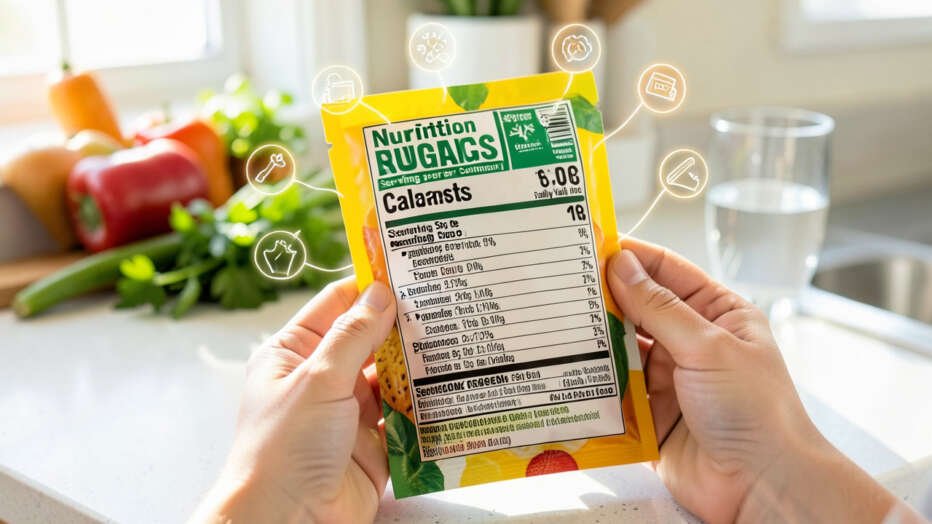
To read a nutrition facts label correctly every time, always begin by checking the serving size, as all other information on the label is based on that specific amount. Next, review the calorie count and the breakdown of nutrients, paying close attention to the % Daily Value to understand how a serving fits into a 2,000-calorie diet. This method allows you to accurately assess a food's nutritional impact and make informed comparisons between products for healthier choices.
Reading a nutrition facts label is one of the simplest skills that can completely transform how you eat and feel. Every packaged food you pick up has one, yet most people skip right past it or only glance at the calorie count. Learning to decode every section of that label gives you the power to make smarter choices at the grocery store.
This guide walks you through every line, number, and footnote so you never feel confused again.
Simply put, a nutrition facts label tells you exactly what is inside a packaged food product – including serving size, calories, fats, carbs, protein, vitamins, and added sugars. By reading it correctly from top to bottom, you can compare products quickly, avoid unhealthy ingredients, and stay on track with your dietary goals.
Key Takeaways
- Reading a nutrition facts label always starts with the serving size, because every number below it depends on that amount.
- The % Daily Value (%DV) column helps you instantly judge whether a product is high or low in a specific nutrient.
- Ingredients are listed by weight from most to least – the first three ingredients make up the bulk of the product.
- Hidden sugars appear under over 60 different names on ingredient lists, so scanning beyond the label itself is essential.
- Comparing two similar products side by side using their labels is the fastest way to pick the healthier option.
What Is a Nutrition Facts Label and Why Does It Matter?
A nutrition facts label is the standardized panel printed on virtually all packaged foods sold in the United States. The U.S. Food and Drug Administration (FDA) requires manufacturers to include it so consumers can see what they are actually eating.
It has been a legal requirement since 1994, and it was updated most recently in 2016 with new rules about added sugars and updated serving sizes.
According to the FDA, roughly 77% of American adults say they read nutrition labels when purchasing food for the first time. Yet studies published in the Journal of the Academy of Nutrition and Dietetics show that only about 43% of consumers can correctly interpret what the numbers actually mean. That gap matters because what you think is a healthy snack could be loaded with sodium or added sugar.
Here is why learning to read a nutrition facts label is so valuable:
- Weight management – You can track calories and macros without guessing or using a separate app for every item.
- Chronic disease prevention – Controlling sodium, saturated fat, and added sugar intake directly reduces risk of heart disease, diabetes, and hypertension.
- Allergy management – The ingredient list reveals allergens and cross-contamination warnings that the front label may hide.
- Budget-friendly eating – Comparing labels lets you spot which products give you more nutritional value per dollar.
- Goal tracking – Whether you are building muscle, cutting weight, or managing a medical condition, the label gives you the exact data you need.
The American Heart Association reports that 1 in 3 American adults has high blood pressure, and excess sodium from processed foods is a leading cause. Reading labels helps you catch foods that seem innocent but pack a surprising amount of salt. A single frozen meal can contain over 1,200 milligrams of sodium – more than half of the recommended daily limit in one sitting.
How Do You Start Reading a Nutrition Facts Label?
The golden rule is simple: always start at the very top and work your way down. Most people flip a package over and immediately look at calories or fat. That is backward.
The first piece of information on any nutrition label is the serving size, and every single number below it is based on that amount. If you misread the serving size, everything else on the label becomes misleading.
Here is the correct order to read through a label:
- Serving Size – Look here first. Note both the amount (e.g., “1 cup”) and the number of servings per container.
- Calories – This shows calories per serving, not per container. Multiply by servings per container if you eat the whole thing.
- Total Fat – Check the type. Saturated and trans fats are the ones to limit. Unsaturated fats are generally fine.
- Sodium – Aim for products with less than 140mg per serving, which the FDA considers “low sodium.”
- Total Carbohydrates – Break this into dietary fiber (good), total sugars, and added sugars (limit these).
- Protein – Most adults need 46-56 grams per day. Check whether this product contributes meaningfully.
- Vitamins and Minerals – Look for calcium, iron, potassium, and vitamin D. These are now required on updated labels.
- Ingredient List – Always read this last. Ingredients are listed from highest quantity to lowest.
This systematic approach takes about 30 seconds once you practice it a few times. It becomes second nature quickly, and you will spot red flags almost instantly.
What Does Serving Size on a Nutrition Label Actually Mean?
The serving size is the anchor for the entire label. The FDA determines serving sizes based on what people actually eat in one sitting, not what a manufacturer thinks is reasonable. This means many serving sizes were updated in recent years to reflect real-world eating habits.
For example, the serving size for ice cream changed from half a cup to two-thirds of a cup because studies showed most people scoop out more than the old serving suggested.
A critical detail many people miss is the “servings per container” line right next to the serving size. A bag of chips might show a serving size of “about 12 chips” but contain 3.5 servings. If you eat the whole bag, you need to multiply every number on the label by 3.5.
| Label Says | Serving Size | Servings Per Container | You Eat | Multiply All Values By |
|---|---|---|---|---|
| 170 calories | 1 cup | 2.5 | Whole container | 2.5x = 425 cal |
| 140 calories | 12 chips | 10 | Half the bag | 5x = 700 cal |
| 210 calories | 2/3 cup | 5 | 1 full cup | 1.5x = 315 cal |
| 80 calories | 6 crackers | 8 | 18 crackers | 3x = 240 cal |
Warning: Single-serve packages (like a 20oz soda or a small bag of chips) are required to reflect one serving, but some packages that seem single-serve are still labeled as multiple servings. Always check – do not assume.
How Do You Understand Calories on a Nutrition Facts Label?
Calories represent the amount of energy your body gets from one serving of the food. The FDA updated the calorie section of the label to make the font larger and bolder because calorie awareness is the single most requested piece of information by consumers. The line below calories often shows “calories from fat,” but the FDA removed this from updated labels because research shows the type of fat matters more than the amount of calories coming from fat.
For most adults, the general calorie targets are:
- Women – approximately 1,800 to 2,400 calories per day, depending on activity level
- Men – approximately 2,200 to 3,000 calories per day, depending on activity level
- Children and teens – varies widely by age, ranging from 1,200 to 3,000 calories
The USDA Dietary Guidelines confirm that a single 2,000-calorie diet is used as the reference point on labels, but your actual needs differ. The key is using the label’s calorie count as a piece of the puzzle, not the whole picture. A 300-calorie snack with high protein and fiber will keep you full longer than a 300-calorie snack made of refined sugar.
Tip: A quick way to evaluate whether a food fits your goals is the “100-calorie rule.” If a snack has more than 150 calories per serving and is not a meal replacement, ask yourself whether it is worth the calories for the nutrition it provides.
What Do the Nutrients on a Label Actually Mean?
The nutrients section is where most of the useful data lives. The updated FDA label separates nutrients into two groups – those you should limit (listed at the top) and those you should get enough of (listed at the bottom). Understanding this split helps you make fast decisions.
Nutrients you should generally limit include:
- Saturated Fat – The American Heart Association recommends no more than 13 grams per day on a 2,000-calorie diet. High intake raises LDL cholesterol.
- Trans Fat – There is no safe amount. The FDA banned partially hydrogenated oils (the main source) in 2018, but trace amounts can still appear.
- Sodium – Keep it under 2,300mg per day, ideally closer to 1,500mg if you have high blood pressure. Nearly 70% of sodium in the American diet comes from packaged and restaurant foods.
- Added Sugars – The FDA now requires this to be listed separately. Aim for less than 50 grams (12 teaspoons) per day on a 2,000-calorie diet.
Nutrients you should get more of include:
- Dietary Fiber – Most Americans get only about 15 grams per day. The recommended target is 25-30 grams. Fiber helps with digestion, blood sugar control, and heart health.
- Vitamin D – Deficiency affects roughly 42% of American adults according to NIH data. Aim for 20mcg (800 IU) daily.
- Calcium – Essential for bone health. Adults need about 1,000-1,200mg daily.
- Iron – Women of childbearing age need 18mg daily. Men and post-menopausal women need 8mg.
- Potassium – Helps counteract the effects of sodium. Aim for 2,600-3,400mg per day.
| Nutrient | Daily Target (2,000 cal) | Low Is Good? | High Is Good? |
|---|---|---|---|
| Saturated Fat | Less than 20g | Yes | No |
| Trans Fat | 0g | Yes | No |
| Sodium | Less than 2,300mg | Yes | No |
| Dietary Fiber | 25-30g | No | Yes |
| Added Sugars | Less than 50g | Yes | No |
| Protein | 50g | No | Usually yes |
How Do You Use Percent Daily Value (%DV) to Make Better Choices?
The %Daily Value column on the right side of the label is one of the most powerful tools most people ignore entirely. It tells you how much a nutrient in one serving of food contributes to your total daily diet. The math is based on a 2,000-calorie reference diet, but even if your needs differ, the percentages give you a reliable scale for comparison.
Here is the simple rule the FDA recommends:
- 5% DV or less is considered low for any nutrient per serving
- 10% DV or less is considered moderately low
- 20% DV or more is considered high per serving
Apply this rule differently depending on the nutrient. For nutrients you want to limit – like saturated fat, sodium, and added sugars – aim for low %DV numbers. For nutrients you want more of – like fiber, calcium, iron, and potassium – aim for high %DV numbers.
For example, if a yogurt shows 25% DV for calcium, that is a great choice because you are getting a quarter of your daily calcium need in one serving. But if that same yogurt shows 20% DV for added sugars, that is a red flag – you would be consuming one-fifth of your daily added sugar limit in a single snack.
Important: The %DV is your best friend for quick product comparisons. Grab two similar cereals, compare their %DV columns side by side, and you will instantly see which one offers more fiber and less sugar without doing any math.
How Do You Read the Ingredient List to Spot Hidden Problems?
The ingredient list sits below the nutrition facts panel and is arguably just as important as the numbers above it. The FDA requires ingredients to be listed in descending order by weight. The first ingredient makes up the largest portion of the product.
If sugar or a sugar variant appears as the first or second ingredient, that tells you the product is primarily sweetener.
Here are the most common tricks manufacturers use that you can catch by reading the ingredient list carefully:
- Splitting sugars – Manufacturers sometimes use four or five different types of sugar (cane sugar, dextrose, maltose, high-fructose corn syrup, brown rice syrup) so none of them appears first on the list, but combined they make up the largest ingredient.
- Fiber padding – Adding “inulin” or “chicory root fiber” lets a product claim high fiber content, but these isolated fibers do not provide the same benefits as naturally occurring fiber from whole grains.
- Health halo terms – Words like “multigrain,” “wheat,” “natural,” and “organic” do not automatically mean healthy. Whole grain should say “100% whole grain” or “whole wheat” as the first ingredient.
- Hydrogenated oils – Any ingredient ending in “hydrogenated” means trans fats are present, even if the label says 0g trans fat (the FDA allows products with less than 0.5g per serving to round down).
- Artificial colors disguised – Dyes like Red 40, Yellow 5, and Blue 1 are linked to behavioral issues in some children. They may appear under their chemical names (Allura Red, Tartrazine, Brilliant Blue).
The World Health Organization recommends that no more than 10% of total daily calories come from added sugars, and ideally less than 5%. Reducing that to 5% can further lower the risk of obesity and dental cavities. Reading the ingredient list is the only way to catch added sugars that the front label might try to hide under a health claim.
How Does Comparing Two Products Using Their Labels Work?
One of the most practical applications of label reading is putting two similar products side by side and letting the data decide. This works whether you are choosing between two brands of pasta sauce, two types of yogurt, or two boxes of crackers. The process is straightforward but highly effective.
Follow these steps to compare any two products:
- Match the serving sizes first. If Product A uses a half-cup serving and Product B uses a two-thirds cup serving, normalize the comparison by mathematically adjusting one set of numbers.
- Compare calories. Higher calories are not automatically worse – context matters. A calorie-dense nut butter is healthier than a low-calorie candy bar.
- Look at added sugars. This is often the tiebreaker. The product with significantly less added sugar wins most of the time.
- Check sodium. If one product has 400mg of sodium and the other has 180mg, the lower option is almost always the better choice for heart health.
- Evaluate fiber and protein. Higher fiber and protein mean the food is more filling and nutritious. This is especially important for snacks and breakfast items.
- Scan the ingredient list. Shorter, more recognizable ingredient lists generally indicate less processing.
A study by the Harvard T.H. Chan School of Public Health found that people who regularly compared nutrition labels consumed 23% less sodium and 18% fewer calories over a six-month period compared to those who relied on front-of-package marketing claims. The data is clear – labels do the heavy lifting when you let them.
What Are the Most Common Mistakes When Reading Nutrition Labels?
Even with the best intentions, several common errors trip up consumers regularly. Recognizing these mistakes will sharpen your label-reading skills immediately.
- Ignoring serving size – This is the number one mistake. A bag of “100-calorie” pretzels might actually be 280 calories if you eat the whole bag, because it contains 2.8 servings.
- Confusing “total fat” with “unhealthy fat” – Fat is not the enemy. Monounsaturated and polyunsaturated fats from olive oil, nuts, and avocados support brain and heart health.
- Trusting front-of-package claims – Labels like “low fat,” “light,” “natural,” and “made with whole grains” are marketing tools. They may be technically true but highly misleading without checking the actual panel.
- Skipping the ingredient list – The numbers tell part of the story, but the ingredient list reveals what is actually in the food. A product can be “fat-free” yet packed with sugar.
- Overlooking serving count – A bottle of juice that looks like one serving might actually contain 2.5 servings. Drinking the whole bottle means you consume 2.5 times every number on the label.
- Thinking calories are everything – Two 200-calorie foods can have vastly different nutritional profiles. A 200-calorie handful of almonds provides protein, fiber, and healthy fats. A 200-calorie candy bar provides sugar and refined carbs with minimal nutrition.
Warning: Products marketed as “sugar-free” or “no sugar added” can still contain significant carbohydrates, artificial sweeteners, or sugar alcohols that affect blood sugar and digestion. Always read the full label, not just the front claims.
What Are the Best Tips for Reading Nutrition Labels Like a Pro?
Once you understand the basics, a few advanced strategies can take your label reading to the next level. These tips work especially well if you have specific health goals or dietary restrictions.
- Use the 5-20 rule for %DV. If a nutrient you want to limit is at 20% or more per serving, put the product back. If a nutrient you want more of is at 5% or less, keep looking.
- Check for “per container” instead of “per serving.” Some snack packages now list nutrition facts per container because the FDA recognizes people eat the whole thing. When available, use this information.
- Read labels at home, not just in the store. Keep packaging from products you buy regularly and review the details in a relaxed setting. You will notice things you missed in a busy aisle.
- Focus on three nutrients first. If full label reading feels overwhelming, start by tracking only added sugars, sodium, and fiber. Master those three and you will already be ahead of most shoppers.
- Compare within the same category. Do not compare a granola bar to a steak. Compare brands within the same product type for the most useful insights.
- Watch for serving size manipulation. Some brands intentionally set unusual serving sizes (like “7 crackers” instead of “10”) to make calorie counts look lower.
The Centers for Disease Control and Prevention (CDC) emphasizes that consistent label reading is a behavior that compounds over time. People who read labels regularly develop an intuitive sense for portion sizes, calorie density, and nutrient balance – skills that eventually require no effort at all.
How Do You Read a Nutrition Facts Label for Specific Dietary Needs?
Different health conditions and dietary goals call for different priorities when reading labels. Here is a quick breakdown of what to focus on depending on your situation:
- Weight loss – Focus on total calories per serving, serving size, and added sugars. Choose products with higher fiber and protein for satiety.
- Diabetes management – Total carbohydrates and added sugars are your primary concerns. Ignore “sugar-free” claims and check the total carb count directly.
- Heart health – Prioritize sodium (keep under 140mg per serving), saturated fat (keep under 3g), and trans fat (must be 0g). Favor products with unsaturated fats.
- Kidney disease – Sodium, potassium, and phosphorus are the critical nutrients to monitor. These appear on the updated label format.
- Muscle building – Protein content is king. Look for at least 15-20g of protein per serving with minimal added sugars.
- Gluten sensitivity – The ingredient list is your primary tool. Wheat, barley, rye, and their derivatives must be listed. Look for certified gluten-free seals as an additional safeguard.
The American Diabetes Association notes that about 37.3 million Americans have diabetes, and many more have prediabetes. For these individuals, reading nutrition labels is not optional – it is a daily medical necessity. Understanding carbohydrate content, especially the difference between total carbs and net carbs, directly impacts blood sugar management.
Frequently Asked Questions
What is the difference between total sugars and added sugars on a label?
Total sugars include both naturally occurring sugars (like lactose in milk or fructose in fruit) and sugars that manufacturers add during processing. Added sugars are the ones you want to limit. The FDA now requires added sugars to be listed separately because research shows that excess added sugar contributes to obesity, heart disease, and type 2 diabetes more significantly than naturally occurring sugars in whole foods.
How do you calculate net carbs from a nutrition label?
Subtract dietary fiber and sugar alcohols (if listed) from the total carbohydrate count. For example, if a product has 20g total carbs, 8g fiber, and 4g sugar alcohols, the net carbs would be 8g (20 – 8 – 4). Net carbs are particularly relevant for people following low-carb or ketogenic diets, though the FDA does not officially define or regulate the term “net carbs.”
Why do some labels have a footnote about daily values and others do not?
The FDA requires a footnote on labels that explains the %Daily Value is based on a 2,000-calorie diet. Smaller packages with limited space may omit this footnote. Additionally, the updated label format (post-2016) has a different footnote than the old format.
The newer footnote explicitly states that daily value helps you understand how a nutrient in a serving contributes to a daily diet without recommending specific calorie amounts.
Can a product be “healthy” if it has a high calorie count?
Absolutely. Calorie count alone does not determine whether a food is healthy. Avocados, nuts, olive oil, and salmon are all calorie-dense yet nutritionally excellent.
The key is looking at the quality of those calories – do they come from protein, healthy fats, and fiber, or from refined sugar and processed starch? A 400-calorie meal packed with whole foods and balanced macros is far healthier than a 200-calorie candy bar with minimal nutritional value.
How often do nutrition labels get updated by the FDA?
There is no fixed schedule for label updates. The most recent major overhaul occurred in 2016, with compliance required from manufacturers by 2020-2021 depending on company size. The FDA evaluates labeling requirements periodically based on new nutritional science, consumer behavior research, and public health data.
Any manufacturer can voluntarily update their labels sooner if they reformulate a product or if new regulations take effect.
Final Thoughts
Learning to read a nutrition facts label correctly is a skill that pays dividends for the rest of your life. Start with the serving size, scan the calories and key nutrients, use %Daily Value as your comparison tool, and always finish by reading the ingredient list. Practice this process for just one week, and you will never look at packaged food the same way again.
Your health is worth the 30 seconds it takes to flip a package over and make an informed choice.