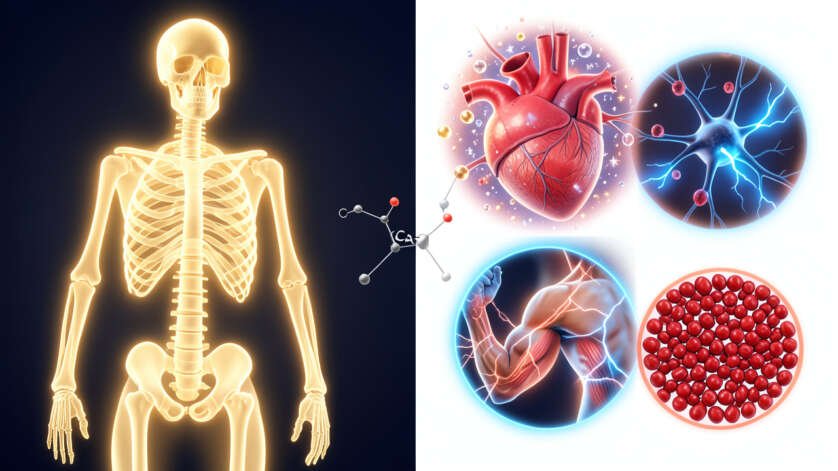
Calcium serves multiple key roles beyond building bones, such as facilitating nerve transmission, muscle contraction, blood clotting, and regulating the heartbeat. It functions as a cellular messenger that enables nerve signals, supports muscle movements including heart contractions, initiates blood coagulation, and aids hormone secretion, with vitamin D enhancing its absorption. Understanding these roles underscores the importance of adequate calcium intake for overall bodily function and health, preventing impairments in these essential processes.
What does calcium do beyond building bones might be a question that surprises many people. We often associate this mineral only with strong skeletons and preventing osteoporosis. However, calcium is a fundamental player in numerous critical bodily functions that keep you healthy and functioning day-to-day.
This post explores the surprising and vital roles calcium plays throughout your body. You’ll learn about its impact on everything from your heartbeat to nerve signals and muscle movement. Understanding these functions highlights why getting enough calcium is crucial for overall wellness.
Simply put, calcium is a multitasking mineral essential for nerve transmission, muscle contraction, blood clotting, and maintaining a steady heartbeat, in addition to its famous role in bone structure.
Key Takeaways
- Calcium is vital for proper nerve signal transmission throughout the body.
- Calcium enables muscles to contract and relax, including the heart muscle.
- Adequate calcium intake supports normal blood clotting after an injury.
- Calcium acts as a signaling molecule for various hormone releases.
- Beyond bones, calcium helps maintain a regular heartbeat and vascular health.
How Does Calcium Function as a Cellular Messenger?
Calcium ions (Ca²⁺) are universal second messengers in your cells. When a nerve or hormone stimulates a cell, calcium rushes in to trigger specific actions. This process is fundamental to how your body communicates internally.
Inside the cell, calcium levels are normally kept extremely low. A sudden influx of calcium acts like a chemical switch. It activates proteins and enzymes that carry out the cell’s intended response.
This mechanism is fast and essential for real-time bodily reactions.
- Nerve Synapses: Calcium triggers the release of neurotransmitters, allowing neurons to communicate.
- Hormone Secretion: Endocrine cells use calcium signals to release hormones like insulin.
- Gene Expression: Calcium can influence which genes are turned on or off in a cell.
- Cell Growth & Division: Proper calcium signaling is needed for healthy cell proliferation.
According to research published in the Journal of Biological Chemistry, calcium signaling is involved in regulating nearly every type of cellular activity. Disruption of this process is linked to various diseases. Your body tightly controls calcium levels to ensure this messaging system works flawlessly.
| Cellular Process | Role of Calcium |
|---|---|
| Neurotransmitter Release | Fuses synaptic vesicles with the neuron membrane to release chemicals. |
| Insulin Secretion | Triggers pancreatic beta cells to release insulin in response to blood sugar. |
| Muscle Contraction | Binds to troponin, allowing actin and myosin filaments to slide. |
This table shows just a snapshot of calcium’s diverse roles at the cellular level. Its action as a messenger is why maintaining proper blood calcium levels is a tightly regulated process involving the parathyroid glands.
What Are The Critical Roles in Muscle Function?
Every movement you make, from blinking to running, depends on calcium. This mineral is the key that unlocks muscle contraction. Without it, muscles cannot function, leading to weakness or cramps.
The process begins when a nerve impulse reaches a muscle fiber. This signal causes calcium to be released from the sarcoplasmic reticulum, a storage site within the muscle cell. The calcium then binds to a protein called troponin.
This binding moves another protein, tropomyosin, out of the way. This allows the contractile proteins actin and myosin to interact and shorten the muscle.
- Nerve signal arrives at the muscle fiber.
- Calcium floods the muscle cell interior.
- Calcium binds to troponin proteins.
- Tropomyosin shifts, exposing binding sites on actin.
- Actin and myosin pull each other, causing contraction.
For the muscle to relax, calcium must be pumped back into storage. This active process requires energy (ATP). This is why magnesium is also crucial—it helps regulate calcium entry and exit in muscles.
Imbalances can lead to symptoms like muscle twitching, spasms, or persistent cramps.
Warning: Chronic muscle cramps or spasms can sometimes indicate an electrolyte imbalance, including issues with calcium, magnesium, or potassium. Persistent symptoms should be evaluated by a healthcare professional.
This principle applies to the heart as well. The heart muscle (myocardium) relies on precise calcium cycling to generate its powerful, rhythmic beats. Disruptions in cardiac calcium handling are linked to conditions like heart failure and arrhythmias.
Why Is Calcium Essential for Nerve Transmission?
Your nervous system operates on electrical signals, but the junction between neurons—the synapse—is chemical. Calcium is the critical link that converts an electrical signal into a chemical one. This allows nerve impulses to jump from one neuron to the next or to a target organ like a muscle or gland.
When an electrical impulse (action potential) reaches the end of a nerve (the axon terminal), it opens voltage-gated calcium channels. Calcium ions rush into the terminal from the surrounding fluid. This influx triggers synaptic vesicles filled with neurotransmitters to fuse with the cell membrane.
The neurotransmitters are then released into the synaptic gap. They travel across the gap and bind to receptors on the next neuron or cell. This binding creates a new electrical signal or response.
This entire process happens in milliseconds and is fundamental to every thought, movement, and sensation.
- Speed: Calcium-mediated transmission allows for rapid communication throughout the body.
- Plasticity: The strength of calcium signaling can change, forming the basis of learning and memory.
- Autonomic Control: It regulates involuntary functions like heart rate, digestion, and breathing.
A deficiency or dysregulation of calcium can impair nerve function. This might manifest as numbness, tingling, or cognitive “fog.” Conversely, an excessive, uncontrolled release of calcium in the brain is involved in the damage following a stroke or traumatic injury, a process called excitotoxicity.
How Does Calcium Regulate Your Heartbeat?
The heart’s rhythm is not set by a single spark. It’s orchestrated by a precise dance of electrolytes, with calcium playing the lead role. This process ensures your heart beats steadily, adjusting its rate based on your body’s needs.
The sinoatrial (SA) node, your heart’s natural pacemaker, initiates each beat. As the pacemaker cells prepare to fire, calcium slowly enters through specific channels. This “calcium clock” is what gives the SA node its spontaneous rhythm.
Once the threshold is reached, a full-blown action potential is fired, spreading across the atria.
When the signal reaches the ventricles, calcium again plays a starring role. Calcium influx into the ventricular muscle cells triggers their contraction, pumping blood out to the lungs and body. The heart muscle’s strength (contractility) is directly influenced by how much calcium enters its cells during each beat.
| Heart Phase | Key Calcium Event |
|---|---|
| Pacemaker Rhythm | Slow calcium influx sets the heart rate in the SA node. |
| Atrial & Ventricular Contraction | Rapid calcium release (calcium-induced calcium release) triggers powerful contraction. |
| Relaxation | Calcium is actively pumped out of heart cells, allowing the chambers to refill with blood. |
Medications for heart conditions often target calcium channels. Calcium channel blockers, for example, reduce calcium entry into heart and blood vessel cells. This lowers blood pressure and can treat certain arrhythmias.
This underscores how central calcium is to cardiovascular health.
What Is Calcium’s Role in Blood Clotting?
When you get a cut, a complex cascade of proteins springs into action to stop the bleeding. Calcium is an essential cofactor at multiple steps in this coagulation cascade. Without it, this life-saving process would fail, leading to prolonged bleeding.
In the coagulation cascade, calcium ions are designated as Factor IV. They are required for the activation of several key clotting factors, including Factor X, prothrombin, and fibrinogen. Essentially, calcium acts as a glue that helps these clotting proteins bind to cell surfaces and interact with each other correctly.
Think of it as a construction site. The clotting factors are the workers, and calcium is the essential tool that allows them to build the fibrin clot that seals the wound. This is why blood donation bags contain an anticoagulant like sodium citrate—it binds to calcium, preventing the donated blood from clotting in the bag.
Tip: While calcium is vital for clotting, a healthy diet provides more than enough for this function. The body prioritizes maintaining blood calcium levels over bone density, drawing from bones if dietary intake is insufficient.
The relationship is so direct that calcium levels are sometimes measured during major surgery to ensure normal clotting capability. This is a clear example of calcium’s role far beyond its structural job in the skeleton.
How Does Calcium Influence Hormone Secretion?
Calcium signaling is a primary trigger for the release of numerous hormones. Endocrine glands use calcium influx to package and secrete hormones into the bloodstream. This makes calcium a key regulator of your body’s chemical communication system.
The most well-known example is insulin from the pancreas. When blood sugar rises, glucose enters pancreatic beta cells. Its metabolism increases ATP, which closes potassium channels.
This changes the cell’s electrical charge, opening voltage-gated calcium channels. The resulting calcium rush triggers the release of insulin-containing vesicles.
This pattern repeats across the endocrine system. The parathyroid gland releases parathyroid hormone (PTH) in response to low blood calcium. The adrenal glands release adrenaline in response to stress, a process influenced by calcium.
Even the release of estrogen and testosterone involves calcium-dependent steps.
- Parathyroid Hormone (PTH): Released when calcium is low, it signals bones to release calcium and the kidneys to conserve it.
- Calcitonin: Released from the thyroid when calcium is high, it inhibits bone breakdown to lower blood calcium.
- Insulin & Glucagon: These blood sugar regulators are secreted via calcium-dependent mechanisms in the pancreas.
- Adrenaline: The “fight or flight” hormone release involves calcium signaling in the adrenal medulla.
This regulatory role means that calcium balance is not just about bones—it’s about maintaining the proper function of your metabolic, stress response, and reproductive systems. Disruptions can have wide-ranging effects on your health.
Why Do We Need Vitamin D for Calcium Absorption?
You can eat plenty of calcium, but without vitamin D, your body cannot absorb it efficiently from your gut. Vitamin D and calcium are a powerful team. Vitamin D transforms into its active form, calcitriol, which is essential for calcium uptake.
In the intestines, calcitriol increases the production of calcium-binding proteins. These proteins act like carriers, actively transporting calcium from your digested food into your bloodstream. Without sufficient vitamin D, only about 10-15% of dietary calcium is absorbed.
With adequate vitamin D, this jumps to 30-40%.
This synergy explains why a deficiency in either nutrient can lead to bone problems like rickets in children or osteomalacia in adults. It also shows why milk is often fortified with both calcium and vitamin D. They are functionally linked for optimal health.
| Scenario | Impact on Calcium Status |
|---|---|
| Adequate Calcium, Low Vitamin D | Poor absorption leads to low blood calcium, triggering PTH release and bone loss. |
| High Vitamin D, Low Calcium | Absorption mechanisms are primed, but there’s little calcium to absorb, leading to deficiency. |
| Adequate Intake of Both | Optimal absorption maintains healthy blood calcium levels and supports all bodily functions. |
Factors like limited sun exposure, darker skin, and aging reduce vitamin D synthesis. This makes dietary sources or supplements important for many people to ensure their consumed calcium is actually usable by the body.
Frequently Asked Questions
Can you get too much calcium?
Yes, excessive calcium intake (hypercalcemia) can be harmful. It may lead to kidney stones, impaired kidney function, and interfere with the absorption of iron and zinc. It can also cause constipation and, in severe cases, heart rhythm abnormalities.
Always stay within the recommended upper limits.
How much calcium do I need daily?
Daily needs vary by age and gender. Most adults require between 1,000 to 1,200 milligrams (mg) per day. Women over 50 and men over 70 need 1,200 mg.
The best approach is to meet needs through food sources first and consider supplements if dietary intake is consistently low.
Are all calcium supplements the same?
No. Common forms include calcium carbonate and calcium citrate. Calcium carbonate is cheaper and requires stomach acid for absorption, so it’s best taken with food.
Calcium citrate is more easily absorbed and can be taken anytime, making it a better choice for older adults or those on acid-reducing medications.
Does calcium interfere with other minerals?
High-dose calcium supplements taken at the same time as iron or zinc supplements can inhibit their absorption. It’s recommended to space them out by at least two hours. A balanced diet typically provides minerals in amounts that don’t cause significant competition.
What foods are highest in calcium?
Dairy products like milk, yogurt, and cheese are excellent sources. Non-dairy options include fortified plant milks (almond, soy), tofu made with calcium sulfate, sardines and canned salmon (with bones), and dark leafy greens like kale and collard greens. Fortified orange juice and cereals also contribute.
Final Thoughts
Calcium truly does far more than just build and maintain strong bones. It acts as a vital messenger, triggers muscle contractions, ensures nerve signals fire correctly, regulates your heartbeat, and enables blood clotting. This mineral is indispensable for moment-to-moment survival and optimal body function.
Ensuring you get enough calcium and vitamin D supports this vast network of essential processes.